
STOCKHOLM – Swedist: Sweden elections — Sweden Prepares to Vote: What You Need to Know About the Upcoming Elections

Sweden is entering the final weeks before voters choose a new Riksdag, while also voting for regional and municipal councils on the same day. The contest is shaping up as a closely watched battle between the centre-left opposition led by Magdalena Andersson and the governing right-wing bloc led by Prime Minister Ulf Kristersson, with immigration, crime, the cost of living, security and energy among the issues dominating the campaign. With voting beginning before election day and several routes available to voters at home and abroad, what should voters know before they cast their ballots?
Sweden elections: When voting starts and when it ends
The main election day is Sunday, September 13. On that day, voters will elect members of the Riksdag, Sweden’s national parliament, as well as representatives to regional and municipal councils. The national parliament has 349 seats, and its members are elected for four-year terms.

For voters in Sweden, the first opportunity to cast a ballot comes earlier. Early voting starts on August 26 and continues through September 13. Unlike election-day voting, early voting is flexible: voters can use any designated early voting location in Sweden rather than being restricted to their assigned polling place.
Election-day voting follows a different system. Assigned voting locations open at 8 a.m. and close at 8 p.m. on September 13. The address of the assigned location appears on the voter’s voting card.
Voters who know they will be away from home can therefore avoid waiting until election day. They can vote early at a location elsewhere in the country, including on election day if necessary, although fewer early voting locations operate on the final day than during the preceding period.
The Swedish Election Authority says voters should receive their voting cards by August 26 at the latest. People with a Swedish digital mailbox can receive the card electronically, while others receive it by post. The card identifies the elections in which the person is entitled to vote and gives the address of the assigned voting location.
For the latest official instructions, voting locations and election information, voters can consult the Swedish Election Authority.
Sweden elections: How the Swedish voting system works
Sweden does not hold a direct presidential election. Instead, voters elect parliamentarians, and the Riksdag subsequently determines who can form a government. This means that the leaders campaigning nationally are seeking parliamentary support rather than asking voters to directly elect a prime minister.
The Riksdag uses a proportional electoral system. Seats are distributed between parties according to their share of the vote, subject to the electoral rules. A party normally needs at least 4 percent of the national vote to participate in the distribution of Riksdag seats. There is also an exception for a party that receives at least 12 percent in a constituency, allowing it to participate in the distribution of seats in that constituency.
Of the 349 Riksdag seats, 310 are permanent constituency seats and 39 are adjustment seats. The adjustment seats exist to make the final parliamentary representation as proportional as possible to the national vote.
The system also gives voters the opportunity to influence which individuals from a party become elected. A voter can cast a party vote without selecting an individual, or can indicate a preference for a particular candidate.
For a personal vote to determine the election of a candidate to the Riksdag, the candidate must receive preference marks on at least 5 percent of that party’s ballot papers in the constituency. After the personal votes have been considered, remaining seats are allocated according to the candidates’ order on the ballot papers.
This makes the Swedish ballot more than a simple choice between party leaders. Voters are primarily choosing parties, but they also have a mechanism for supporting a particular person on the party’s list.
Three elections on the same day
The national contest is only one part of the voting process. Swedish voters will also choose regional and municipal representatives.
The Riksdag deals with national legislation and the central government budget. Regional councils are responsible for areas including healthcare and public transport, while municipal councils make decisions on matters such as schools and elderly care.
This means voters may cast ballots in three separate elections during the same visit to a polling location.
The ballot papers are colour-coded. Yellow is used for the Riksdag election, blue for regional elections and white for municipal elections.
Who can vote in Sweden?
The rules differ depending on which election is being contested.
To vote in the Riksdag election, a person must be a Swedish citizen, be at least 18 years old on election day and currently be, or previously have been, registered in the Swedish Population Register. The same basic eligibility applies to Swedish citizens living abroad.
Citizens living outside Sweden therefore do not automatically lose their right to participate in the parliamentary election simply because they have moved abroad.
Swedish citizens abroad can vote in several ways, including through advance voting at Swedish diplomatic missions or by postal vote. They can also vote at a designated voting location in Sweden if they are there during the election.
The eligibility rules for regional and municipal elections are broader in some respects because citizenship and residence determine which local elections a person can participate in. The voting card tells each voter which elections they are entitled to take part in.
For voters who need assistance, Swedish election authorities provide several options. Help can be available at voting locations, while people who cannot travel to a voting location because of circumstances such as disability, illness or advanced age can use special arrangements.
What happens inside the polling station?
The Swedish voting procedure is designed to protect both voter choice and secrecy.
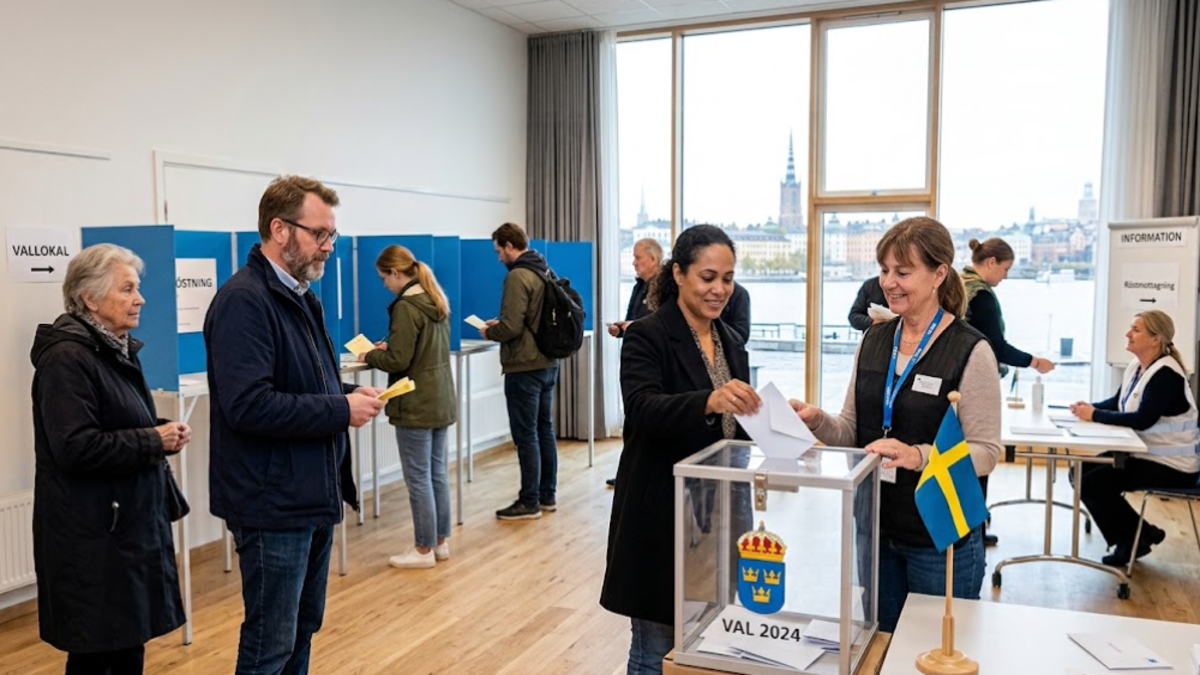
At an assigned voting location on election day, voters first take the ballot papers they need. Ballots are displayed in a screened area so that voters can select them without others seeing which party they intend to support.
After selecting the ballot papers, the voter receives ballot envelopes and enters a voting booth alone. The vote is prepared behind the screen, away from other voters.
A voter can select a party without choosing an individual candidate. Alternatively, the voter can mark a specific candidate on the ballot paper. A candidate’s name can also be written on an appropriate party ballot or on a blank ballot paper. Only one individual candidate can be selected in each election.
Once the ballot papers have been placed in the envelopes, the voter takes them to election officials and shows identification.
An identity card, driving licence or passport can be used. A person without identification can also have their identity confirmed by someone else who meets the requirements set by the election authority.
The election official verifies the voter’s identity and checks the envelopes before placing the votes in the appropriate ballot boxes.
The procedure is deliberately separated into stages so that officials can establish who has voted without learning how that person voted. Election workers have a duty of secrecy, and assistance inside the voting booth must respect the voter’s confidentiality.
Who are the main political candidates?
The most important names in the parliamentary contest are the leaders of Sweden’s major political parties. However, it is important to understand that voters are not directly choosing between candidates for prime minister.
The centre-left opposition is led by Social Democratic Party leader Magdalena Andersson. She has presented herself as a candidate to lead a new government and has made security, economic prosperity and social cohesion central themes of her campaign. The Social Democrats say they want to strengthen Sweden’s military and civil defence, tackle gang recruitment and improve household finances.
On the governing side, Prime Minister Ulf Kristersson leads the Moderate Party. His political bloc includes the Moderates, Christian Democrats, Liberals and Sweden Democrats in the broader parliamentary cooperation that has supported the government.
Jimmie Åkesson leads the Sweden Democrats, which have become a central force on the Swedish right. The party has pushed immigration and crime high on the political agenda and is seeking a more formal role in government if the right wins. Reuters reported in July that Åkesson was demanding cabinet influence after the Sweden Democrats had supported the centre-right government from outside the cabinet.
The other parliamentary party leaders include Nooshi Dadgostar of the Left Party, Elisabeth Thand Ringqvist of the Centre Party, Ebba Busch of the Christian Democrats, Amanda Lind of the Green Party and Simona Mohamsson of the Liberal Party. The government has brought the leaders of all eight parties represented in the Riksdag together for discussions on election security and foreign information influence.
The exact candidate lists are broader than these nationally prominent figures. Sweden’s electoral system allows parties to register candidates for the parliamentary, regional and municipal contests, meaning thousands of individuals can appear across different ballots and constituencies.
What the latest polls are showing
The political race has become more difficult for the governing bloc as election day approaches.
A Reuters report published on August 18 said a Verian poll for Swedish broadcaster SVT put the centre-left opposition at 53.9 percent and the four-party right-wing coalition at 43.9 percent. The survey was conducted among 3,000 voters between August 3 and 16.
According to the same report, the Social Democrats stood at 30.5 percent, making them clearly the largest individual party in the poll. The figures suggested that the opposition could win a substantial parliamentary majority if the poll translated into election results.
The latest polling picture is significant because the governing coalition still has a path to retaining power, but the size of the reported gap puts considerable pressure on the parties of the right.
A separate Demoskop poll reported by Reuters several days earlier also showed the opposition ahead, although by a smaller margin. That survey placed the centre-left bloc at 50.6 percent and the governing right-wing bloc at 46.9 percent. It also showed the Liberals below the 4 percent threshold for parliamentary representation.
Polls, however, are not election results. Voters can change their minds, turnout can affect the final distribution and smaller parties face particular pressure because crossing the parliamentary threshold can determine whether they receive Riksdag seats.
The issues driving the campaign
The campaign is being fought around a combination of traditional economic concerns and questions of national security.
The cost of living remains a major concern for voters. Political parties are competing over how to strengthen household finances, support economic growth and address pressures affecting ordinary families.
Crime and security have also become defining themes. The rise of gang violence and the government’s response to organised crime have helped move law and order to the centre of political debate.
Immigration remains another dividing issue. The Sweden Democrats have pushed for tighter immigration policies, while other parties have focused on different approaches to integration, social cohesion and migration.
Security has gained additional importance as Sweden adjusts to its changing role in European and international defence cooperation. The parties are also debating energy policy, welfare provision and the future of public services.
Recent reporting from Reuters indicates that the major campaign issues include the cost of living, security, immigration, crime and energy.
The Social Democrats are also presenting economic growth and welfare as central campaign priorities. Andersson has said a government under her leadership would focus on strengthening security, increasing prosperity and improving social cohesion.
What happens after the vote?
The first indications of the result are expected on election night, when preliminary results will be published.
The preliminary count gives voters and political parties an early picture, but it is not the final result. The County Administrative Boards begin the final count after election day, and the final parliamentary result is normally expected during the following weekend. Municipal and regional counts take longer and are normally completed later.
The crucial political question comes after the ballots have been counted: which combination of parties can command enough support in the Riksdag to form a government?
Because Sweden uses proportional representation and has several significant parties, winning the largest share of the vote does not automatically mean that one party can govern alone.
Coalition negotiations, agreements between parties and parliamentary support can therefore become just as important as the headline result.
The election will also determine the balance between the political blocs. If the opposition performs as current polling suggests, Sweden could face a change of government. If the governing parties recover support, Kristersson could seek to continue in office with parliamentary backing from his allies.
The final result will ultimately depend on votes cast at polling stations and through the country’s other authorised voting methods, rather than on opinion surveys.
What voters should remember before election day
For voters in Sweden, the essential dates are straightforward. Early voting begins on August 26, while the main election takes place on September 13.
Assigned polling locations are open from 8 a.m. to 8 p.m. on election day. Voters should check their voting card for the correct location and bring identification.
Those who cannot reach their assigned location can use early voting. Early voting remains available through election day, although people voting away from home on the final day may have fewer locations to choose from.
Swedish citizens living abroad also have voting options. They can vote in advance at Swedish diplomatic missions or use postal voting procedures, subject to the rules governing overseas voters.
Most importantly, voters should remember that the ballot concerns three levels of government. The national vote determines the composition of the Riksdag, while regional and municipal votes decide who will make decisions closer to where people live.
The result will therefore reach far beyond the question of who becomes prime minister. It will determine the balance of power in national politics while simultaneously shaping healthcare, public transport, schools, elderly care and other local services.
With the latest opinion polls showing a sizeable advantage for the opposition but several weeks of campaigning still remaining, Sweden’s political parties now face the final test: turning campaign promises and polling support into votes.
Frequently Asked Questions
When is the Swedish election?
The main election day is Sunday, September 13. Voting locations are open from 8 a.m. until 8 p.m.
When does early voting start?
Early voting in Sweden begins on August 26 and continues until election day.
Who can vote in the Riksdag election?
Swedish citizens who are at least 18 on election day and who are currently, or have previously been, registered in the Swedish Population Register can vote.
Who are the main political leaders?
The leading figures include Social Democratic leader Magdalena Andersson, Moderate leader and Prime Minister Ulf Kristersson, Sweden Democrats leader Jimmie Åkesson, Left Party leader Nooshi Dadgostar, Centre Party leader Elisabeth Thand Ringqvist, Christian Democrat leader Ebba Busch, Green Party leader Amanda Lind and Liberal Party leader Simona Mohamsson.