
Stockholm – Swedist: Sweden Work Permit Salary Threshold: How Much Must You Earn?

Sweden has raised the financial bar for many people from outside the EU and EEA who want to work in the country. The new Sweden Work Permit Salary Threshold is tied directly to the national median wage, meaning the amount applicants must earn can change when Sweden updates its wage statistics. For most new applicants, the required salary is now SEK 34,470 a month before tax, while certain professions and groups qualify for a lower threshold. What does the new system mean for foreign workers planning to build their careers in Sweden?
Sweden Work Permit Salary Threshold rises to SEK 34,470
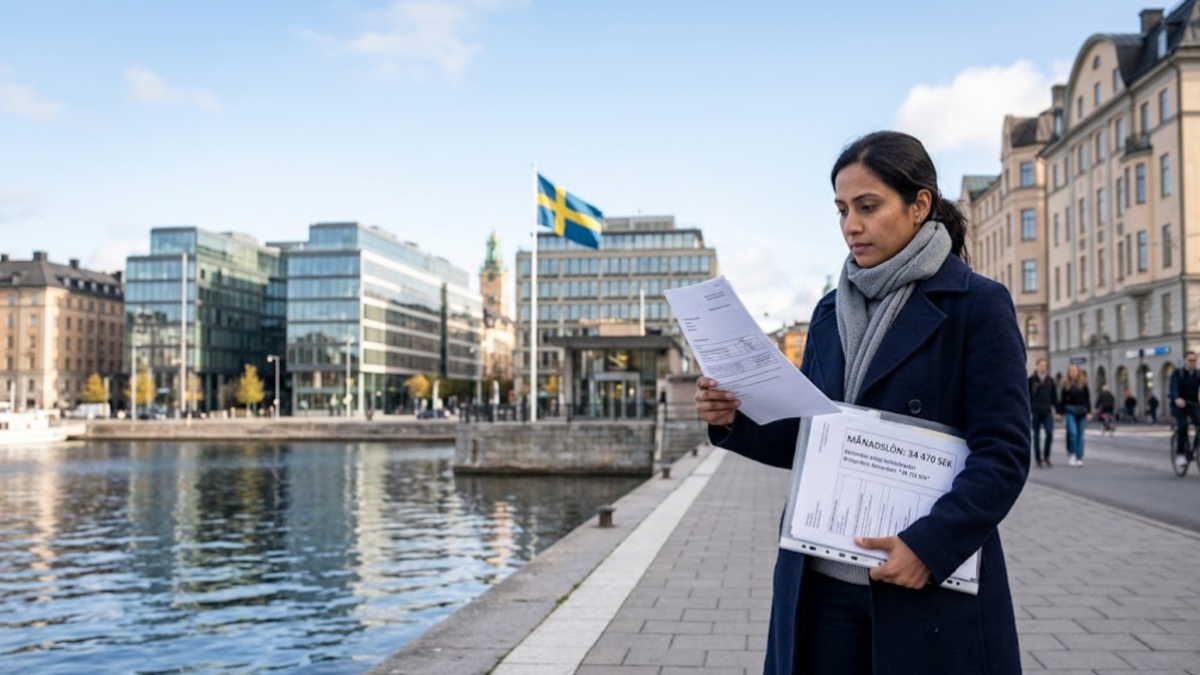
The Swedish Migration Agency has confirmed that most people applying for a Swedish work permit must now have a monthly salary of at least SEK 34,470.

The figure represents 90 percent of Sweden’s median salary. The relevant median salary is currently SEK 38,300, according to Statistics Sweden, and the Migration Agency uses that figure to calculate the work-permit requirement.
The rule took effect on June 1, replacing the previous system based on a lower salary requirement linked to 80 percent of the median wage. The change represents a significant increase for foreign workers whose salaries previously sat close to the old minimum.
The requirement does not simply ask whether an applicant earns enough to cover basic living costs. The new system establishes a specific relationship between immigration and the country’s overall wage level.
The Swedish Migration Agency also makes clear that meeting the numerical threshold alone does not automatically guarantee a permit. The salary must also correspond with Swedish collective agreements or established practice within the relevant profession or industry.
That second test matters because an employer cannot necessarily secure a work permit simply by increasing an offered salary to reach the national threshold. The employment conditions must also meet the standards expected for the occupation.
The figure can change when Statistics Sweden publishes a new median salary. For applicants, the relevant median is the one that applied when the work-permit application was submitted.
That means prospective workers should check the current figure rather than rely on an older salary guide, social-media post or recruitment advertisement.
The latest adjustment also shows how quickly the requirement can move. The median salary used for applications increased from SEK 37,100 to SEK 38,300 when the statistics were updated in June. As a result, the 90-percent threshold moved from SEK 33,390 to SEK 34,470.
For anyone negotiating a Swedish employment contract, that difference can be decisive.
How the new salary rule works
The basic calculation is straightforward: Sweden takes the national median salary and applies a percentage to it.
For most work-permit applicants, that percentage is 90 percent. With a median salary of SEK 38,300, the calculation produces a minimum of SEK 34,470 per month.
The threshold is therefore not a fixed amount that will remain unchanged indefinitely. It follows the wage statistics.
The Swedish Migration Agency says the salary must reach at least 90 percent of the median salary that was current when the applicant applied. This makes the application date particularly important.
The rule also applies to certain people extending their permits, although transitional arrangements protect some existing permit holders for a limited period.
Workers who already held a permit under the previous rules and apply for an extension during the transitional period can remain under the previous maintenance requirement instead of immediately facing the new 90-percent level. The transition covers extensions submitted between June 1 and December 1 for people whose existing permits were granted under the earlier system.
For new applicants, however, the new standard is much more important.
The change also affects people who may have submitted an application before the new rules started but whose case receives a decision after the starting date. The Migration Agency has explained that the new requirement can apply according to when the decision is made in those circumstances.
This makes timing a major issue for applicants and employers.
A job offer that looked sufficient under the earlier rules may no longer be enough if the case falls under the new requirements.
Some occupations can qualify for a lower salary
The new system is not identical for every foreign worker.
Sweden has created exemptions for certain professions and groups considered important to the labour market. People covered by an exemption do not have to meet the full 90-percent threshold.
Instead, they must generally earn at least 75 percent of the median salary.
With the current median salary of SEK 38,300, that lower level is SEK 28,725 per month.
The Government has identified 27 shortage occupations for exemption. The list includes jobs in areas such as information technology, engineering, healthcare, agriculture, food processing and heavy industry.
The Migration Agency’s current list includes several technical occupations, among them IT operations technicians, IT support technicians, systems administrators and network and systems technicians.
Several healthcare roles also appear on the list. These include assistant nurses in different healthcare settings, ambulance care assistants and care assistants.
The exemptions also cover a number of occupations connected with agriculture, forestry, food production and industrial work. Welders, structural steel erectors, maintenance mechanics and certain machine operators are among the listed occupations.
The government said the exemptions were designed to maintain access to workers in areas where Sweden has identified shortages.
The policy therefore creates two different salary tracks. Most foreign workers face the higher national threshold, while eligible workers in specified occupations can use the lower 75-percent requirement.
That distinction is especially important for workers considering jobs that traditionally pay below the national median.
A person should not assume that an occupation qualifies merely because an employer describes it as a shortage job. The occupation must correspond to the official classification and appear within the applicable exemption framework.
Sweden Work Permit Salary Threshold and special groups
The lower salary level is not limited to workers in the listed occupations.
Sweden has also identified several other categories that can qualify for the 75-percent threshold.
Former students and researchers who hold a Swedish residence permit can fall within the exemption when they apply for their first work permit under the relevant rules.
People covered by temporary protection under the European Union’s Temporary Protection Directive can also qualify under the lower requirement when moving into a work-permit route.
There is also a specific provision for certain foreign-trained healthcare professionals. Doctors, dentists and nurses with foreign qualifications who are working toward Swedish professional certification are included among the groups eligible for the lower salary requirement.
Another important category concerns employees of certain technology and life-science startups.
The company must meet specific conditions. According to the Swedish Migration Agency, the business must be in its startup phase, be less than five years old and have fewer than 100 employees.
The Government has presented these exemptions as part of a broader attempt to combine stricter labour-migration rules with continued recruitment in sectors where Sweden needs skills.
The approach reflects a balancing act. Policymakers want higher wages and stronger safeguards for foreign workers while avoiding a system that makes it impossible for employers to recruit for occupations facing genuine shortages.
For applicants, the practical lesson is clear: the headline salary figure is important, but it is not the only figure that matters.
The occupation, employer, application date and immigration history can all affect which threshold applies.
Which jobs are excluded from work permits?
The reforms go beyond salary.
Two occupations have been excluded from the possibility of receiving a Swedish work permit under the new framework: personal assistants and forest berry pickers.
The decision means that earning a sufficiently high salary does not solve the problem for someone seeking a permit for one of these excluded occupations.
The Government has also introduced stronger controls around employment after a permit has been granted.
Employers must report if a foreign worker who received a work permit has not started employment within four months of the permit’s first validity date.
Authorities have also gained access to certain information concerning employers in criminal and suspects registers as part of efforts to strengthen checks.
These measures form part of a wider tightening of labour immigration rules.
The Government has argued that the reforms should reduce abuse while shifting Sweden’s labour migration system toward higher-skilled recruitment.
At the same time, the exemption system shows that policymakers do not want the new salary requirement to affect every occupation in exactly the same way.
The Government has specifically highlighted technology, industry and healthcare as areas where Sweden needs continued international recruitment.
What employers and jobseekers need to check
For foreign jobseekers, the first step is to establish whether the offered position falls under the standard 90-percent threshold or one of the exemption categories.
If the standard rule applies, the salary needs to be at least SEK 34,470 a month based on the current median salary.
If the applicant qualifies for a 75-percent exemption, the corresponding minimum is SEK 28,725.
Those amounts refer to the gross monthly salary, before tax.
The employment conditions also need to satisfy the requirements concerning collective agreements or common practice in the occupation or industry. A salary that technically reaches the national threshold may still need to be assessed against the normal conditions for the job.
Applicants should also pay close attention to the timing of their application.
Because the calculation uses the median salary applicable at the time of application, an outdated figure can create confusion. Sweden updates the underlying statistics, and the required amount can consequently change.
The official Swedish Migration Agency provides the current calculation and the applicable transitional provisions.
Employers, meanwhile, need to consider the requirement before making an offer to a foreign worker.
A contract below the applicable threshold may not support a work-permit application unless the worker belongs to a category covered by the lower salary requirement or another applicable exemption.
Human-resources departments should therefore verify the occupation classification rather than relying only on the job title used internally.
Why the change matters for Sweden’s labour market
The higher salary threshold is likely to have its strongest effect on occupations where foreign recruitment has traditionally helped employers fill vacancies at comparatively modest wages.
The Local’s reporting on the reform noted that several occupations that business groups had hoped would receive exemptions were not included, including teachers, waiters, chefs, taxi drivers and bricklayers.
That creates a difficult question for employers.
If a company cannot recruit enough domestic workers for a position and the offered wage falls below the national immigration threshold, raising the salary may be the only way to recruit a worker from outside the EU and EEA.
Supporters of the policy argue that higher wage requirements can protect migrant workers from exploitation and prevent labour migration from becoming a source of downward pressure on wages.
Critics and business representatives, meanwhile, have warned that stricter requirements can make recruitment harder in sectors already facing shortages.
The exemption list is intended to soften that impact.
Still, the exemptions cover a defined set of occupations rather than the entire labour market. A worker in one profession may therefore face a substantially different immigration salary requirement from another worker with a similar level of experience.
The policy also reinforces the importance of salary negotiations.
For an international applicant, a job offer is no longer simply a question of whether the employer is willing to hire them. The pay level has become a central part of whether the employment can support immigration permission.
What applicants should remember before accepting a job offer
Anyone planning to work in Sweden should check the salary before signing an employment contract.
For most applicants, the current benchmark is SEK 34,470 per month. The lower benchmark of SEK 28,725 applies only to eligible exempt occupations and groups.
Applicants should also verify whether the actual job duties match the occupation listed in the exemption rules.
The distinction matters because Sweden assesses eligibility against defined occupations rather than informal descriptions.
The salary must also be consistent with Swedish collective agreements or established practice for the profession or industry.
Another point concerns future applications. The threshold is linked to the median salary and can therefore change when new statistics become applicable.
People already holding permits should pay particular attention to the transitional rules when planning an extension.
The reforms also introduce additional requirements beyond salary, including comprehensive health-insurance provisions for certain applicants planning to stay in Sweden for up to one year.
Taken together, the changes make the Swedish work-permit process more demanding for many foreign workers.
Yet the system is not designed as a blanket ban on lower-paid international recruitment. The government has deliberately retained lower thresholds for selected shortage occupations, certain healthcare professionals, former students and researchers, eligible Ukrainians and employees of qualifying young technology and life-science companies.
For prospective workers, the key question is therefore not simply, “How much does a Swedish work permit pay?”
It is, “Which salary threshold applies to my particular job and application?”
That distinction could determine whether an employment offer becomes a viable route to working in Sweden.
FAQ
How much must most foreign workers earn for a Swedish work permit?
Most applicants must earn at least SEK 34,470 per month before tax, based on 90 percent of the current Swedish median salary.
Can some workers qualify with a lower salary?
Yes. Certain shortage occupations and applicant groups can qualify under a 75-percent threshold, currently SEK 28,725 per month.
Does salary alone guarantee a work permit?
No. The salary must also meet the applicable standards under Swedish collective agreements or common practice in the relevant profession or industry.
Can the salary threshold change?
Yes. Sweden calculates the requirement from the national median salary, so the applicable threshold can change when new wage statistics become effective.