
STOCKHOLM – Swedist: Sweden election results have placed the centre-left opposition ahead of the governing right-wing bloc, giving former Prime Minister Magdalena Andersson a narrow parliamentary advantage after a closely contested vote. With all electoral districts counted provisionally, the opposition holds 176 of the 349 seats in the Riksdag, compared with 173 for the four parties supporting Prime Minister Ulf Kristersson. But what does the narrow result mean for Sweden’s next government?

The outcome leaves Sweden facing a period of political negotiations rather than an immediate change of government. Although the centre-left has crossed the 175-seat threshold needed for a parliamentary majority, Andersson still needs to navigate differences among the parties that make up her potential governing bloc.
The result also marks a setback for the Sweden Democrats, whose influence has shaped Swedish politics in recent years. The party remains one of the country’s largest political forces, but its representation has fallen compared with the previous parliamentary term.

According to the latest information from the Swedish Election Authority, the final election process is still being completed. The authority says the final Riksdag results are expected after the remaining counting process, including votes that require additional verification.
Sweden election leaves Andersson in front
The centre-left bloc emerged from the vote with a narrow but potentially decisive advantage.
The Social Democrats, led by Magdalena Andersson, finished as the largest party. The party received 1,781,174 votes, equivalent to 28.1 percent, and secured 100 seats according to the latest complete district count reported by election-result data.
The Moderates, led by Prime Minister Ulf Kristersson, finished second with 1,260,382 votes, or 19.9 percent, translating into 70 seats.
The Sweden Democrats followed with 1,114,292 votes, or 17.6 percent, and 62 seats. The result keeps the party as a major parliamentary force but represents a decline from its previous position.
The Left Party won 29 seats, while the Centre Party secured 25. The Greens took 22 seats, giving the four parties in the centre-left grouping a combined 176 seats.
On the other side, the Moderates’ 70 seats were joined by 62 for the Sweden Democrats, 22 for the Christian Democrats and 19 for the Liberals. Together, those parties hold 173 seats.
That three-seat difference is enough to give Andersson’s side the advantage, but it is hardly a comfortable political margin.
Sweden’s Riksdag contains 349 seats, meaning 175 seats constitute an absolute majority. The centre-left grouping therefore stands just one seat above that threshold.
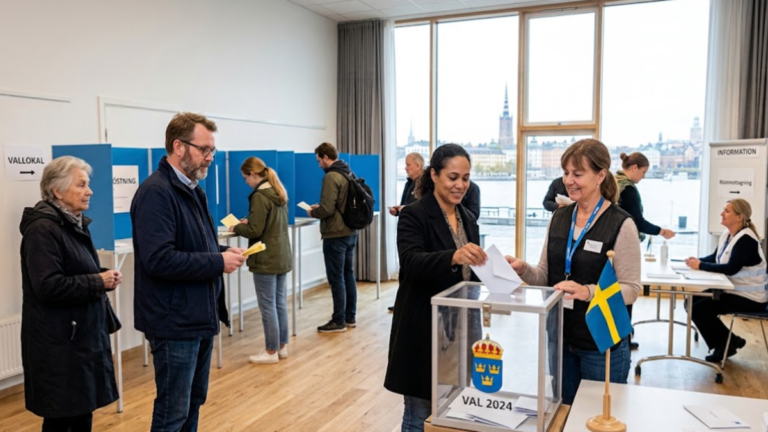
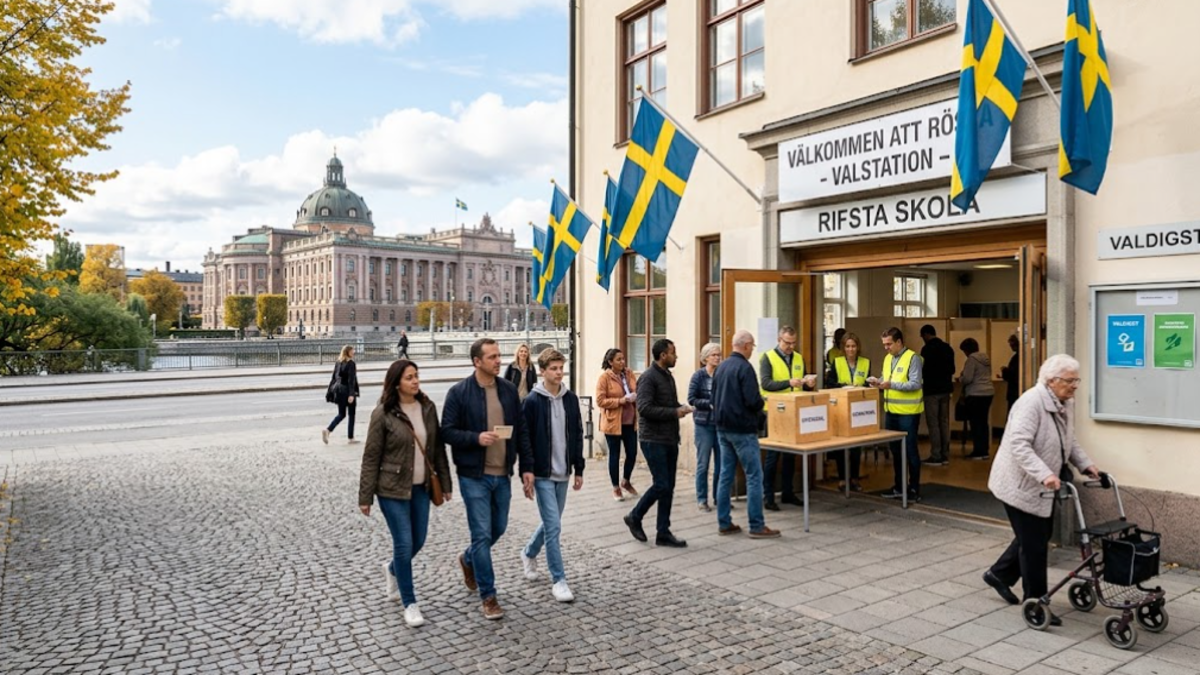
The Swedish Election Authority has reported that the vote count is being conducted through a multi-stage process. Preliminary counting began at polling stations after voting ended, while the final count is handled by county administrative boards.
Sweden election puts coalition politics at the centre
The arithmetic may appear straightforward, but forming a government will be more complicated.
Andersson is attempting to bring together four parties with different priorities. The Social Democrats remain the dominant force, but the Left, Centre and Green parties each have their own political demands.
The Centre Party is particularly important because its participation could help provide stability to a government seeking to operate with a narrow majority. At the same time, the party has differences with the Left Party over economic policy and the role of the state.
Those disagreements could become significant during negotiations over a government programme.
The political challenge is therefore not simply to determine which bloc has more seats. Andersson must also establish whether the parties supporting her can agree on a workable policy agenda.
The result has already triggered coalition discussions. Reports from Swedish and international media indicate that both political blocs have begun considering their options, while Kristersson has not immediately abandoned the possibility of trying to remain in power.
Sweden does not elect its prime minister directly. Voters elect members of the Riksdag, and the parliamentary balance determines who can form a government.
That makes the negotiations following the vote almost as important as the vote itself.
Sweden election delivers setback for the Sweden Democrats
One of the most closely watched developments concerns the Sweden Democrats.
The party has transformed itself from a political outsider into a central force on the Swedish right. During the previous parliamentary period, its influence helped shape the government’s policies even though it initially remained outside the cabinet.
The latest result shows that the party remains powerful but has lost ground.
With 17.6 percent of the vote and 62 seats in the latest count, the Sweden Democrats remain the third-largest party in the Riksdag. Their position means they cannot simply be ignored in Swedish politics.
However, their reduced representation weakens the right-wing bloc’s parliamentary position.
For Kristersson, this creates a difficult situation. His governing alliance relied heavily on cooperation with the Sweden Democrats during the previous term. The election result now leaves that alliance behind the centre-left bloc.
The political significance extends beyond the number of seats.
The campaign demonstrated that issues associated with the Sweden Democrats — particularly migration, integration and crime — have become central to mainstream Swedish political debate. Even parties that oppose the Sweden Democrats have increasingly had to address those questions.
The party’s electoral setback therefore does not necessarily mean the end of its influence.
Instead, it may force the Swedish right to reconsider how it works with the party and what role it should play in a future government.
Sweden election puts migration and crime under scrutiny
Migration and crime remained among the major political questions surrounding the campaign.
Sweden has undergone a significant political shift on immigration over recent years. Policies that once appeared politically difficult have become part of mainstream debate, while voters have increasingly focused on integration, gang violence and public security.
The Sweden Democrats have traditionally made these issues central to their political identity.
The Social Democrats, meanwhile, have also moved toward tougher positions on migration and crime compared with the party’s earlier approach. That change reflects the broader transformation of Swedish politics.
The election therefore cannot be understood simply as a traditional left-versus-right contest.
Economic concerns, welfare services, healthcare, security and the cost of living have also influenced voters.
The centre-left bloc now has to balance competing expectations. Left-wing voters want stronger public services and social protection, while centrist voters are likely to demand fiscal discipline and policies aimed at economic growth.
At the same time, crime and integration remain issues that neither side can easily avoid.
The challenge for Andersson will be to turn an electoral majority into a coherent governing programme without allowing disagreements between coalition partners to destabilise the new administration.
Sweden election reveals a divided political landscape
The narrow parliamentary margin underlines how divided Swedish politics has become.
The Social Democrats remain the country’s largest party, but their 28.1 percent share does not give them enough seats to govern alone.
The Moderates, meanwhile, remain a major force on the right, but they cannot compensate for the losses suffered elsewhere in their bloc.
The election has also confirmed the importance of smaller parties.
The Centre Party’s 25 seats, the Left Party’s 29 and the Greens’ 22 can determine who controls the parliamentary majority. In a political system based on proportional representation, relatively small changes in support can therefore have major consequences for government formation.
The Liberals and Christian Democrats also remain important to the right-wing camp, despite their smaller parliamentary representation.
This fragmentation makes coalition-building unavoidable.
The political negotiations will also test whether Sweden’s established parties can maintain cooperation despite disagreements over economic policy, migration, environmental policy and the welfare state.
The election result provides a numerical advantage to Andersson, but numbers alone do not guarantee a stable administration.
Sweden election keeps Kristersson under pressure
For Ulf Kristersson, the result represents a major political challenge.
His government entered the election seeking another mandate after a parliamentary term in which the Sweden Democrats exercised substantial influence over national policy.
The right-wing bloc now trails the centre-left by three seats.
Kristersson has nevertheless indicated that he will examine the possibilities available to him.
That means the political contest is not necessarily finished simply because the centre-left has the larger number of seats.
Swedish parliamentary politics allows parties to negotiate support across traditional bloc boundaries. The coming discussions will determine whether the centre-left can consolidate its majority or whether the right can find a combination capable of surviving parliamentary votes.
The question of who becomes prime minister will therefore depend on parliamentary confidence and political agreements rather than on a direct presidential-style election.
The next phase could be lengthy.
Swedish authorities have also stressed that election results move through several stages before they become final. The preliminary count takes place at polling stations, followed by the final count conducted by county administrative boards.
Readers can follow the official count and final allocation of seats through the Swedish Election Authority.
Sweden election and the road to a new government
The immediate priority for Swedish politicians is now government formation.
Andersson has the strongest starting position because the parties associated with her bloc hold 176 seats in the current count.
That gives her a one-seat cushion over the absolute majority threshold.
But governing with such a narrow margin would require discipline.
Every parliamentary vote could become politically important. Any disagreement between coalition partners could create pressure on the government, particularly if opposition parties unite against a major proposal.
The Centre Party could become especially influential because its position in the political centre gives it potential leverage over the direction of the next government.
For the Left Party, meanwhile, the challenge will be to secure policies that reflect its priorities without undermining cooperation with the Centre Party.
The Greens will also seek influence over environmental and climate policy.
These competing demands mean that the first political negotiations could focus as much on policy as on ministerial positions.
A government may be possible relatively quickly if the parties compromise. If negotiations become difficult, however, Sweden could face a prolonged period of political uncertainty.
Sweden election changes the balance of power
The result nevertheless represents a clear change in the parliamentary balance.
The centre-left bloc has moved from opposition to a position where it can realistically seek to form the next government.
For Andersson, the result creates an opportunity to return to the premiership.
For Kristersson, it creates the challenge of defending the governing alliance despite its weaker parliamentary position.
For the Sweden Democrats, the election provides a reminder that influence does not automatically translate into continuous electoral growth.
And for Swedish voters, the result opens a new political chapter.
The country’s next government will have to address security, economic pressures, welfare services, migration, integration and Sweden’s role in Europe and NATO.
The campaign also showed that Swedish politics no longer fits easily into the traditional divisions of previous decades.
The rise of the Sweden Democrats has changed the right, while the Social Democrats have adjusted their approach to issues such as migration and crime. At the same time, smaller parties now have considerable influence over the possibility of forming a stable government.
The result is therefore more than a narrow parliamentary victory for one side.
It is a test of whether Sweden’s political parties can translate a fragmented electorate into a functioning administration.
As the counting and verification process continues, the country knows which bloc currently holds the advantage. What remains uncertain is how that advantage will be converted into government.
FAQ
Who won the Sweden election?
The centre-left opposition bloc currently leads with 176 seats in the 349-member Riksdag, compared with 173 for the right-wing bloc.
Is Magdalena Andersson returning as prime minister?
Andersson is in the strongest position to form the next government, but coalition negotiations must take place before the final political outcome is known.
How many seats did the Sweden Democrats win?
The Sweden Democrats won 62 seats in the latest complete district count, with 17.6 percent of the vote.
What happens next in Sweden?
The parties will negotiate over government formation while the electoral authorities complete the remaining procedures and final verification of the results.
Contact: info@alswedalyom.com