
STOCKHOLM – Swedist: Sweden BankID for Newcomers is one of the first digital services many people discover after moving to Sweden. The electronic identification system is widely used for banking, public services, healthcare, payments and signing documents, but obtaining it can be considerably more complicated for someone who has just arrived. What does a newcomer actually need to do before applying for BankID?
For people already established in Sweden, BankID can feel almost invisible because it has become part of everyday digital life. A person can use it to prove their identity online, approve a payment or access a service without visiting an office.
For newcomers, however, the process often starts with several separate steps. The person may first need to become registered in Sweden, receive a Swedish personal identity number, establish a banking relationship and satisfy the identification requirements of a bank that issues BankID.

The distinction between a personal identity number and a coordination number is particularly important. The Swedish Tax Agency, Skatteverket, states that people who move to Sweden intending to stay for at least one year should normally notify the agency about their move and seek registration in the Swedish Population Register. People who are not registered in the Population Register may instead qualify for a coordination number in certain circumstances.
That distinction can determine whether a newcomer can obtain BankID at all.
Sweden BankID for Newcomers: Why the Personal Number Matters
The central requirement highlighted by BankID is straightforward: a person needs a Swedish personal identity number to obtain BankID and must also be a customer of a bank that issues the service.
This means that having a passport, residence permit or even a Swedish bank account does not automatically mean that a newcomer can activate BankID.
The personal identity number is therefore one of the most important pieces of the process. It connects the individual to Sweden’s Population Register and provides the identity reference used across many Swedish systems.
For someone planning to live in Sweden for at least a year, the first practical step is normally to notify Skatteverket of the move. The authority explains that people who are registered as living in Sweden receive a personal identity number. The process also involves an identity check at a selected service centre.
Newcomers should therefore avoid treating BankID as an isolated application. It is better understood as one part of a larger administrative chain.
First comes legal residence and registration where applicable. Then comes the personal identity number. After that, the newcomer can establish the necessary banking relationship and ask the bank about BankID.
This sequence explains why some newly arrived residents cannot obtain digital identification immediately, even when they have already found employment, rented a home or opened other services.
Sweden BankID for Newcomers: The Role of the Bank
BankID is not issued directly by the Swedish Tax Agency. The service is provided through participating banks, which means the bank’s customer relationship plays a crucial role.
A newcomer who has received a Swedish personal identity number should contact a bank that offers BankID and ask about its current requirements for identification and account opening.
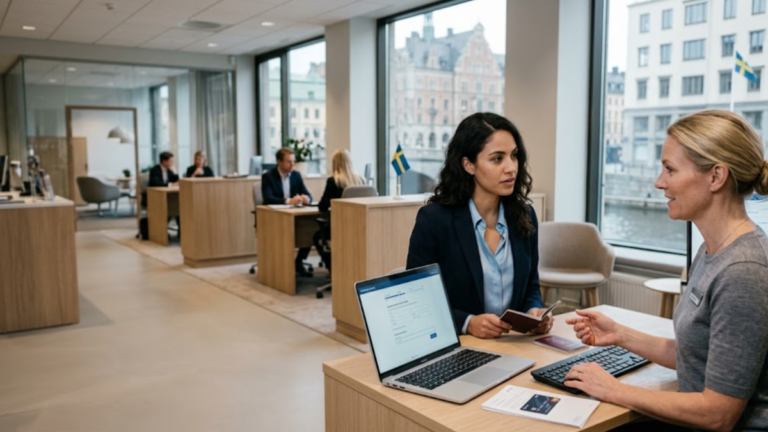
The bank will carry out its own customer identification and security checks. These procedures can require documents and, depending on the circumstances, an in-person visit.
This stage can be frustrating for people who are accustomed to completing banking applications entirely online. Sweden’s highly digital system often assumes that the customer already has a trusted digital identification method.
That creates an obvious problem for a person who has just arrived: BankID helps with digital banking, but getting BankID normally requires the person to have an established relationship with a participating bank first.
Newcomers should therefore be prepared to use traditional identification during the initial banking process. A valid passport or other accepted identity document may be required, while the bank may also request information about residence, employment, address or the purpose of the banking relationship.
The precise documentation and procedures can vary between banks. For that reason, newcomers should not assume that a requirement described by one bank automatically applies to another.
Once the bank has accepted the customer and the person satisfies the BankID requirements, the bank can provide instructions for obtaining the digital identification service.
What If a Newcomer Has a Coordination Number?
A coordination number can be useful in Sweden, but it should not be confused with a personal identity number.
Skatteverket describes a coordination number as an identifier for someone who is not, and has not previously been, registered in the Swedish Population Register. A person can apply for one in qualifying circumstances, and an identity check at a service centre is part of the process.
The situation is especially relevant for people who intend to stay in Sweden for less than one year. In such cases, the Swedish Tax Agency says that a coordination number may be appropriate instead of registration in the Population Register.
However, a coordination number should not be viewed as a substitute for the personal identity number required for BankID.
BankID’s own guidance states that a Swedish personal identity number is needed to obtain BankID.
This is one of the most important points for newcomers because confusion between the two identifiers can lead to unrealistic expectations. Someone may have a valid Swedish connection, employment or a coordination number and still be unable to obtain BankID.
The best approach is to establish exactly which form of registration applies to the individual’s situation before planning around BankID.
People who already have a coordination number and later become registered in Sweden receive a personal identity number instead. Skatteverket states that the personal identity number replaces the coordination number when a person becomes registered in the Swedish Population Register.
The Identity Check Comes Before Many Digital Services
For newcomers, identity verification is one of the most important practical steps.
Skatteverket currently requires people applying for a coordination number to attend an identity check at a service centre. Applicants must bring identity documentation, such as a passport or national identity card, and a Swedish residence permit card where applicable.
People moving to Sweden for longer stays also need to complete an identity check as part of the population-registration process. The Swedish Tax Agency says newcomers and accompanying family members must attend an identity check in person after arriving in Sweden.
The reason is simple: digital identification ultimately depends on a reliable link between the person and their verified identity.
A newcomer should therefore keep original identity documents available during the early stages of settling in Sweden. Copies, photographs or informal translations may not be enough when an authority or bank requires an official identity document.
The exact documents requested can depend on the individual’s circumstances, nationality and residence status. Applicants should follow the instructions given by the relevant Swedish authority or bank rather than relying solely on advice from other newcomers.
What Can BankID Be Used For?
Once obtained, BankID can significantly simplify everyday life in Sweden.
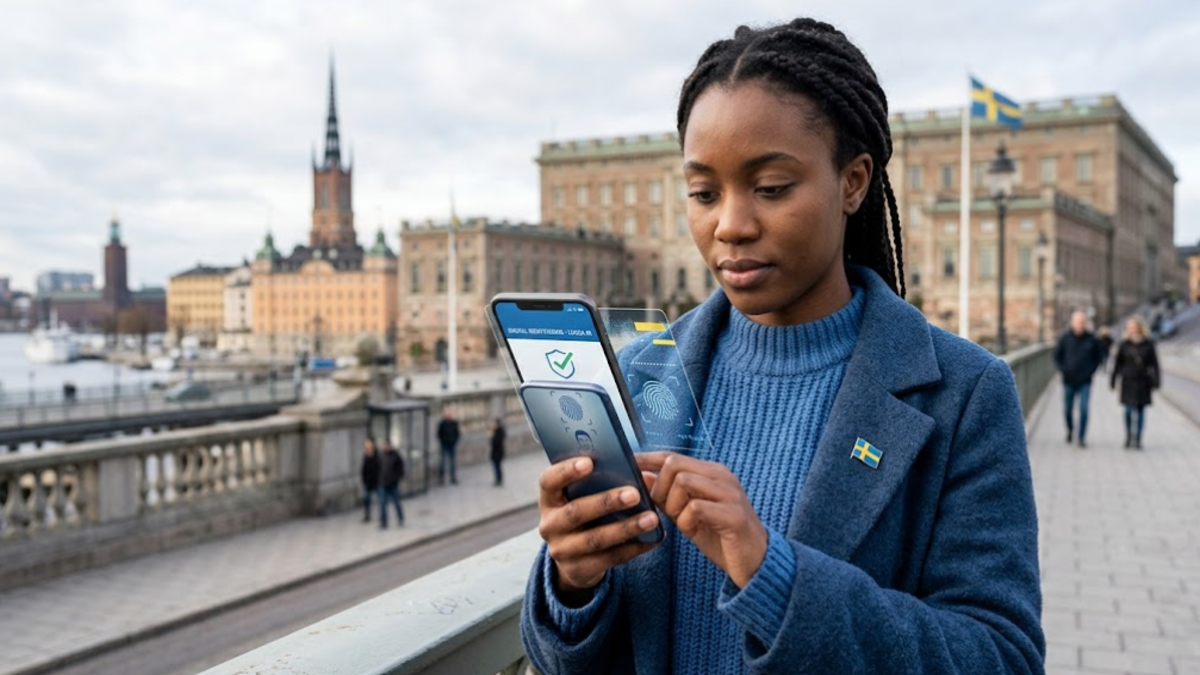
Digital identification can be used when accessing banking services, confirming transactions, logging into online services and proving identity to organisations that support BankID.
Its importance extends beyond banking. Swedish digital services commonly use electronic identification as a way of establishing that the person behind an online session is the account holder.
For newcomers, this can affect everything from administrative tasks to healthcare-related digital services and commercial transactions.
The system also supports electronic signatures. That means BankID can be used not only to log in but also, where supported, to approve or sign an electronic document.
The convenience becomes especially clear after the initial setup. Instead of repeatedly presenting physical documents or attending offices, the user can authenticate through a smartphone or another supported device.
This is one reason BankID has become so deeply integrated into Swedish society. For an established resident, many online processes simply begin with the question of whether the user can identify themselves digitally.
For a newcomer, however, the absence of BankID can make those same processes feel considerably less accessible.
Why BankID Can Be Difficult for New Arrivals
The difficulty is not necessarily that the BankID application itself is complicated. The bigger challenge is meeting the conditions that come before it.
A newly arrived person may need to complete several administrative processes in succession. The person may need the correct residence documentation, registration with the Swedish authorities, a personal identity number, a bank relationship and the bank’s approval for BankID.
Each step can depend on the previous one.
This produces what some newcomers experience as a digital-access gap. Sweden expects residents to use online services, but the most convenient digital identification method is difficult to obtain until the person has already completed several traditional administrative steps.
Previous reporting on international residents has documented this problem, particularly among students and researchers who arrive without an established Swedish administrative identity. International students have described difficulties opening bank accounts and obtaining the personal number needed to move further into Sweden’s digital ecosystem.
The issue is therefore not simply technological. It is also administrative.
For someone moving from a country where a passport and bank card are enough for most online services, Sweden’s combination of personal identity numbers, banking relationships and electronic identification can initially seem unfamiliar.
Understanding the sequence makes the process much easier.
A Practical Route for Newcomers
For most people planning a longer stay, the process can be viewed as a series of stages rather than one BankID application.
The first stage is establishing the person’s right and intention to live in Sweden and completing the relevant registration procedure.
The second is identity verification with the Swedish authorities. Applicants should have their required identity and residence documents ready.
The third is receiving the appropriate Swedish identity number. For someone who becomes registered in the Population Register, this is the personal identity number. For certain people staying for shorter periods and meeting the requirements, it may instead be a coordination number.
The fourth stage is establishing a relationship with a bank that offers BankID.
The fifth is asking the bank to issue BankID once all requirements have been satisfied.
The sixth is installing and activating the BankID service according to the bank’s instructions.
Newcomers should remember that the bank remains an important part of the process. Even if two people have similar residence situations, their banking circumstances can differ.
For this reason, there is no single universal appointment or application that guarantees BankID immediately.
What Newcomers Should Prepare
Preparation can reduce unnecessary delays.
A newcomer should keep their passport or national identity document accessible and ensure that residence documentation is available when required.
It is also useful to keep official information about the person’s Swedish address, employment or study situation available, because a bank may need to understand the customer’s circumstances when establishing the banking relationship.
People who are moving for a long-term stay should also understand the difference between registering their move and applying for a coordination number. Skatteverket explicitly advises people intending to live in Sweden for at least one year to notify the authority about their move rather than applying for a coordination number.
Another practical point is patience. Population-registration matters can take time, and the Swedish Tax Agency states that processing times vary depending on the matter and whether further investigation or information is required.
Newcomers should avoid paying third parties who promise to obtain BankID faster. BankID is connected to identity verification and banking, so legitimate applications should go through the appropriate official channels and participating financial institutions.
Security Matters After Getting BankID
Obtaining BankID is only the beginning. Protecting it is equally important.
Digital identification can provide access to sensitive financial and personal information. A user should therefore never approve a BankID request simply because someone on the telephone, in a message or through social media tells them to do so.
The person should understand what they are approving before confirming an authentication request.
This is particularly important because newcomers may receive calls or messages from people claiming to represent banks, authorities or companies. If something appears unusual, the safest response is to stop the transaction and contact the organisation through an independently verified channel.
BankID should be treated as a personal identity tool, not as an ordinary password.
A newcomer should also keep the mobile device used for authentication secure and follow the security instructions provided by the bank and BankID.
Recent attention surrounding Sweden’s digital identity infrastructure has reinforced the importance of cybersecurity. Reporting on a security incident involving a technology supplier connected to systems used by Swedish authorities and BankID-related services said that the affected systems were internal test servers and that there was no indication of an impact on customers’ production environments or operational services.
That incident does not change the basic application process for newcomers, but it illustrates why digital identity must be handled carefully.
Sweden BankID for Newcomers: The Bottom Line
For a newcomer, getting BankID is less about downloading an application and more about establishing a verified identity within Sweden’s administrative and banking systems.
The key requirement is a Swedish personal identity number, according to BankID’s own information. The applicant must also be a customer of a bank that issues BankID.
That makes population registration particularly important for people who intend to stay in Sweden for a year or longer.
Those staying for shorter periods may instead encounter the coordination-number system, but a coordination number does not automatically provide access to BankID.
The process can appear slow or complicated when viewed from the perspective of someone who has just arrived. Yet each stage serves a purpose: Swedish authorities verify the person’s identity, the Population Register establishes the official identity record, the bank verifies its customer and BankID provides a secure method of digital authentication.
For newcomers, the most reliable strategy is therefore to work through the process in the correct order rather than searching for shortcuts.
BankID can eventually make everyday life much easier in Sweden. But before that convenience becomes available, the newcomer must first establish the identity and banking foundations on which the digital system depends.
FAQ
Can a newcomer get BankID immediately after arriving in Sweden?
Usually not. BankID requires a Swedish personal identity number and a customer relationship with a bank that issues BankID.
Can I use a coordination number to get BankID?
A coordination number is not the same as a Swedish personal identity number. BankID states that a Swedish personal identity number is required.
Do I need a Swedish bank account?
Yes. You must be a customer of a bank that issues BankID before the service can be obtained through that bank.
Where should newcomers check the requirements?
Start with the Swedish Tax Agency for registration and identity information, then contact a participating bank for its BankID requirements.
Contact: info@alswedalyom.com