
STOCKHOLM – Swedist: Sweden Bank Account for Foreigners is becoming an important practical question for people moving to Sweden for employment, studies, family reasons or longer-term residence. While Swedish banks operate in a highly digital environment, newcomers can face additional identification, tax and compliance checks before gaining access to everyday banking services. So, what does a foreigner actually need to open a Swedish bank account?
Sweden Bank Account for Foreigners: What the Rules Say
Opening a bank account in Sweden is not reserved for Swedish citizens. Foreign residents can apply for banking services, and people who legally reside in Sweden or elsewhere in the European Union or European Economic Area have a statutory right to a payment account with basic functions.
The Riksbank has highlighted this right in its latest payments analysis. A basic payment account can provide essential services such as making payments, receiving funds and carrying out transfers. However, the right does not automatically extend to every banking product or digital service offered by a bank.

This distinction matters for newcomers.
A foreigner may have the right to request a basic payment account but still need to complete identity and customer checks before the bank can activate the relationship. Banks must follow anti-money-laundering rules and need to understand who their customers are, why they need an account and how they expect to use it.
The Swedish Bankers’ Association explains that a prospective customer must be able to identify themselves and answer questions about the reason for opening an account.
That means the process involves more than simply presenting a passport.
For someone arriving in Sweden, the most important question is often whether they already have a Swedish personal identity number and BankID. Those two elements can significantly affect how easily the application can move through the country’s digital banking system.
Why the Swedish Personal Identity Number Matters
The Swedish personal identity number, known as the personnummer, plays a central role in everyday administration.
Banks use personal identification information to establish customer identity and connect banking services with other parts of the Swedish financial system. However, not having a Swedish personal identity number does not necessarily prevent a foreigner from requesting an account.
The process can simply become more complicated.
Nordea’s current customer guidance, for example, says that people without a Swedish personal identity number can use a foreign passport when applying. The bank also provides specific instructions for customers who have a coordination number.
The practical difference is important.
A newcomer with a personnummer may have access to more digital options, while someone who has recently arrived may need to provide documents at a branch and undergo additional verification.
People should therefore avoid assuming that the lack of a Swedish personal identity number means that opening an account is impossible.
Instead, they should ask the bank which application route applies to their situation.
Universities and other Swedish institutions continue to advise new international residents to prepare identity documents, residence information and evidence of employment or income when approaching a bank.
Documents Foreigners Should Prepare
The exact documentation depends on the applicant’s nationality, residence status and financial circumstances.
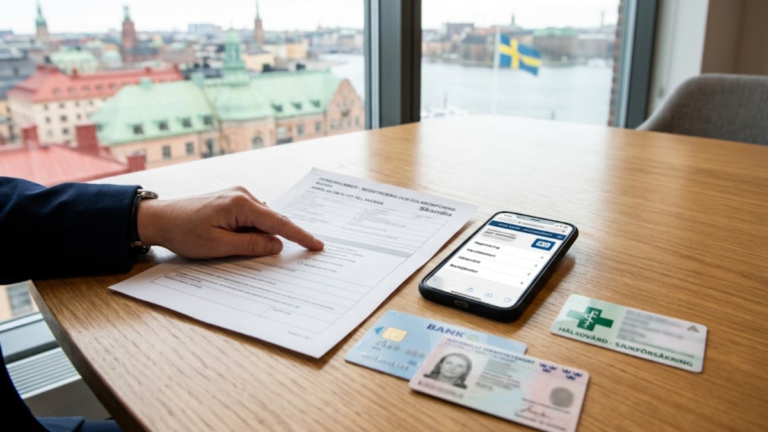
A valid passport or another approved identity document is generally the starting point. Banks may also ask for evidence showing why the applicant lives in Sweden and what the account will be used for.
For an employee, an employment contract can be particularly useful because it can demonstrate the relationship with a Swedish employer and provide information about expected income.
Students may need documentation connected with their studies or financial support.
A person relocating to Sweden with savings may need to explain the origin of those funds, particularly if substantial international transfers are expected.
Banks can also request information concerning tax residence.
This is one of the reasons applicants should prepare before visiting a branch. Having only a passport may not be enough to complete the entire process if the bank needs additional information.
Current guidance from Swedish financial institutions shows that applicants without a Swedish personal identity number may need to present a foreign passport and, in some circumstances, additional tax or registration documentation.
The safest approach is to contact the bank before the appointment and ask which documents it requires.
That can prevent an unnecessary second visit.
Sweden Bank Account for Foreigners Without BankID
BankID is one of the most important digital identification systems in Sweden.
It allows people to identify themselves online and approve digital transactions and documents. It also supports access to a wide range of services beyond traditional banking.
For foreigners, however, BankID can create a practical challenge.
BankID’s own requirements state that an individual must have a Swedish personal identity number and be a customer of a bank that issues BankID.
This creates an important distinction between opening a bank account and obtaining the full digital banking experience.
A newcomer may first need to establish a banking relationship before becoming eligible for BankID. Until then, the customer may need to rely on branch services or other identification methods offered by the bank.
This explains why some foreigners find the first stage of banking in Sweden more complicated than later stages.
Once the necessary identification and banking arrangements are in place, many routine transactions can move online.
But the first step may still require direct contact with the bank.
The issue also demonstrates why newcomers should not judge their banking options solely by looking at the digital application page. Some online forms are designed for customers who already have Swedish credentials and therefore may not be suitable for newly arrived foreigners.
What Banks Ask About Your Finances
Swedish banks do not only verify identity.
They also need to understand the customer’s financial situation and intended account activity.
The questions can include employment status, expected income, tax residence, existing banking relationships and the reason for opening the account.
These checks form part of the wider anti-money-laundering framework.
Swedish banks operate under rules designed to prevent financial institutions from being used for money laundering or terrorist financing. The banking industry has repeatedly stressed that customer identification and knowledge of the purpose of an account form part of these obligations.
Recent Swedish financial reporting has also kept attention on the tension between access to banking services and financial-crime controls.
The Riksbank has warned that banks must comply with anti-money-laundering requirements when opening payment accounts, while also recognising the importance of access to basic payment services.
For foreigners, this means that questions about money transfers should not automatically be interpreted as a sign that the application is in trouble.
The bank may simply need enough information to satisfy its legal obligations.
Clear and consistent answers are therefore essential.
If an applicant says that an account will mainly receive a Swedish salary but later expects large unexplained international transfers, the bank may ask additional questions.
Providing documentation that supports the explanation can make the process easier.
The Difference Between a Basic Account and Other Banking Services
One of the most important points for foreigners is that a basic payment account is not the same thing as access to every banking product.
Swedish and European rules protect access to basic payment services for eligible consumers. The Riksbank specifically notes that the basic functions covered by this right do not automatically include BankID or Swish.
That distinction can surprise newcomers.
Someone may successfully establish a basic account but still discover that certain digital services require additional conditions.
Credit cards, overdrafts, loans and mortgages also involve separate assessments.
A bank can evaluate income, financial history and other factors before approving credit products. Opening an ordinary payment account therefore should not be confused with receiving approval for borrowing.
For people moving to Sweden, the sensible priority is usually to establish basic banking first.
Additional products can then be considered once the customer’s financial position and banking history are established.
Can EU and EEA Citizens Open an Account?
EU and EEA citizens benefit from important protections when accessing basic banking services.
The Swedish Financial Supervisory Authority states that consumers residing in the EEA are entitled to a payment account with basic functionality, subject to the applicable rules.
European Union guidance also confirms the broader principle that legally resident consumers have a right to a basic payment account and that banks cannot reject an application solely because the customer does not live in the country where the bank is established.
However, this right does not mean that every account application must be accepted without checks.
Banks can still verify identity and comply with anti-money-laundering obligations.
The applicant may also need to demonstrate their identity and provide information necessary for the bank to fulfil its legal duties.
Foreign residents should therefore distinguish between a legal right to request basic banking services and the practical documentation required to exercise that right.
What About Non-EU Citizens?
People arriving from outside the EU and EEA can also apply for Swedish banking services, but their documentation may differ.
A bank may need to establish the customer’s identity, immigration status, Swedish connection and financial circumstances.
A residence permit or other immigration documentation can therefore become relevant.
The applicant’s employment status can also help explain why the account is needed.
For example, someone arriving in Sweden to take up a job may be asked for evidence of employment and expected salary.
A foreigner who has moved to Sweden to study may instead provide documentation related to university enrolment and financial support.
There is no universal document package for every non-EU applicant.
The bank’s requirements depend on the customer’s circumstances and the services being requested.
That is why applicants should contact the chosen bank before travelling to a branch.
How to Open a Swedish Bank Account Step by Step
The process can be broken down into several practical stages.
First, choose a bank.
Look at the basic account services, fees, cards, digital banking options and international transfer facilities that matter to you.
Second, determine your identification status.
Check whether you already have a Swedish personal identity number, coordination number or only a foreign passport.
Third, establish whether you have BankID.
If you have recently arrived in Sweden, you may not yet have it. Do not assume that an online application designed for existing Swedish customers will work for you.
Fourth, collect your documents.
Prepare your passport or approved identity document together with residence, employment, tax and financial documents relevant to your situation.
Fifth, explain the purpose of the account.
Be ready to tell the bank whether you need the account for salary payments, everyday expenses, studies, household bills or another legitimate purpose.
Sixth, provide information about your finances.
The bank may ask about your expected income, savings, tax residence and international transfers.
Seventh, attend a branch if required.
Applicants without the digital credentials needed for online onboarding may have to complete the process in person.
Eighth, answer compliance questions accurately.
Do not leave important information unexplained. If the bank asks for evidence, provide the relevant documentation.
Finally, arrange digital services.
After becoming a customer, ask the bank about available online banking, BankID and other digital payment services.
This sequence can save time because it addresses the most common obstacles before the application begins.
Why Banking in Sweden Is So Digital
Sweden has developed one of Europe’s most digital payment environments.
The Riksbank’s latest payments reporting describes a market where electronic payments dominate everyday transactions, while fraud and money laundering remain significant concerns for the financial system.
The same digital environment creates both convenience and challenges for foreigners.
Once a person has the necessary Swedish identification and banking credentials, everyday payments can become extremely straightforward.
But newcomers who arrive without those credentials may initially find the system less accessible.
This is particularly relevant because BankID and other digital services are not automatically part of the basic payment-account right.
The Riksbank has explicitly recommended clearer guidance to help banks reconcile anti-money-laundering requirements with consumers’ rights to payment accounts.
For foreigners, that debate has practical consequences.
It shows that access to banking is not simply a question of technology. It also involves regulation, identity verification and the ability of banks to establish a customer’s circumstances.
Common Reasons an Application Takes Longer
A banking application can take longer when the applicant’s documentation does not clearly establish identity or residence.
Missing information about tax residence can also lead to additional questions.
The same can happen when a customer expects international transfers but cannot immediately explain their source or purpose.
Language can create another practical obstacle.
Applicants who are not comfortable communicating in Swedish or English may need assistance when completing the process. Some banks provide specific instructions for customers who require an interpreter.
The best solution is preparation rather than trying to rush the application.
Foreigners should keep their documentation organised and make sure that the information they give the bank is consistent.
They should also ask the bank directly if they do not understand a question.
What Foreigners Should Know Before Going to the Bank
The most important step is to check the bank’s requirements before arriving.
Applicants should confirm whether they need an appointment, whether the branch handles new-customer applications and which identity documents it accepts.
They should also establish whether they can apply without a Swedish personal identity number.
A passport should be treated as essential, while supporting documents can help explain residence, employment and income.
Applicants should know their tax-residence status and be prepared to provide relevant tax identification information.
If they expect money from outside Sweden, they should be ready to explain where those funds come from and why they will enter the account.
It is also worth remembering that the first account does not necessarily provide access to every digital service.
BankID, Swish and credit products can have separate requirements.
The Bottom Line for Foreigners
A Sweden Bank Account for Foreigners is possible, but newcomers should expect the process to involve more than simply filling out an online form.
The Swedish banking system relies heavily on digital identification, yet the absence of a personal identity number or BankID does not automatically close the door to basic banking.
The key is to understand which route applies to the individual applicant.
A foreigner should prepare a valid identity document, relevant residence information and evidence explaining employment, income and the intended use of the account.
The applicant should also be prepared for questions about tax residence and the source of funds.
For EU and EEA residents, the right to a basic payment account provides an important legal safeguard. At the same time, banks retain obligations to carry out customer checks and comply with financial-crime regulations.
Recent Swedish payments reporting shows why this balance remains important: authorities want broad access to basic payment services while banks must continue strengthening safeguards against fraud and money laundering.
For a newcomer, the practical message is clear.
Do not assume that a missing personnummer means you cannot open an account. Do not assume that an online form is the only route. And do not arrive at a branch without the documents needed to explain who you are, where you live and how you expect to use the account.
With the right preparation, opening a Swedish bank account can become a manageable first step toward establishing everyday financial life in the country.
Frequently Asked Questions
Can foreigners open a bank account in Sweden?
Yes. Foreigners can apply for Swedish banking services, and eligible residents have rights concerning basic payment accounts.
Do I need a Swedish personal identity number?
Not necessarily. Banks can have procedures for customers who do not yet have a Swedish personal identity number.
Can I open an account without BankID?
Yes. The absence of BankID does not automatically prevent a foreigner from applying for a basic bank account, although the application may require additional steps.
What documents should I bring?
Bring a valid passport or approved identity document and, where relevant, residence, employment, income, tax and financial documentation.
Contact: info@alswedalyom.com