
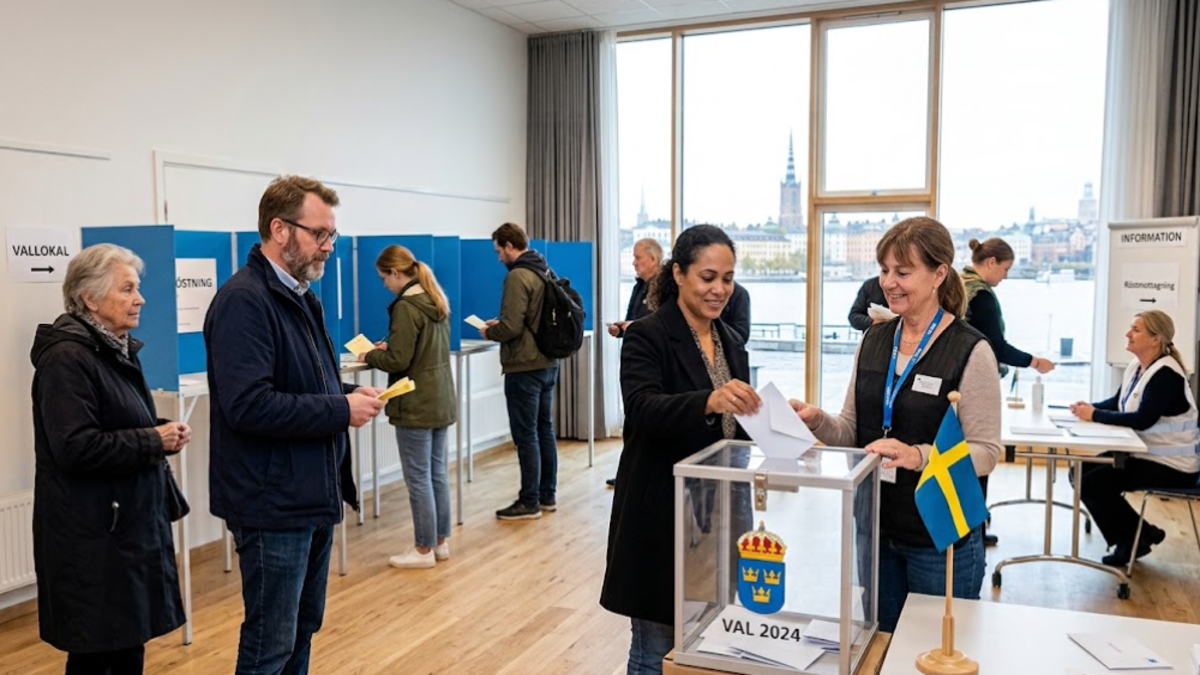
STOCKHOLM – Swedist: Sweden’s elections have left Sweden facing a tense political reckoning after the centre-left opposition emerged with a narrow parliamentary advantage over the governing right-wing bloc, while the Sweden Democrats suffered a significant setback. With the final count still under way, the country now enters a period of difficult negotiations that could determine who governs and how Sweden’s political direction evolves, but what does the result really mean for the country?

The preliminary picture that emerged on Monday showed the bloc supporting Social Democratic leader Magdalena Andersson ahead of the centre-right grouping led by Prime Minister Ulf Kristersson.
The difference is exceptionally small. Current projections put the centre-left side on 176 seats in the 349-member Riksdag, compared with 173 for the right-wing bloc. The figures remain provisional because outstanding votes, including ballots from overseas and other votes that require additional counting, could still affect the final distribution.

That narrow margin means neither political camp can treat the result as a simple victory. Andersson has reason to believe she can return to government, but she still faces the difficult task of assembling a workable parliamentary arrangement. Kristersson, meanwhile, has not conceded the possibility of continuing on the right and has described the result as too close to settle the political question immediately.
The Swedish Election Authority confirmed on Monday that the final counting process had begun, with county administrative boards reviewing and recounting ballots while also assessing votes for individual candidates.
Sweden’s elections produce a narrow centre-left advantage
The most important immediate development is the centre-left bloc’s small lead.
The Social Democrats remain the largest individual party, with around 28% of the vote according to preliminary reporting. Yet the party’s result also contains an uncomfortable message for Andersson: its share is historically weak compared with the strength it has traditionally enjoyed in Swedish politics.
The opposition’s advantage comes from the combined performance of several parties rather than from a decisive Social Democratic breakthrough.
The Left Party, Centre Party and Greens are all important to the arithmetic. Together with the Social Democrats, they form the parliamentary basis that could allow Andersson to seek the prime minister’s office again.
That combination, however, does not automatically create a stable government.
Swedish politics has become increasingly fragmented, and the parties that could give Andersson the numbers she needs do not share identical views on taxation, economic policy or the role of the state.
The Centre Party presents a particularly important piece of the puzzle. Its position between the traditional left and right has given it considerable strategic importance, especially when neither major bloc can comfortably govern alone.
The political challenge is therefore larger than the three-seat difference suggests.
A government needs to be capable of passing budgets and legislation, not merely surviving the initial vote on the prime minister. That makes negotiations over policy priorities at least as important as the headline seat count.
For Andersson, the election has therefore delivered an opportunity rather than a guaranteed return to power.
Sweden’s elections expose the changing strength of the far right
One of the clearest stories from the vote is the decline of the Sweden Democrats.
The party had entered the election with expectations of expanding its influence after becoming a central parliamentary force during the previous political period. Instead, preliminary figures show it losing roughly 11 seats and falling to about 17.6% of the vote.
That represents an important change.
The Sweden Democrats had risen steadily over previous elections and became a crucial source of parliamentary support for Kristersson’s government. Their influence helped move immigration and crime higher on the national political agenda and contributed to a major shift in Sweden’s approach to migration.
This time, however, the party failed to continue that upward trajectory.
The Sweden Democrats also lost their position as the country’s second-largest political force, with the Moderates moving ahead of them in the preliminary results.
The setback does not mean the party has become irrelevant.
Its support remains substantial, and its political influence can still be seen in the positions adopted by other parties, particularly on immigration, integration and crime.
The election has therefore produced an unusual situation. The far right has lost electoral ground at the same time that several of its once distinctive policy concerns have become part of mainstream political debate.
Analysts quoted in today’s reporting have argued that Sweden’s tougher approach to migration is unlikely to disappear even if Andersson returns as prime minister.
The Social Democrats themselves have moved considerably away from the more liberal migration policies associated with the refugee crisis of the previous decade.
That means a change of government would not necessarily mean a return to Sweden’s earlier immigration model.
A difficult road back for Magdalena Andersson
For Magdalena Andersson, the preliminary result represents both a political opportunity and a warning.
The former prime minister remains the central figure on the centre-left and is positioned to begin negotiations if the preliminary advantage survives the final count.
Yet her party has not produced a dominant result.
The Social Democrats’ roughly 28% share is far below the level that would allow them to govern comfortably without partners. Andersson therefore needs cooperation from parties that have their own priorities and, in some cases, reservations about the Social Democrats’ economic programme.
Her campaign placed considerable emphasis on welfare, economic inequality and taxation.
Among the proposals associated with her campaign were higher taxes on banks and wealthier earners, with the additional revenue intended to strengthen public services and the welfare state.
Those priorities could become major points of negotiation if a centre-left government takes shape.
The Left Party, for example, has its own demands, while the Centre Party has historically been cautious about moving too far toward the left on economic questions.
The Greens also bring their own priorities, particularly around climate and environmental policy.
The result could therefore force Andersson to balance several competing agendas while trying to create a government that can pass legislation.
That is why Monday’s preliminary parliamentary numbers do not provide a complete picture of what happens next.
Ulf Kristersson refuses to disappear from the contest
The governing side faces a different but equally complicated situation.
Prime Minister Ulf Kristersson’s Moderates have performed better than the Sweden Democrats, helping the party regain importance within the right-wing bloc.
Kristersson has indicated that he intends to examine the possibilities available to the right rather than immediately accepting defeat.
That approach reflects the narrowness of the preliminary result.
Three seats separate the two blocs, and the outstanding votes mean that the final parliamentary balance is not yet formally settled.
The right also has a potential route to power if it can maintain its parliamentary support and resolve the question of cooperation with the Sweden Democrats.
That question has become more complicated because the Centre Party has resisted arrangements that would place the Sweden Democrats at the heart of government.
The Sweden Democrats had hoped that a strong election performance could open the door to a more direct role in government.
Instead, their decline could weaken that argument.
Even so, their parliamentary presence remains large enough to matter, particularly if the right-wing parties seek to construct a majority or minority government.
Kristersson therefore faces a delicate calculation.
He must determine whether a renewed right-wing government can function with the Sweden Democrats as a parliamentary partner while also considering whether a broader centrist arrangement could offer greater stability.
Immigration and crime remain central after the vote
Although the election has produced a narrow contest between political blocs, immigration and crime remain among the most consequential issues shaping Swedish politics.
Sweden has adopted considerably stricter migration policies in recent years.
The outgoing government tightened rules surrounding residence, welfare and deportations, while asylum applications fell to their lowest level in decades.
A return of the centre-left is unlikely to reverse every element of that policy.
Andersson and the Social Democrats have themselves adopted a significantly tougher position on migration than the party held during the refugee crisis of the 2010s.
This reflects a broader change in Swedish public debate.
Gang violence, organised crime and integration have become central political concerns, creating pressure on governments from both the left and right.
The election result suggests that voters have not simply divided themselves between traditional left-wing and right-wing positions.
Instead, they have responded to a mixture of economic concerns, security issues, migration, taxation and the future of Sweden’s welfare model.
That makes the next government’s policy programme difficult to predict.
A centre-left administration may place greater emphasis on welfare spending and redistribution while retaining substantial elements of the stricter migration framework introduced under the right.
The economy and welfare state could shape coalition talks
Economic policy is likely to become one of the most difficult areas for the parties trying to form a government.
Andersson has campaigned on strengthening the welfare state and addressing economic inequality.
Her proposal to increase taxation on banks and higher earners points toward a more interventionist economic agenda than the policies traditionally associated with the centre-right.
For coalition partners, however, the question will be how far such policies can go.
The Centre Party has a different economic outlook, while the Greens and Left Party also have distinctive priorities.
A government agreement would therefore require compromises.
The same applies to the right.
The Moderates, Christian Democrats, Liberals and Sweden Democrats have not always approached taxation, welfare and public spending from the same perspective.
A narrow parliamentary majority can make disagreements especially dangerous.
If even one supporting party withdraws from an agreement, the government could face difficulty passing its budget or maintaining parliamentary support.
That is why Sweden’s political parties are expected to proceed carefully rather than rushing to announce a final governing arrangement.
Sweden’s elections could lead to weeks of negotiations
The next phase will be dominated by negotiations.
The final result must first be established through the continuing count, including outstanding ballots.
The Swedish Election Authority says the final counting process includes a renewed examination of votes and the assessment of candidate votes.
That process matters because the current parliamentary margin is so narrow.
Once the final numbers become clear, the focus will move from campaigning to government formation.
Andersson will need to demonstrate that she can assemble sufficient parliamentary support.
Kristersson will attempt to determine whether the right can maintain a path to power.
Smaller parties will suddenly gain influence because their decisions could determine which bloc can command enough support in the Riksdag.
The Centre Party may be particularly important.
Its refusal to cooperate with the Sweden Democrats could restrict Kristersson’s options, while its willingness to work with the centre-left could make an Andersson-led government more viable.
At the same time, Andersson will need to manage tensions with the Left Party and convince potential partners that a new government can function effectively.
The negotiations could therefore take time.
Sweden’s elections send a mixed message about Europe’s far right
The Swedish result is also attracting attention beyond the country’s borders.
Across Europe, nationalist and far-right parties have gained ground in a number of elections.
Sweden’s preliminary result offers a different picture.
The Sweden Democrats, after years of growth, have suffered a notable electoral decline.
That does not amount to the disappearance of the far right. The party remains one of the country’s largest political forces and has already influenced the direction of national policy.
But its failure to increase its vote share changes the immediate political landscape.
The result may also encourage other Swedish parties to reassess their strategies.
The Moderates have strengthened their position relative to their right-wing partner, while the Social Democrats remain the country’s largest party despite their own disappointing percentage.
For European observers, Sweden therefore offers a complicated political lesson.
The far right can lose votes without losing its broader influence on political debate.
Policies on immigration and crime that were once closely associated with the Sweden Democrats have increasingly become mainstream positions.
At the same time, voters have shown that the party’s electoral expansion cannot be taken for granted.
What happens next in Sweden?
The immediate priority is to complete the vote count.
Until the final figures are confirmed, the three-seat centre-left advantage remains provisional.
The next challenge will be political rather than administrative.
Sweden needs a government capable of winning parliamentary support and passing a budget.
That could require agreements between parties that have significant ideological differences.
If Andersson succeeds, she would return to the prime minister’s office after a period in opposition.
If Kristersson manages to assemble enough support, the right could remain in power despite the preliminary centre-left lead.
The Sweden Democrats’ weakened result adds another layer of uncertainty because the party’s role in a future right-wing arrangement is now less straightforward.
Whatever the final outcome, the election has demonstrated that Sweden’s traditional political divisions have become more complicated.
The Social Democrats remain the largest party, but their support has weakened.
The Sweden Democrats remain influential, but their growth has stalled.
The Moderates have regained ground, while smaller parties could hold the balance of power.
That combination means the final result may matter less than the negotiations that follow it.
Sweden now faces a political period in which every parliamentary seat could count.
The country has voted, but it has not yet produced a clear governing formula.
The final answer will depend on the completed count and on whether Sweden’s parties can find enough common ground to turn a narrow electoral advantage into a functioning government.
FAQ
Who is leading after Sweden’s elections?
The centre-left bloc led by Magdalena Andersson is ahead in the preliminary parliamentary count, with 176 seats projected against 173 for the right-wing bloc.
Has Sweden’s next government been decided?
No. The result remains provisional, and outstanding votes still have to be counted before the final parliamentary balance is confirmed.
What happened to the Sweden Democrats?
The Sweden Democrats suffered a significant setback, falling to about 17.6% in preliminary figures and losing their position as the second-largest party.
Could Magdalena Andersson become prime minister again?
Yes. Her centre-left bloc currently has the strongest preliminary position, but Andersson must still secure sufficient parliamentary support to form a workable government.
Contact: info@alswedalyom.com