
STOCKHOLM – Swedist: Sweden Personnummer — For many newcomers, obtaining a Swedish personal identity number is one of the most important administrative steps after moving to the country. The number can make everyday dealings with banks, healthcare providers, employers and other services considerably easier. But how long does it actually take, and why does the personnummer matter so much?

Sweden Personnummer: What Is It?
The Swedish personnummer is a personal identity number used to identify people who are registered in Sweden. The Swedish Tax Agency, Skatteverket, assigns the number when a person is entered into the Swedish Population Register.
For people born in Sweden, the process is normally straightforward because registration begins at birth. For people arriving from another country, however, receiving a personnummer depends on whether they meet the requirements for population registration.

The distinction matters because simply living in Sweden does not automatically mean that someone qualifies for a personnummer.
A person who moves to Sweden generally needs to demonstrate that the country will be their place of residence for at least one year. Different rules can apply depending on nationality and the reason for moving, including employment, study, family ties or other circumstances.
The personnummer itself consists of a sequence based partly on a person’s date of birth and partly on an individual number. It is used throughout Swedish society as a central identifier.
That makes it much more than an administrative reference. For many residents, it becomes a key that connects different parts of everyday life.
Recent Swedish reporting has highlighted the scale of the issue. According to figures from Skatteverket reported by The Local, hundreds of thousands of people in Sweden have lived without a personnummer, including people who instead have coordination numbers and others who have neither identification number. The same reporting noted that eligibility for a personnummer depends, among other things, on demonstrating an intention to remain in Sweden for at least a year.
Sweden Personnummer Processing Time Explained
One of the most common questions among newcomers is how long the application will take.
Skatteverket currently states that a case involving a move to Sweden takes about three weeks to be assigned to an administrator. This is an important distinction: three weeks refers to the assignment of the case, not necessarily the moment when the applicant receives a final decision or personnummer.
The authority also explains that processing times vary according to the type of population-registration matter and whether officials need additional information or have to investigate the case further.
This means applicants should not treat the published three-week figure as a guaranteed delivery time.
A straightforward case can move through the system without major complications, while an application requiring additional documentation or clarification can take longer.
Skatteverket processes cases in the order in which they are received and says that it does not give individual cases priority over others.
For newcomers, this distinction is important because expectations about the process often come from personal experiences shared online. Some applicants report receiving their numbers relatively quickly, while others describe substantially longer waits. Such experiences can vary because every application depends on the circumstances and documentation involved.
The safest approach is therefore to use Skatteverket’s published processing information rather than relying on an unofficial fixed timetable.
Applicants should also remember that the personnummer application is connected to population registration. It is not simply a separate number request that anyone can make regardless of their residence status.
Why the Personnummer Matters in Daily Life
The importance of the personnummer becomes particularly clear when newcomers begin handling ordinary administrative tasks.
Sweden has a highly digitised public and private sector. Many organisations use personal identity numbers to identify customers, patients, employees and residents.
A personnummer can therefore simplify interactions with banks, healthcare services, insurance companies, employers, telecommunications providers and other organisations.
The number also plays an important role in the Swedish tax and social-security systems because it links a person’s identity with official records.
For newcomers, this can make the period immediately after arrival frustrating. A person may have a residence permit, employment contract, address and bank documents but still encounter situations where an organisation asks for a Swedish personal identity number.
The absence of a personnummer does not mean that a person cannot live in Sweden or carry out every type of activity. However, some administrative processes can become more complicated.
Earlier reporting by Lundagård described the personnummer as central to everyday life in Sweden and highlighted difficulties experienced by international students who did not qualify for registration. The publication noted that services such as banking, mobile contracts and insurance could be harder to arrange without the number.
This helps explain why the waiting period can feel disproportionately long to someone who has recently moved to the country.
Who Can Receive a Sweden Personnummer?
Eligibility depends primarily on whether a person should be registered in Sweden’s Population Register.
For people from outside the EU and EEA, Skatteverket states that someone who has moved to Sweden and plans to live there for at least one year will generally need to be registered. Such applicants must also provide evidence concerning their right to reside in Sweden, including a valid Swedish residence permit where applicable.
EU and EEA citizens face a different framework.
For example, an EU or EEA citizen moving to Sweden for studies generally needs to demonstrate a right of residence and show that the studies and circumstances support an expectation of living in Sweden for at least one year.
Employment can also provide a basis for registration, but the details depend on the individual’s circumstances.
A person who comes to Sweden simply to look for work may not automatically qualify. Skatteverket explains that an EU citizen can normally remain in Sweden for a period while seeking employment, but population registration requires the authority to be able to assume that the person will stay for the required period.
This is why two people arriving in Sweden at roughly the same time can have completely different experiences with their applications.
What Happens During the Registration Process?
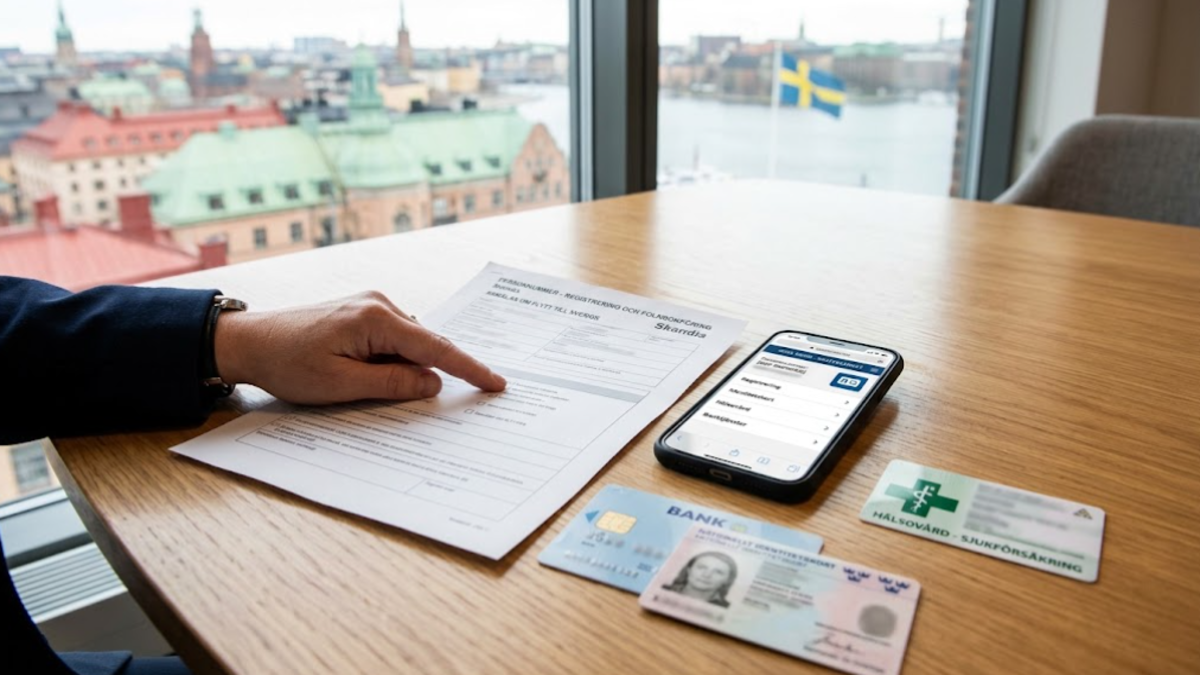
The process begins when the individual reports the move to Skatteverket and provides the information and documentation required for the population-registration assessment.
The authority then examines whether the person meets the conditions for registration.
Officials may need to establish the person’s identity, residence situation and expected length of stay. Depending on the circumstances, supporting documents may include information about employment, studies, family relationships, residence rights or other relevant matters.
The quality and completeness of the application can therefore influence how smoothly the case proceeds.
If Skatteverket needs more information, the applicant may be contacted. This is one reason applicants should ensure that their contact details and supporting documents are accurate.
Once the authority approves population registration, the person receives a personnummer as part of the registration process.
The number is then used in dealings with Swedish authorities and many private organisations.
Applicants should distinguish this process from obtaining a Swedish identity card. The personnummer and the physical ID card are not the same thing. A person can first become registered and receive a personal identity number and then deal separately with the requirements for an identification card.
Sweden Personnummer and the Coordination Number
Another source of confusion is the Swedish coordination number, known as a samordningsnummer.
A coordination number is not simply a temporary version of a personnummer. It serves a different administrative purpose and can be issued to people who need to be identified in Sweden but are not registered in the Swedish Population Register.
This distinction has become significant because many people living or working in Sweden do not have a personnummer.
According to figures reported by The Local from Skatteverket, hundreds of thousands of people had active coordination numbers, while another group was estimated to be living and working in Sweden without either a personnummer or coordination number.
The figures underline an important point: not having a personnummer does not necessarily mean that someone is in Sweden unlawfully or has failed to complete an application.
There can be legitimate reasons why an individual has another form of identification instead.
For someone planning a longer-term move, however, population registration can become an important milestone because the personnummer connects the resident to Sweden’s administrative infrastructure.
Why Some Applications Take Longer
The published processing time should be viewed as an indication rather than a promise.
Skatteverket explicitly says that processing times vary depending on the type of case and whether further investigation or additional information is necessary.
Several practical factors can therefore affect an individual application.
One is documentation. If officials need clarification or additional evidence, the case may require further work.
Another is the applicant’s legal and residential situation. A straightforward employment-based move can present a different assessment from a family-based application or a study-related move.
The expected length of residence is also important. The authority needs to determine whether the person should be included in the Population Register.
Applicants should therefore avoid assuming that a delay automatically means something is wrong with their case.
At the same time, a person who has been waiting should pay attention to correspondence from Skatteverket. Missing a request for additional information can create unnecessary delays.
Keeping copies of submitted documents and checking mail and official communications regularly can make the process easier to manage.
What Can You Do While Waiting?
Life in Sweden does not necessarily have to stop while a personnummer application is being processed.
The exact alternatives available depend on the organisation involved and the individual’s circumstances.
Some services can accept other forms of identification or documentation. Employers, banks, healthcare providers and other organisations may have their own procedures for customers or employees who have not yet received a Swedish personal identity number.
Newcomers should therefore ask each organisation what alternative documentation it accepts rather than assuming that the absence of a personnummer makes the service impossible.
A coordination number may also be relevant in some circumstances, although it does not provide exactly the same administrative function as a personnummer.
The key is to understand that Swedish systems can distinguish between different forms of identification.
People who have recently moved should also keep their residence and employment documents accessible. These documents can remain useful when dealing with organisations that need to establish identity or status before a personnummer becomes available.
The Personnummer Is More Than a Number
The importance of the Swedish personnummer goes beyond filling out forms.
It represents a person’s connection to Sweden’s population-registration system and provides a common identifier across a wide range of administrative and commercial interactions.
That is why the number is often described as an essential part of establishing everyday life in Sweden.
It can make it easier to manage banking, healthcare, employment-related administration, insurance and other services. It also helps public authorities maintain accurate population records.
The importance of accurate registration has attracted wider attention in Sweden.
Skatteverket’s population data work has identified people registered at addresses where they do not actually live, as well as people who appear to qualify for a personnummer but do not have one. The government has linked better population data to efforts to reduce errors, fraud and crime.
This gives the personnummer a broader significance. It is not merely a convenience for newcomers; it forms part of a national system designed to maintain reliable information about who lives in Sweden.
Official Information for Applicants
Anyone preparing to move to Sweden should rely on official information rather than unofficial promises about how quickly a personnummer will arrive.
Skatteverket’s guidance explains the population-registration process, eligibility requirements and current processing information.
The most important point is to separate the expected processing time from the total time until the personnummer is actually available.
At present, Skatteverket says that a move-to-Sweden case takes about three weeks to be assigned to an administrator. The final processing period can vary depending on the circumstances of the case and whether additional investigation is necessary.
For newcomers, patience and preparation are therefore equally important.
A complete application, accurate information and prompt responses to requests from the authority can help avoid unnecessary complications. But no responsible source can guarantee an identical waiting period for every applicant.
The personnummer remains one of the most significant administrative milestones for people who settle in Sweden. Understanding what it is, who qualifies and how the process works can help newcomers navigate the first stage of life in the country with fewer surprises.
FAQ
How long does a Sweden personnummer take?
Skatteverket currently says a move-to-Sweden case takes about three weeks to be assigned to an administrator. The final decision may take longer if additional information or investigation is required.
Who qualifies for a personnummer?
People who meet the requirements for registration in Sweden’s Population Register can receive a personnummer. In general, the authority needs to establish that the person intends to live in Sweden for the required period.
Is a personnummer the same as a coordination number?
No. A personnummer identifies people registered in Sweden’s Population Register, while a coordination number can identify people who need to interact with Swedish authorities but are not registered in the population register.
Why is the personnummer important in Sweden?
It is widely used to identify residents when dealing with public authorities and private organisations, including areas such as banking, healthcare, employment and insurance.
Contact: info@alswedalyom.com