

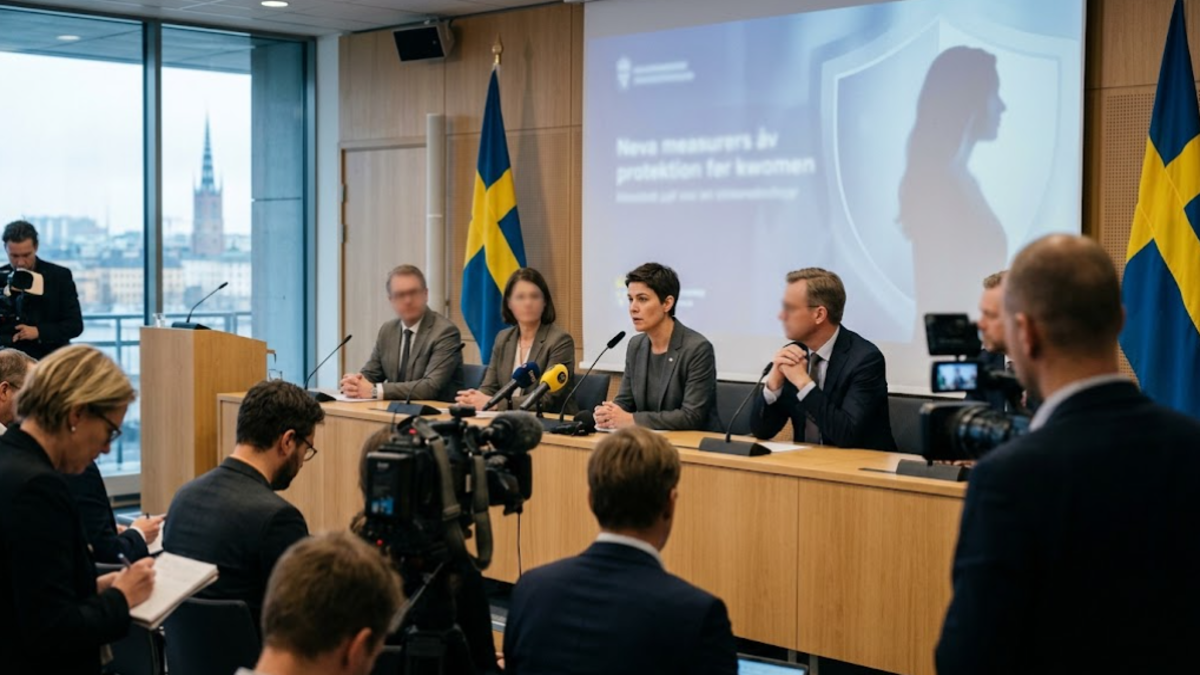
STOCKHOLM – Swedist: Swedish government measures against violence against women take center stage as ministers announce a broad new investigation into how Sweden can strengthen protection for women and girls. The package includes a possible new crime of femicide, a review of how women’s murders are investigated, tougher rules for repeated violations, and stronger protection against rape and sexual assault. What exactly will the new investigation examine, and why has the government chosen to act now?

Swedish government measures against violence against women put protection at the center
The Swedish Government presented a new package of measures on Friday aimed at strengthening the country’s response to men’s violence against women.
Justice Minister Gunnar Strömmer appeared at a press conference in Stockholm together with Gender Equality Minister Nina Larsson and Christian Democrats group leader Camilla Brodin. The government described the initiative as a strategic review of the continued work to prevent and combat violence against women.

The announcement does not introduce every measure immediately. Instead, the government has appointed a special investigator to examine several major areas of legislation, criminal justice and public protection.
According to the government’s presentation, the investigator will take a broad approach to the issue rather than focusing on a single type of crime. The aim is to identify weaknesses in the existing system and determine whether further legal or institutional changes are needed.
The investigation comes at a time when violence against women has become a prominent issue in Swedish political debate. Same-day Swedish media coverage highlighted the government’s decision to examine whether a formal review body should be used after every murder of a woman.
Swedish daily newspaper coverage reported that the proposed investigation will also consider femicide as a separate criminal offence, examine penalties for honour-based oppression and stalking, and review the legal protection surrounding rape, including sexual violence against older women.
The government says the investigation should take a strategic and comprehensive view of the problem. Its final report is due no later than September 3, 2029.
A possible new crime of femicide
One of the most significant elements of the announcement is the instruction to consider whether Sweden should introduce a specific criminal offence for femicide.
The government’s presentation says there may be reasons to make the intentional killing of girls or women more visible in criminal legislation. It also notes that the UN Committee on the Elimination of Discrimination against Women, known as CEDAW, has recommended that Sweden criminalise femicide.
The proposal does not mean that Sweden has already created a new crime. The investigator must first consider whether a separate legal classification would be appropriate.
That distinction matters. The government has asked for an assessment, not announced an immediate change to the criminal code.
The debate over femicide focuses on whether murders of women in contexts connected to gender-based violence should receive a clearer legal identity. Supporters of the idea argue that a specific offence could make the nature and scale of such killings more visible.
The government’s decision places that question inside a much broader review of protection against violence. The investigator will therefore have to assess how a possible femicide offence would fit within Sweden’s existing criminal justice system.
The announcement also links the question to the country’s stated goal of achieving a zero vision for lethal violence against women.
That goal already forms part of the government’s wider strategy on violence, oppression and exploitation. The Council for Women’s Peace, established earlier in the year, works across government authorities and institutions with the stated objective of preventing and combating men’s violence against women.
A review after every murdered woman
Another central proposal is the possibility of introducing a formal accident-investigation-style commission whenever a woman is murdered.
The investigator will review the rules governing investigations into serious injuries and deaths and consider whether Swedish law should change to better support the country’s zero vision for lethal violence against women.
The review will also examine how conclusions from such investigations can have a stronger practical impact.
The idea is significant because it shifts attention beyond the individual criminal case. A conventional criminal investigation focuses primarily on establishing what happened, identifying the perpetrator and determining criminal responsibility.
A broader investigation can ask different questions.
Were there warning signs? Did authorities have information that could have indicated a risk? Were protection measures available? Did agencies communicate effectively? Were previous incidents handled in a way that could have prevented further violence?
The government has therefore asked the investigator to examine the rules surrounding these wider reviews and determine whether they should become more systematic.
The proposal has also been prominent in political debate. The Moderates previously called for a commission to be established whenever a woman is murdered, describing it as part of efforts to prevent lethal violence against women.
The government’s investigation will now assess how such a model could work within the legal framework.
Stronger protection against rape and sexual assault
The new investigation will also examine Sweden’s criminal-law protection against rape and sexual assault.
One part of the assignment concerns older victims. The investigator must analyse whether the existing criminal-law protection against rape and sexual assault of older people is adequate.
That review comes alongside a broader examination of the most serious forms of rape.
The investigator will consider whether Sweden should introduce a new category of “particularly serious rape”. A corresponding question will also be examined in relation to rape against children.
The investigation will additionally evaluate how the existing provisions on negligent rape and negligent sexual assault work in practice.
These questions could become important for future Swedish criminal law because they concern both how offences are classified and how the justice system responds to different levels of seriousness.
The government has already pursued a series of changes to Sweden’s criminal justice system in recent years. The new investigation is intended to determine whether further adjustments are needed specifically in the area of violence against women.
Rather than limiting the review to one offence, the government has grouped rape, sexual assault, stalking, honour-based oppression and repeated violations into a wider examination of protection.
The government wants to identify weaknesses in the safety net
The announcement also focuses on what the government describes as weaknesses in society’s protective safety net.
The investigator will conduct a broad review of the responsibilities of public authorities and examine where protection may fail, particularly when risk factors are present.
The purpose is not simply to identify problems. According to the government, the review should determine what measures could address those weaknesses and help create a comprehensive and effective regulatory framework.
This part of the assignment is important because violence against women can involve several authorities and services.
Police, prosecutors, courts, healthcare providers, social services and other public institutions may all encounter different parts of the same situation. If information remains fragmented, warning signs can be missed even when individual organisations perform their own responsibilities.
The government wants the investigator to look at that wider system.
The question is therefore not only whether individual laws are sufficiently strict. It is also whether the institutions responsible for protecting women can identify risk, respond quickly and work together effectively.
That approach fits with the government’s broader national strategy, which aims for coordinated and sustainable action against men’s violence against women, domestic violence, exploitation in prostitution and human trafficking, as well as honour-based violence and oppression.
Repeated violence and stalking could face tougher penalties
The investigation will also examine the penalties attached to several offences involving repeated or systematic violations.
These include aggravated violations of a person’s peace, honour-based oppression and unlawful stalking.
The government’s presentation states that the investigator should consider whether the penalty scales for these offences need to change so that the criminal justice system more clearly reflects the seriousness of repeated and systematic violations.
The issue is particularly relevant to cases in which violence does not consist of one isolated incident.
Threats, harassment, stalking, intimidation and repeated violations can form a pattern over time. Such behaviour may restrict a victim’s freedom and create an ongoing risk even when individual incidents appear less serious when considered separately.
The government is therefore asking whether sentencing rules adequately reflect the cumulative seriousness of this kind of conduct.
The review will take place against a backdrop of wider changes to Swedish criminal law and sentencing policy. The government has said the aim is to ensure that repeated and systematic violations receive a response that reflects their full seriousness.
The question of stalking is also increasingly connected to digital communication and online harassment, an area already examined in recent Swedish legislative work.
A government inquiry previously proposed stronger responses to serious online violations and stalking as part of Sweden’s implementation of the European Union’s rules on combating violence against women and domestic violence.
Contact bans will also be evaluated
Another element of the announcement concerns Sweden’s reformed contact-ban legislation.
The government says a major reform of the contact-ban system entered into force on July 1, 2025. The new investigator will now evaluate whether that reform has produced the intended effects and determine whether additional measures are necessary.
Contact bans can play an important role in protecting people who face threats or violence from another person.
For women exposed to violence from a current or former partner, the effectiveness of such restrictions can be particularly important. A legal order is only one part of protection, however, and its practical impact depends on how effectively authorities identify risks and respond to violations.
The government’s review will therefore provide an opportunity to assess whether the reformed system is working as intended.
It also connects directly to the broader investigation into the safety net. If the authorities identify gaps between legal protection and practical enforcement, the investigator can consider whether further changes are required.
The investigation will examine psychiatric assessment rules
The new assignment also includes a review of when forensic psychiatric examinations can be ordered during criminal proceedings.
Under the current system, a forensic psychiatric examination can in certain circumstances take place at an early stage of a preliminary investigation.
The government says the current arrangement can be questioned and has asked the investigator to review at what point in the legal process a decision on such an examination should be possible.
This part of the assignment broadens the investigation beyond individual offences.
It reflects the government’s attempt to examine how different parts of the justice system interact when dealing with serious violence.
The investigator will therefore have to look at criminal law, sentencing, investigative procedures, protection measures and the relationship between authorities.
The final result could become an important basis for future reforms, but no conclusions have yet been reached on the individual questions.
A broader strategy behind Friday’s announcement
Friday’s announcement does not stand alone.
The Swedish Government has already adopted a long-term national strategy addressing men’s violence against women, domestic violence, exploitation and human trafficking, and honour-based violence and oppression. The strategy is intended to create more coordinated and sustainable action across government and public authorities.
The government also established the Council for Women’s Peace as a forum for cooperation between relevant authorities and organisations. The council’s work is guided by a zero vision for lethal violence against women.
In June, the government also highlighted sexual violence in the work of the council and discussed additional measures concerning protection and safety.
Against that background, the latest announcement represents another step toward a more comprehensive examination of the problem.
The timing is also politically significant. With Sweden preparing for a national election, violence against women has become a major issue in political debate.
However, the measures announced today go beyond campaign statements. The government has formally instructed an investigator to examine specific legal and institutional questions, with a deadline for a final report.
That means the immediate result is an investigation rather than a completed package of new laws.
What happens next?
The special investigator now has several areas to examine, ranging from femicide and lethal violence to rape, stalking, honour-based oppression and contact bans.
The investigator must also assess weaknesses in the public protection system and consider whether existing regulations provide adequate protection when risk factors are present.
The final report is due by September 3, 2029.
Until then, the questions raised at Friday’s press conference will remain under examination.
Among the most closely watched will be whether Sweden should create a specific crime of femicide, whether a commission should review every murder of a woman, and whether penalties for repeated violations should become tougher.
For victims and organisations working against violence, the practical test will ultimately be whether these reviews lead to faster intervention, stronger protection and a justice system capable of identifying dangerous situations before they become fatal.
FAQ
What did the Swedish Government announce today?
The government announced a broad investigation into measures to strengthen protection against men’s violence against women.
Will Sweden introduce a femicide law immediately?
No. The investigator has been asked to consider whether femicide should become a separate criminal offence.
Will every murder of a woman receive a special review?
The investigator will examine whether a formal investigation or commission should be conducted after every murder of a woman.
When will the investigation be completed?
The final report must be submitted no later than September 3, 2029.
Contact: info@alswedalyom.com