
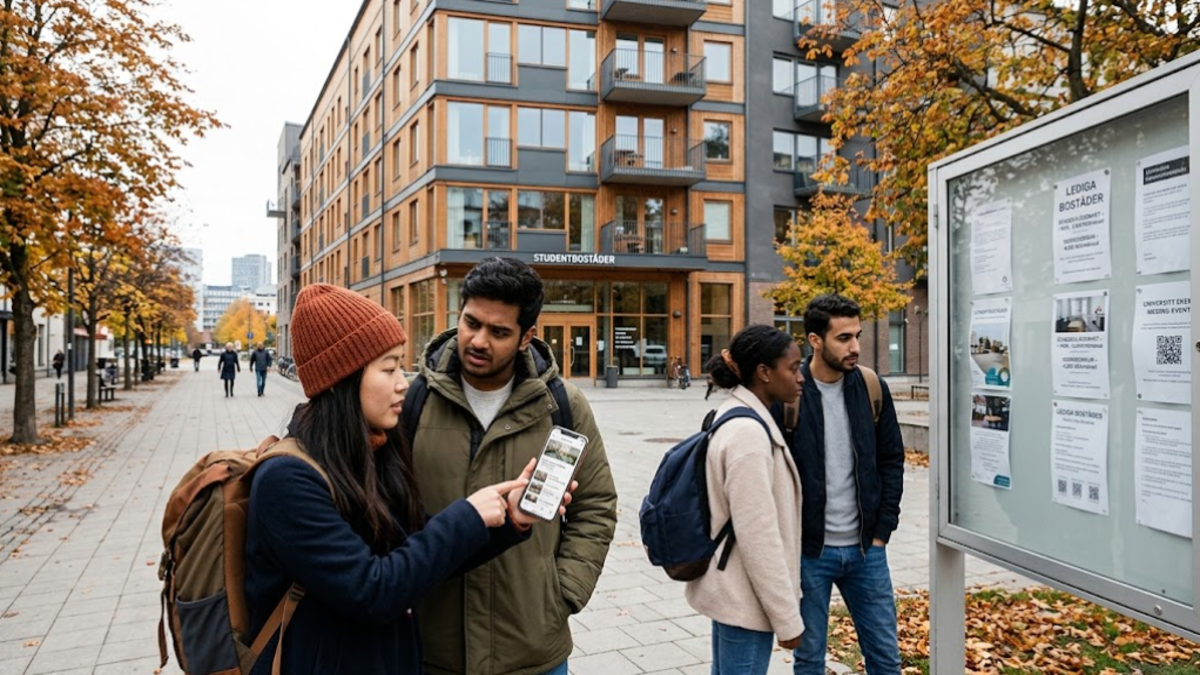
STOCKHOLM – Swedist: Sweden Student Accommodation Costs are once again at the centre of attention as thousands of students begin searching for rooms and apartments in the country’s biggest university cities. Recent housing reporting shows that Stockholm and Gothenburg remain the most difficult markets, while Uppsala and Lund have expanded student housing capacity. But how much should students actually expect to pay for accommodation across Sweden?

Sweden Student Accommodation Costs remain a major student concern
Finding somewhere to live can be almost as important as securing admission for students moving to Sweden. The country’s major university centres attract large numbers of domestic and international students, but the supply of affordable rooms does not always keep pace with demand.
Recent reporting on Sweden’s student housing market indicates that Stockholm and Gothenburg continue to face the greatest pressure. The Swedish National Union of Students’ latest housing report found that the situation has improved in some areas, but the two largest university cities remain particularly challenging for students looking for accommodation.

Stockholm stands out for the length of its housing queues. The latest figures reported by The Local put the average waiting time for a student apartment in the capital at 4.7 years. That figure illustrates why students who wait until shortly before their studies begin can face serious difficulties.
Gothenburg also has a substantial shortage. Students may wait between 14 and 15 months for a room, according to the same recent reporting. The city had promised thousands of additional student homes over the past decade, but only around 2,000 of 7,000 promised units had been built.
The situation is not identical throughout the country. Uppsala and Lund have made notable progress in expanding their student accommodation stock, with both cities completing major housing projects.
That does not mean students can assume a room will be immediately available. Competition remains strong, particularly around the start of the autumn semester, when large numbers of students arrive at the same time.
For international students, the challenge can be even more significant because they may not have accumulated time in local housing queues before arriving.
Stockholm: Sweden’s most expensive and competitive student market
Stockholm is one of Sweden’s most attractive destinations for higher education, but it is also one of the most demanding places for students searching for affordable accommodation.
Current rental-market data show a wide range of prices. A live student-housing market snapshot available today puts the median advertised rental price in Stockholm at about €1,264, while the average across the tracked rental market is around €1,418. The available properties range from comparatively inexpensive rooms to much more costly apartments.
Those figures cover a broader rental market rather than only traditional student rooms, so students should not treat them as a standard student-rent tariff. The actual amount depends heavily on whether the student rents a corridor room, a room in a shared apartment, a studio or a complete apartment.
Student-specific accommodation can be considerably cheaper than private-market apartments. A current Swedish student-housing guide lists corridor rooms in Stockholm at roughly SEK 3,800 to SEK 5,200 per month.
The lower end is particularly attractive to students working with tight budgets because corridor accommodation normally provides a private bedroom while kitchen and other communal areas are shared.
The trade-off is availability. Cheaper student rooms are often the properties that attract the greatest demand, meaning that a lower monthly rent can come with a much longer wait.
Students who cannot secure official student accommodation may turn to private rooms or shared apartments. This can provide a faster solution, but private rental prices can vary sharply depending on neighbourhood, size, furnishings and distance from central Stockholm.
For students planning their budget, Stockholm therefore requires two separate calculations: the rent itself and the likelihood that a cheaper student property will actually be available when needed.
Gothenburg: high demand and limited student housing
Gothenburg offers another difficult housing market for students. The University of Gothenburg warns prospective students that accommodation can be scarce and recommends beginning the housing search as early as possible.
The university says students may wait a year or more for student housing, particularly around the autumn semester. It also points out that spring can be easier because fewer programmes begin at that time.
Rent varies according to the type of property. The University of Gothenburg currently estimates student housing for a single household at approximately SEK 4,000–7,500 per month. Small apartments and private accommodation can cost about SEK 6,000–10,000 per month.
Location makes a considerable difference. Rooms and apartments closer to the centre generally cost more, while students willing to live farther away can find more options.
Gothenburg’s public transport network gives students an important advantage. Living outside the central districts does not necessarily mean being disconnected from university life, and the university specifically encourages students to widen their search beyond the city centre.
The city’s student housing operator, SGS, manages a large share of accommodation aimed at students. However, demand remains strong enough that students are advised to join queues and investigate several alternatives rather than relying on one housing provider.
The latest national housing report reinforces that picture. Gothenburg remains one of the Swedish cities where students have the greatest difficulty finding a home, despite improvements in the overall supply.
Uppsala: more housing, but demand remains strong
Uppsala has long been associated with university life in Sweden and remains one of the country’s most important student cities.
Recent housing reporting offers some encouraging news. Uppsala is among the cities that have made significant progress in expanding student accommodation, with major construction projects adding to the available supply.
That additional supply can make Uppsala more attractive to students who are trying to balance rent and housing availability.
A current student accommodation guide places corridor-room rents offered through major student housing providers in Uppsala at roughly SEK 3,200–4,600 per month, depending on the provider and property.
The figures illustrate an important point about Sweden’s housing system: a city can be cheaper than Stockholm without being easy to enter. Students must consider both the monthly rent and the time required to secure a contract.
Uppsala’s student accommodation market also includes rooms with shared kitchens and bathrooms, studios and other forms of student housing. Shared facilities usually allow students to keep rent lower than they would pay for a private apartment.
For students who can plan well in advance, Uppsala may therefore provide a stronger combination of affordability and availability than the capital.
Lund: student accommodation with improving supply
Lund is another major university destination where accommodation plays a central role in student planning.
The city’s housing situation has also benefited from new student accommodation projects. Recent national reporting identifies Lund, alongside Uppsala, as one of the traditional university cities that has done the most to increase student housing capacity.
Lund University says accommodation prices vary according to the type and location of housing. For rooms rented through LU Accommodation, current semester costs range from approximately SEK 26,000 to SEK 54,000 for the full semester, with electricity, water, heating, furniture and several basic facilities included.
That semester-based figure translates into a broad monthly range because contracts and accommodation types differ.
Earlier published university guidance has also placed typical LU Accommodation rents around SEK 4,000–7,000 per month, depending on the property offered.
Students should pay attention to what the rent includes. A room that appears more expensive may include heating, electricity, furniture and access to laundry facilities, while a cheaper private room could involve additional bills.
Lund also has an important advantage for international students: some categories of students can receive housing guarantees through the university’s accommodation system. However, the guarantee does not apply to every student, so applicants need to check their eligibility before relying on it.
Lund University recommends that students without a housing guarantee apply through several providers and arrange accommodation before arriving whenever possible.
Malmö and other university cities
Malmö provides another option for students who want to study in southern Sweden. It is closely connected to Lund and offers its own university environment, while its location gives students access to the wider Öresund region.
Housing costs can differ significantly within Malmö depending on whether students rent a room, share an apartment or take a private studio.
The broader Swedish student market also includes cities such as Linköping, Umeå, Örebro, Växjö and Jönköping. These locations can offer alternatives to the country’s most pressured housing markets.
A current student-housing price guide lists corridor rooms in Linköping at around SEK 3,000–4,000 per month, while accommodation through student providers across several Swedish cities can fall within a similar lower-cost range.
This does not mean every property in these cities is available at those prices. The type of accommodation, neighbourhood, contract and housing provider all influence the final cost.
Students should therefore use city-wide figures as planning indicators rather than guaranteed prices.
What students should budget beyond rent
Rent is usually the largest single housing expense, but it is not the only cost students should consider.
A room may come furnished or unfurnished. Some contracts include electricity, heating, water and internet, while others require students to pay some or all of these costs separately.
Deposits can also affect the amount of money needed before moving in. Lund University, for example, notes that students using LU Accommodation must pay a deposit and a one-time cleaning charge when accepting certain housing contracts. The deposit is refundable after the student moves out, subject to the applicable conditions.
Private rentals require particular care. Students searching under time pressure can become vulnerable to fraudulent advertisements and requests for deposits before they have properly verified the landlord or property.
Universities repeatedly advise students to use established housing providers and to be cautious when dealing with private landlords.
Students should also account for food, transportation, mobile services, study materials and personal expenses. A low rent does not necessarily produce the lowest overall budget if the property is far from campus and requires substantial commuting costs.
For international students, currency fluctuations can also affect the real cost when funds come from another country.
Sweden Student Accommodation Costs: which city offers the best value?
There is no single answer because affordability depends on both rent and availability.
Stockholm generally presents the greatest financial and practical challenge. The city has high private rental prices and one of the longest student-housing queues in the country.
Gothenburg follows a similar pattern, although students can find more affordable options by considering accommodation outside the city centre and registering with housing providers early.
Uppsala and Lund appear more favourable for students who can access student accommodation, particularly following recent additions to the housing supply.
Smaller university cities may offer another route for students who place affordability above living in Sweden’s largest metropolitan areas.
The most important lesson from the latest housing picture is that the cheapest advertised room is not necessarily the most realistic option. A student who waits for a highly affordable room without joining queues early could eventually spend more on short-term or private accommodation.
Planning is therefore part of the cost calculation.
How students can reduce accommodation expenses
Students can take several practical steps to keep housing costs under control.
The first is to register with student housing providers as early as possible. In cities with long queues, time in the system can be extremely valuable.
The second is to consider shared accommodation. Sharing a kitchen, living room or apartment can reduce the monthly cost compared with renting a private studio.
The third is to expand the geographic search. Students who focus exclusively on central districts face stronger competition and generally higher prices. Gothenburg University specifically recommends considering areas outside the city centre.
Students should also compare what each contract includes. Heating, electricity, water, furniture and internet can make a meaningful difference to the final monthly budget.
For international students, it is also worth contacting the university’s international office or housing service before arrival. Some universities have specific accommodation arrangements for exchange students and fee-paying students.
The University of Gothenburg, for example, provides a limited number of rooms and apartments for eligible exchange and fee-paying students through its Academic Housing service.
Finally, students should avoid making rushed payments to unverified landlords. The pressure to secure a room can make applicants more vulnerable to scams, especially during the busy period before a new semester.
The outlook for Sweden’s student housing market
The latest evidence presents a mixed picture.
On one hand, student accommodation supply has improved in several important university cities. Uppsala and Lund have added housing, while national reporting indicates that overall availability has increased compared with the previous period.
On the other hand, the improvements have not eliminated shortages. Stockholm and Gothenburg continue to face major difficulties, and long queues remain a defining feature of the student housing market.
That contrast is likely to shape the decisions of students choosing where to study. A university in a highly competitive city can offer excellent academic opportunities, but students must factor accommodation into their decision from the beginning.
For prospective students, the safest strategy is simple: research rents before accepting a study place, join housing queues as soon as possible, consider shared accommodation and keep several neighbourhoods or cities in mind.
The headline figure for rent matters, but availability may matter even more.
FAQ
How much does student accommodation cost in Sweden?
Student housing commonly ranges from about SEK 3,000 to SEK 7,500 per month, depending on the city, property and contract.
Which Swedish city is hardest for student housing?
Stockholm and Gothenburg currently face some of the country’s most serious student-housing pressures.
Is Lund cheaper than Stockholm for students?
Lund generally offers more affordable student-housing options than Stockholm, although prices vary by accommodation type and availability.
How can students find cheaper housing in Sweden?
Joining housing queues early, considering shared accommodation and searching outside city centres can improve the chances of finding a lower-cost room.
Contact: info@alswedalyom.com