

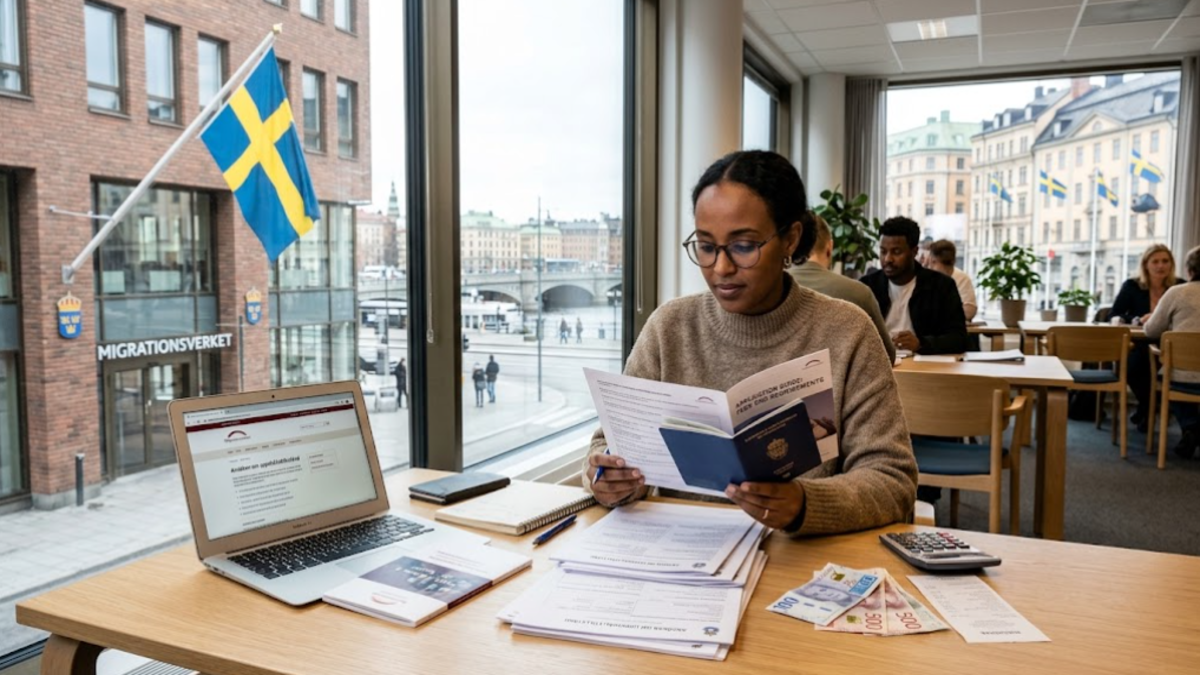
STOCKHOLM – Swedist: Sweden Residence Permit Application Fees vary according to the reason a person wants to live in the country, with applicants for work, studies, family reunification and other forms of residence facing different charges. The Swedish Migration Agency says some applicants are exempt from paying altogether, while fees paid for unsuccessful applications are generally not refunded. So, how much should people planning to move to Sweden actually budget for their residence permit application?

Recent immigration coverage has again put Sweden’s residence system under scrutiny as the country continues to tighten migration rules and review how residence rights are granted. At the same time, the practical cost of submitting an application remains an important issue for foreign workers, international students and families planning a move.
The key point for applicants is that there is no single Sweden Residence Permit Application Fee. The amount depends on the category under which the application is submitted and, in several categories, whether the applicant is an adult or a child.

Sweden Residence Permit Application Fees depend on the permit type
The Swedish Migration Agency sets different charges for different residence routes. Applicants therefore need to identify the correct category before calculating how much their application will cost.
For people applying for a Swedish work permit, the fee for the employee is SEK 2,200. An adult family member applying alongside the worker pays SEK 1,500, while a child under the age of 18 pays SEK 750.
This means that a worker moving to Sweden with a spouse and one child would face a combined application charge of SEK 4,450, assuming all three applicants are subject to the standard fees.
The Swedish Migration Agency also states that Japanese citizens do not pay an application fee for work permits. Applicants should therefore check whether a nationality-based exemption applies to their circumstances before making payment.
For family-based residence permits, the standard charge is different. An adult applying to live with a partner, parent or another relative in Sweden generally pays SEK 2,000, while a child under 18 pays SEK 1,000.
These figures are particularly relevant to people moving to Sweden to join close family members. The Migration Agency makes clear that the application fee is separate from the substantive requirements for obtaining the permit.
Sweden Residence Permit Application Fees for workers and families
Work migration remains one of the most important routes for people seeking long-term residence in Sweden. The application fee, however, is only one part of the financial planning involved.
A worker applying for a permit pays SEK 2,200 under the standard fee schedule. Family members who apply with the worker are charged separately according to their age. This distinction matters because the total amount can rise significantly when several people submit applications at the same time.
The same principle applies to other employment-related residence applications. For example, people seeking a residence permit after completing studies or research and looking for employment face a fee of SEK 1,500 as adults. Adult family members also pay SEK 1,500, while children pay SEK 750.
The cost should therefore be calculated on a family-by-family basis rather than using a single figure advertised for a particular migration route.
This distinction has become more significant as Sweden has introduced changes affecting work permits. The Swedish Migration Agency has announced stricter rules concerning employment-based permits, including a salary requirement linked to the Swedish median salary and additional grounds on which applications can be rejected.
The application fee does not guarantee approval. It is a processing charge, meaning applicants remain responsible for satisfying all eligibility requirements after payment.
Study permits carry their own application costs
International students are another major group affected by Sweden’s residence permit system.
A person coming to Sweden for higher education generally needs a residence permit when the course requires a stay beyond the short-visit period. The financial requirements attached to student applications are separate from the application fee itself.
The Swedish Migration Agency’s current information shows that students must demonstrate sufficient funds for their stay. The required amount can also change depending on whether the applicant receives free food or accommodation and whether family members accompany the student.
This makes it important for prospective students to distinguish between the residence permit application fee and the wider financial evidence required for the permit.
The fee itself is generally SEK 1,500 for an adult applicant under the standard study residence permit category, while children applying under relevant categories can face a lower charge.
Family members can add further costs. Changes affecting international students and their accompanying relatives have also attracted attention, with Swedish universities warning applicants that new migration rules can alter requirements for family members and study-related residence arrangements.
Students should therefore check the applicable category before submitting an application rather than relying on figures from older immigration guides.
What students should budget for
The application fee is only one expense facing an international student.
Applicants may also need to account for tuition, accommodation, travel, insurance and proof of sufficient funds. None of those expenses should be confused with the government application charge.
A student who pays the residence permit fee but fails to meet another requirement can still receive a refusal. The Migration Agency also states that application fees are not normally refunded when an application is rejected.
That makes accurate documentation just as important as having enough money to pay the fee.
Family reunification applications cost SEK 2,000 for adults
For people seeking to join family members in Sweden, the standard fee is SEK 2,000 for adults and SEK 1,000 for children under 18.
The fee applies to several applications involving family ties, including people who want to live with a partner or another relative in Sweden.
However, important exemptions exist.
The Swedish Migration Agency says family members of EU/EEA citizens generally do not pay a fee for residence permit applications under the relevant rules. EU/EEA citizens themselves are also exempt in applicable cases, while Swiss citizens and their family members can also qualify for exemption. Japanese citizens are another group specifically identified as fee-exempt in the relevant guidance.
There are also special exemptions for certain family members of people who have received residence permits in Sweden because they need protection or because of exceptionally distressing circumstances.
These exemptions mean that two people making apparently similar family applications could face completely different costs depending on their legal status and nationality.
Applicants should therefore establish their eligibility before paying.
Some residence permit applications cost SEK 1,500
Not every residence permit route has the SEK 2,000 or SEK 2,200 charge.
For certain categories, the standard adult fee is SEK 1,500, with children paying SEK 750.
The Migration Agency applies this fee, for example, to some applications for people with long-term resident status in another EU country. In that category, adults pay SEK 1,500 and children pay SEK 750.
The same adult and child amounts also appear for certain extended-stay visitor permits. An adult applying for a residence permit for a visit lasting more than 90 days pays SEK 1,500, while a child pays SEK 750.
People who have completed studies and are applying for a residence permit to seek employment can also face the SEK 1,500 adult fee, with a SEK 750 charge for children.
The differences underline why applicants should not rely on a general statement such as “a Swedish residence permit costs SEK 2,000”. There is no universal fee.
Permanent and long-term residence have separate rules
Applicants also need to distinguish between a temporary residence permit and long-term resident status.
The Swedish Migration Agency currently lists a fee of SEK 1,000 for adults and SEK 500 for children for an application for long-term resident status in Sweden.
That is different from several other residence-related applications.
The agency also warns that people who are uncertain whether they meet the requirements may choose to submit an application for long-term resident status together with an application to extend their existing residence permit. In such cases, applicants can be required to pay the fee for both applications.
This is an important financial detail because submitting two applications can result in two separate government charges.
The distinction has become particularly relevant amid Sweden’s broader migration-policy changes. Recent official announcements have included changes affecting permanent residence for people whose permits are based on protection, reflecting a wider policy shift in the country’s approach to migration and residence rights.
The application fee is not a guarantee of approval
Paying the correct fee is necessary in categories where a charge applies, but it does not mean the application will be accepted.
The Migration Agency evaluates the applicant against the legal requirements for the specific permit. Depending on the category, this can involve employment conditions, family relationships, study admission, financial maintenance, identity documents and other evidence.
Applicants should therefore treat the fee as the cost of having an application considered rather than as a payment for a residence permit itself.
The agency also makes clear that applicants generally do not receive a refund if their application is rejected.
That rule makes the quality of the application particularly important.
Incomplete applications can lead to requests for additional information, while missing or incorrect documents can complicate the assessment. Applicants should make sure they understand the specific requirements of their permit category before submitting the form and paying the charge.
Who can apply without paying a fee?
Sweden’s residence system includes several fee exemptions.
Among the groups identified by the Swedish Migration Agency are EU/EEA citizens and qualifying family members, Swiss citizens and their family members, and Japanese citizens in categories where the exemption applies.
Certain people applying on the basis of family ties to a person who has received protection in Sweden can also be exempt, depending on the circumstances and the basis of the family member’s permit.
Nordic citizens and some family members of Nordic citizens also benefit from specific rules under the relevant residence framework.
The exemptions are not interchangeable, however. A person should not assume that having a Swedish relative automatically means the application is free.
The Migration Agency specifically notes that Swedish citizens do not count as EU citizens for the particular EU/EEA family-member exemption. This is an important distinction for applicants joining Swedish citizens.
What recent migration news means for applicants
The cost question comes at a time when Sweden’s immigration system is undergoing significant change.
Recent reporting has highlighted cases involving residence rights after Brexit, including British nationals who have faced difficulties with applications for post-Brexit residency. The Guardian recently reported on cases involving elderly British residents who have been ordered to leave Sweden after losing migration appeals.
The cases illustrate a broader point for anyone dealing with Swedish immigration authorities: deadlines, legal status and documentation can be decisive.
At the same time, the Swedish government has continued to pursue reforms designed to tighten migration policy and strengthen integration. Official government information describes an overhaul of migration and integration policy, while the Migration Agency has announced several changes affecting workers, students and people seeking long-term residence.
For prospective applicants, this means that an older article or social-media post may no longer provide a reliable picture of the current rules.
Where applicants should verify the fee before paying
The safest source for the final amount is the Swedish Migration Agency’s own application guidance for the exact permit category.
The agency’s pages provide category-specific fees and identify exemptions. Applicants should check the relevant page immediately before submitting an application because immigration rules and administrative charges can change.
News reports can provide useful context, particularly when Sweden introduces new migration legislation, but the official authority remains the best source for the amount payable on an individual application.
This is especially important for families, where several separate application fees may apply.
A simple breakdown of the main fees
For a quick reference, the commonly encountered charges are:
- Work permit: SEK 2,200 for the employee.
- Adult family member of a worker: SEK 1,500.
- Child family member of a worker: SEK 750.
- Family reunification: SEK 2,000 for an adult and SEK 1,000 for a child.
- Several study-related residence applications: SEK 1,500 for an adult and SEK 750 for a child.
- Extended visitor residence permit: SEK 1,500 for an adult and SEK 750 for a child.
- Long-term resident status: SEK 1,000 for an adult and SEK 500 for a child.
These figures are category-specific rather than a universal Swedish residence permit charge. The exact fee depends on the application being submitted and any exemption that applies.
Applicants should also remember that fees are generally non-refundable after a refusal.
The cost is only one part of moving to Sweden
For prospective migrants, the government application fee can look like the most obvious expense, but it is rarely the largest cost associated with relocation.
Workers need to consider accommodation and living expenses. Students may face tuition and housing costs. Families may need to demonstrate sufficient funds and provide documents for every applicant.
The financial requirements can therefore be substantially greater than the fee shown on the application form.
For this reason, anyone planning to move to Sweden should prepare a complete budget before starting the residence permit process.
The financial calculation should include the government application charge, travel, accommodation, document preparation, translations where required and other expenses connected with establishing residence.
At the same time, applicants should avoid paying unofficial intermediaries simply because they promise faster approval. The Migration Agency determines whether a permit is granted, and paying a third party does not replace the legal requirements of the application.
What applicants should remember
The most important lesson is that Sweden Residence Permit Application Fees depend on the route chosen.
A worker generally pays SEK 2,200, while an adult joining family can pay SEK 2,000. Several categories use a SEK 1,500 adult fee, and long-term resident status has a lower application charge.
Children normally pay less in the categories where a fee applies.
There are also significant exemptions, particularly for certain EU/EEA and Swiss nationals and family members, Japanese citizens in specified categories and some people covered by protection-related provisions.
Because Sweden’s migration rules are changing, applicants should not assume that a fee found in an old article remains valid.
The latest official information should always be checked before payment, especially where an application involves several family members or more than one residence category.
FAQ
How much does a Swedish work permit cost?
The standard application fee for a worker is SEK 2,200. Adult accompanying family members pay SEK 1,500 and children pay SEK 750.
How much does family reunification cost?
The standard fee is SEK 2,000 for adults and SEK 1,000 for children under 18. Some applicants are exempt.
Is the residence permit fee refunded if the application is rejected?
No. The Swedish Migration Agency states that the application fee is not refunded when an application is rejected.
Do all applicants have to pay?
No. Certain EU/EEA and Swiss nationals and family members, Japanese citizens in applicable categories and some protection-related applicants can be exempt from fees.
Contact: info@alswedalyom.com