

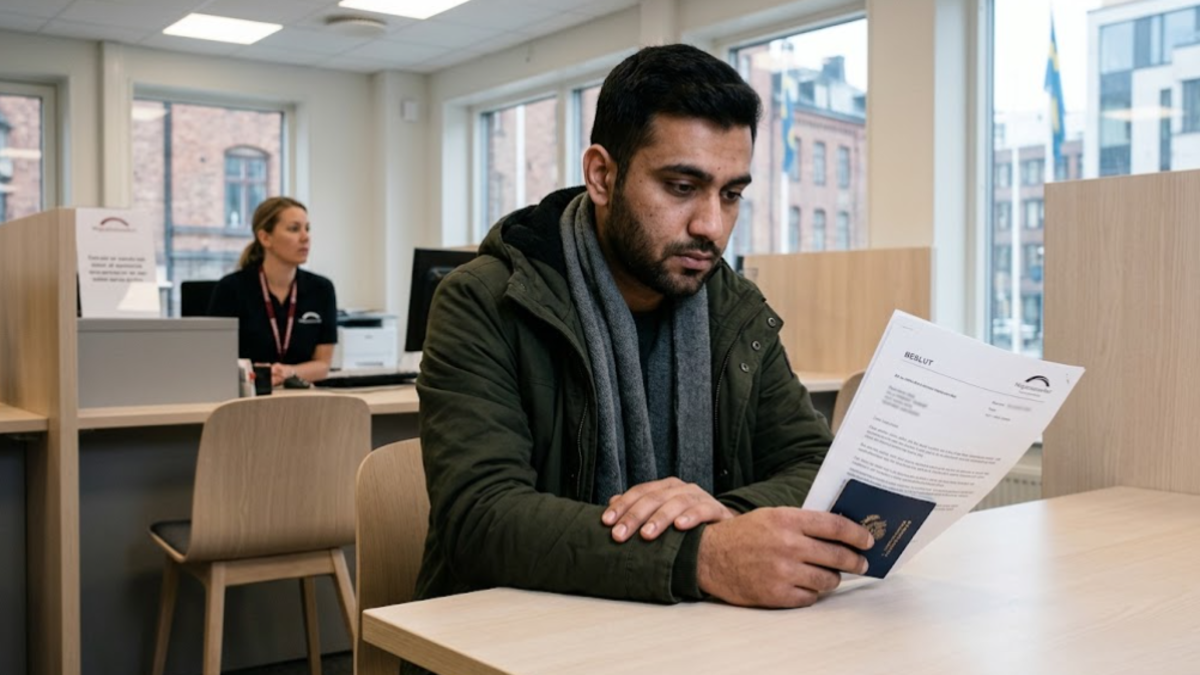
STOCKHOLM – Swedist: Sweden Residence Permit Rejection has become a growing concern for foreign nationals seeking to live, work, study or reunite with family in Sweden, with recent cases highlighting how incomplete documentation, missed deadlines, employment conditions and conduct assessments can affect an application. But what are the most common reasons behind a Swedish residence permit being refused?

Recent news coverage has drawn particular attention to the strict application of Sweden’s immigration rules. Several British citizens who lived in Sweden for many years have faced removal after their applications for post-Brexit residence rights were rejected, while the Swedish Migration Agency has also introduced or clarified stricter requirements affecting work, study and family-based applications.
For applicants, the cases underline an important point: having lived in Sweden for a long time, having a Swedish family connection or having a job does not automatically guarantee a residence permit. The Migration Agency examines whether the legal requirements for the particular type of permit have been met and whether the evidence submitted supports the application.

Sweden Residence Permit Rejection: Missing or Insufficient Documents
One of the clearest reasons for a Sweden Residence Permit Rejection is failure to provide documents that demonstrate eligibility for the permit.
This issue has featured prominently in recent reporting on British nationals who sought to establish residence rights in Sweden after Brexit. In one widely reported case, a British man who had lived in Sweden for decades was refused because documents had not been submitted demonstrating that he met the requirements for the relevant right of residence. His family subsequently challenged the decision.
Documentation requirements vary according to the residence permit category. A person applying for work, for example, may need evidence concerning employment, salary and the conditions of the job. A student needs to demonstrate that the requirements for studying in Sweden are satisfied, while applicants seeking to live with family members must establish the relevant relationship and meet the applicable conditions.
The Swedish Migration Agency makes clear that applicants should read the decision carefully because it explains the reasons behind a refusal and the available appeal procedure.
A missing document is not necessarily the only problem. Information that is inconsistent, incomplete or insufficient to establish that an applicant meets the legal requirements can also become decisive.
That is why applicants should not treat the document checklist as a formality. Evidence must support the claims made in the application.
Sweden Residence Permit Rejection and Missed Deadlines
Another issue receiving significant attention is the failure to apply within the required period.
Recent cases involving British citizens have highlighted the consequences of late applications under the post-Brexit residence system. One elderly British woman who had lived in Sweden for more than two decades was told to leave after authorities considered her application late. Her case became part of a broader debate over how Sweden handles applications submitted after the relevant deadline.
Swedish authorities have said that late applications can still be considered in exceptional circumstances when applicants provide an explanation showing why they were unable to apply within the prescribed period. However, simply saying that the applicant did not know an application was required is not, by itself, considered sufficient.
The issue has attracted attention because Sweden’s refusal rate for post-Brexit residence applications has been substantially higher than in other European Union countries, according to figures cited in recent reporting. The European Commission’s figures referenced by the Guardian indicated that almost 4,000 applications had been refused out of around 14,200 applications in Sweden.
These cases concern a specific residence-rights system and should not be interpreted as a general refusal rate for every Swedish residence permit category.
Nevertheless, they demonstrate why deadlines matter. Applicants should establish which deadline applies to their particular permit and keep evidence showing when applications and supporting documents were submitted.
Work Permit Problems Can Lead to Refusal
Employment-based applications face their own set of requirements.
The Swedish Migration Agency says that a person applying for a permit to work, run a business or look for employment can have the application rejected if the relevant requirements are not fulfilled. A rejected applicant who is in Sweden may also have to leave, depending on the decision and its legal status.
Salary requirements are particularly important for work-permit applicants.
Recent Swedish rules have increased the financial threshold for certain work permits. The Migration Agency reported that the applicable salary requirement was linked to 90 percent of the country’s median salary, producing a monthly threshold of SEK 34,470 after Statistics Sweden updated the median figure.
This means that an employment contract alone may not be enough. The salary and other employment conditions must satisfy the applicable requirements.
Employers can also become relevant to the assessment. The Migration Agency has stated that, under newer rules, certain shortcomings on the employer’s side can result in a work-permit application being rejected. Examples can include specified offences or sanctions involving the employer.
For applicants, this is significant because a residence or work permit application is not assessed solely on the worker’s personal qualifications. The employment arrangement itself must meet Swedish requirements.
Study Applications Face New Requirements
Students are another group affected by changing residence-permit rules.
The Swedish Parliament has introduced changes concerning residence permits for higher education, including limitations on work alongside studies and stronger requirements relating to study results. The Migration Agency has also explained that students at bachelor’s or master’s level generally face a limit of 15 hours of work per week during semesters under the newer rules, with specific exceptions.
This creates another potential route to a residence permit refusal or problems with an extension.
For example, the Migration Agency states that an extension application may be refused if a student has worked beyond the permitted limit. The authority can also withdraw a permit in certain circumstances where the work restrictions have been breached.
Students should therefore distinguish between being legally allowed to study and being legally allowed to work while studying. The conditions attached to a residence permit matter throughout the permit period, not only when the original application is submitted.
Study applicants must also demonstrate that they meet the financial and educational requirements applicable to their circumstances.
The Migration Agency says that private individuals cannot act as sponsors for higher-education residence permits. Funds provided by relatives, for example, must be treated as the applicant’s personal bank assets and be held in an account the applicant can access. Employment income also requires supporting evidence such as an employment certificate and, where relevant, payslips.
Good Conduct Is Becoming More Important
A significant recent development concerns the assessment of good conduct.
Sweden has introduced stricter requirements under which authorities assess not only whether an applicant has committed offences but also whether the person is law-abiding and honest, supports themselves honestly and poses a threat to public order.
The Migration Agency has said that authorities can consider unpaid debts, inaccurate information connected with social insurance or benefits, and information indicating links to criminal, terrorist or extremist organisations.
The rules do not mean that every minor incident will automatically result in a refusal.
The Migration Agency says isolated and minor incidents will normally not be enough on their own to justify refusing or withdrawing a residence permit. Repeated behaviour can, however, become relevant to the assessment.
The authority also weighs misconduct against the reasons supporting the residence permit. Where the grounds for granting residence are particularly strong, more serious misconduct may be required before the behaviour becomes decisive.
For applicants, the practical message is straightforward: accuracy and compliance matter throughout the immigration process.
Family Residence Applications Also Require Evidence
Family reunification and applications to live with another person in Sweden can also be refused when the legal conditions have not been established.
Applicants should be prepared to prove the relationship forming the basis of the application and provide the documents requested by the authorities. The exact requirements depend on the applicant’s situation and the residence category being used.
The Migration Agency’s procedures also show that applicants may be required to verify their identity and present their passports. In some cases, digital passport checks are available, while others may involve an embassy or consulate visit.
The existence of a family relationship does not therefore remove the need to satisfy the other conditions attached to the application.
Recent British cases illustrate the wider principle. Long residence, family ties and personal circumstances can become important factors in an appeal, but they do not necessarily override the statutory requirements governing residence rights.
Why Personal Circumstances May Not Be Enough
Some recent cases have raised difficult questions about proportionality and humanitarian circumstances.
One case involved a British man with severe dementia who had lived in Sweden for many years. His family argued that his medical condition and dependence on care in Sweden should be taken into account. The Migration Court of Appeals nevertheless rejected the challenge, finding that the immigration-control interest outweighed the personal circumstances in that case.
Such cases show why applicants should not assume that sympathetic circumstances automatically lead to a residence permit.
The legal basis of the application remains central.
What Happens After a Sweden Residence Permit Rejection?
A refusal does not necessarily mean that every legal avenue has ended.
The Swedish Migration Agency states that applicants can appeal many residence-permit decisions. The decision itself explains whether an appeal is possible and gives information about the deadline and procedure. If an appeal is submitted, a court can review the Migration Agency’s decision.
However, applicants should act quickly.
Missing the appeal deadline can have serious consequences. The precise rights of an applicant during an appeal also depend on the type of permit and the wording of the decision.
The Migration Agency says that a person whose work-permit application has been rejected may have to leave Sweden and the Schengen area. The authority also explains that the decision will specify the applicable arrangements and whether the person can remain while an appeal is being examined.
Anyone receiving a refusal should therefore read the complete decision rather than relying on an informal explanation of what happened.
How Applicants Can Reduce the Risk of Refusal
The recent cases and rule changes point to several practical lessons for people preparing a Swedish residence application.
First, applicants should identify the correct permit category before submitting an application. Work, study, family and other residence routes have different legal requirements.
Second, every statement in the application should be supported by appropriate evidence. Employment claims should be backed by employment documentation, financial claims by acceptable financial evidence and family claims by documents establishing the relevant relationship.
Third, applicants should monitor deadlines carefully. The cases involving late post-Brexit applications demonstrate that assuming authorities will accept a late submission can be risky.
Fourth, applicants should remain compliant after receiving a permit. A permit is not necessarily unconditional. Students, for example, face restrictions concerning work, while work-permit holders must continue to satisfy the conditions attached to their employment.
Finally, applicants should take a refusal seriously. The decision normally sets out why the application failed and whether an appeal is available. Understanding that reasoning is essential before deciding what to do next.
The Bigger Picture
Recent reporting suggests that Sweden is applying immigration rules with increasing scrutiny, while applicants face a changing regulatory environment.
The most visible cases have involved British nationals affected by post-Brexit residence rules, but other changes affect workers, students and people seeking residence on family grounds.
For workers, salary and employer conditions can be decisive. For students, academic progress, finances and restrictions on employment can matter. For family applicants, evidence of eligibility remains essential. Across categories, authorities can also consider compliance and conduct.
A Sweden Residence Permit Rejection is therefore rarely explained by a single universal rule. The decisive issue is usually whether the applicant has demonstrated that all the requirements for the specific permit have been met.
For anyone preparing an application, the safest approach is to work from the requirements applicable to the precise permit category, submit complete and accurate evidence and respond promptly to requests from the Migration Agency.
FAQ
Why can Sweden reject a residence permit?
Applications can be refused when an applicant does not meet the legal requirements, fails to provide sufficient evidence, misses applicable deadlines or, in relevant cases, does not satisfy employment, study, financial or conduct requirements.
Can I appeal a Sweden Residence Permit Rejection?
In many cases, yes. The refusal decision explains whether an appeal is available, how to submit it and the applicable deadline.
Can a late application be accepted?
In some specific circumstances, a late application may be considered, but the applicant generally needs to provide an explanation demonstrating why the deadline could not be met.
Does having a Swedish job guarantee residence?
No. A job alone does not guarantee a permit. The employment, salary, employer and other applicable requirements must satisfy Swedish immigration rules.
Contact: info@alswedalyom.com