

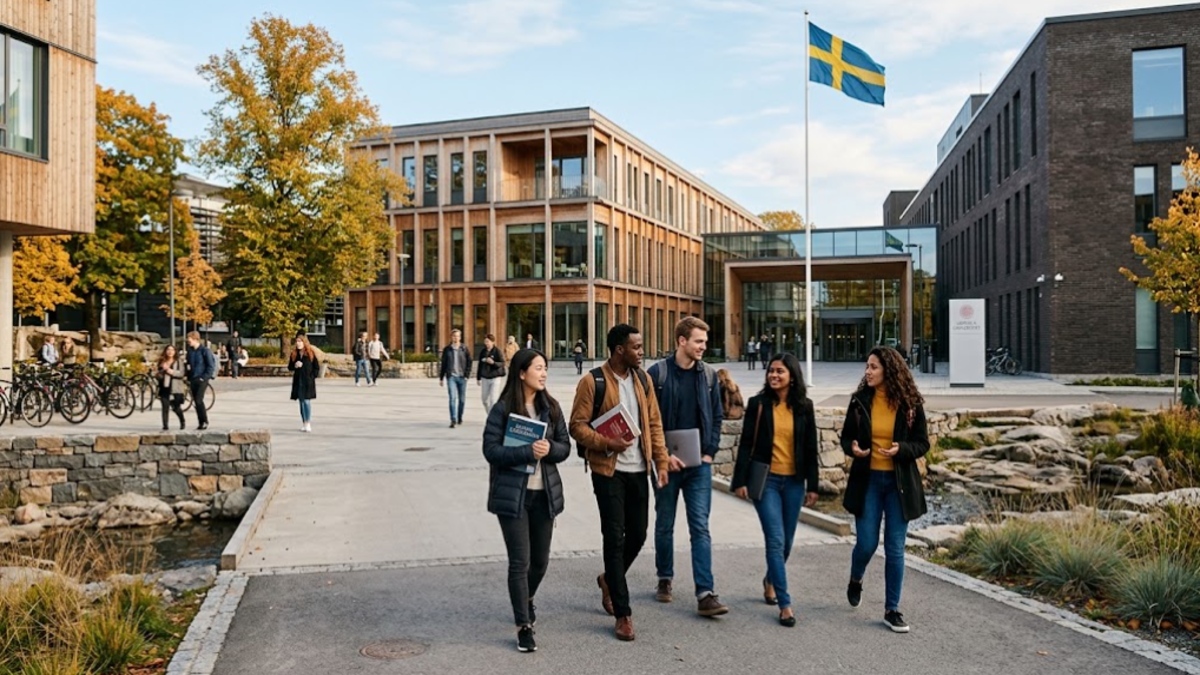
STOCKHOLM- Swedist: Sweden English-Taught Degrees are giving international students access to a wide range of university programmes without requiring Swedish as the language of instruction, but where can overseas applicants actually study and what should they know before applying?

Sweden has built a strong international profile in higher education, particularly among students looking for programmes connected to technology, engineering, business, sustainability, innovation and research. While Swedish remains the dominant language in everyday life and across much of the country’s domestic education system, universities and university colleges offer a substantial selection of courses and degree programmes in English.
For international applicants, the distinction between bachelor’s and master’s education is important. English-language options are considerably more common at master’s level, while the selection at undergraduate level is smaller. Universities in cities including Stockholm, Lund, Gothenburg, Uppsala, Linköping, Jönköping and other Swedish university centres offer opportunities for students who want to study in English.

The official Swedish admissions system allows prospective students to search for courses and programmes across the country and apply through a central platform. Its current guidance also makes clear that international applicants should pay close attention to application rounds, documentation and language requirements before choosing a programme.
For students considering Sweden as their next study destination, the question is therefore not whether English-language education exists, but how to identify the right programme, university and admission route.
Sweden English-Taught Degrees: Why International Students Look to Sweden
Sweden’s appeal goes beyond the availability of courses in English. The country’s universities have developed strong international links, and many programmes place emphasis on independent study, problem-solving, research, collaboration and practical applications.
That approach can be particularly attractive to students who want an education connected to industry rather than one based entirely on traditional classroom teaching.
The country’s academic strengths also help explain why international students look toward Sweden. Engineering, information technology, computer science, environmental studies, sustainability, business, economics, design and social sciences all feature prominently among English-language study options.
The structure of Swedish higher education can also make the country appealing to students who want to combine academic study with international experience. Some institutions maintain exchange agreements with universities abroad, while others include projects, internships or cooperation with companies as part of their programmes.
Jönköping University, for example, describes its English-taught bachelor’s and master’s programmes as internationally focused and lists study areas ranging from business and economics to engineering, global studies, media and communication, education and health sciences. The university also highlights exchange opportunities through its international university network and practical elements in a number of programmes.
This means prospective students should look beyond a university’s overall reputation. The individual programme matters just as much.
A university may have an excellent international reputation but offer only a limited number of undergraduate programmes in English. Another institution may provide a more specialised course that matches a student’s professional goals more closely.
Sweden English-Taught Degrees at the Bachelor’s Level
Students who want to begin their university education in Sweden immediately after secondary school face a different landscape from those applying for master’s studies.
English-language bachelor’s programmes exist, but they are less numerous than English-taught master’s degrees. This makes programme research especially important for undergraduate applicants.
The central admissions system states that applicants for bachelor’s courses and programmes taught in English must meet both general and specific entry requirements. Applicants must have completed upper-secondary education and demonstrate the required level of English proficiency.
The requirements do not stop at English.
Individual programmes can demand specific academic preparation. A student applying for an engineering programme, for example, may need particular mathematics or science qualifications, while a business programme can have different academic prerequisites.
Applicants therefore need to read the entry requirements for the exact programme rather than relying on general statements about admission to Swedish universities.
Stockholm University illustrates the range available at undergraduate level. Its published programme information includes English-taught bachelor’s options in areas such as business, ethics and sustainability, international business and politics, Latin American studies and earth science through distance learning.
The existence of these programmes also demonstrates why international applicants should search by subject rather than simply by university name.
A student interested in international business may discover several possible institutions, while someone seeking a specialised bachelor’s degree may find that only a smaller number of universities offer a suitable English-language programme.
Sweden English-Taught Degrees at the Master’s Level
The strongest concentration of English-language education in Sweden is at master’s level.
For international graduates, this creates a much broader choice. Swedish universities offer master’s programmes across technology, engineering, economics, business, sustainability, computer science, life sciences, social sciences, design and other fields.
The master’s route also fits naturally with Sweden’s international academic environment. Many programmes are designed for students who already hold an undergraduate qualification and want to specialise in a particular discipline.
Stockholm University, for instance, reports a large selection of master’s programmes taught in English, alongside a much smaller group of English-language bachelor’s programmes.
The difference is significant for applicants. A student with a bachelor’s degree from another country may find considerably more English-language choices than a student looking for a first university degree.
Swedish institutions also vary in how they structure master’s programmes. Some concentrate heavily on research and academic theory, while others place greater emphasis on applied projects, professional skills or links with industry.
That variation means international applicants should compare course content, assessment methods, thesis requirements, internship possibilities and career relevance before applying.
The programme title alone can be misleading. Two degrees with similar names may have very different academic content.
Where International Students Can Study in Sweden
International applicants are not restricted to Stockholm.
The capital is home to several important higher-education institutions and offers the largest metropolitan environment in the country. Students interested in technology, business, social sciences and a wide range of other disciplines can find English-language options in and around Stockholm.
Lund is another major destination. Lund University has a strong international profile and offers English-language study opportunities across numerous academic fields.
Gothenburg provides another major university environment, with opportunities connected to areas such as business, engineering, technology, social sciences and other disciplines.
Uppsala is one of Sweden’s historic university cities and remains an important centre for higher education and research.
Linköping has particular relevance for students interested in technology, engineering and innovation, while Jönköping offers a broad portfolio that includes business, engineering, education, communication and health-related subjects.
Other universities and university colleges across Sweden also participate in international education.
This geographical spread matters because the student experience can differ substantially between cities. Stockholm offers a large urban environment, while smaller university cities can provide a more concentrated student community.
Housing, transport, living costs, campus culture and access to employers can also differ from one location to another.
International students should therefore compare the city as well as the university.
How to Find an English-Taught Programme
The safest starting point is Sweden’s central university admissions system. It provides a searchable database covering courses and programmes throughout the country.
Students can search by subject, location and other programme characteristics before reviewing individual admission requirements.
The official system also separates applications into different admission rounds. Its guidance recommends that international students pay particular attention to the first admission round because the later round can create difficulties for students outside the European Union and European Economic Area who need time to obtain a residence permit.
This is an important practical issue.
Finding an attractive degree is only the first stage. Applicants must also make sure they can complete the application process, submit academic documents and satisfy language requirements within the relevant deadlines.
The admissions authorities warn that only a smaller portion of English-language courses and programmes may be available during the second admission round. For non-EU/EEA applicants who require a residence permit, applying late can therefore create additional problems.
Applicants should check the current dates directly through the official admissions service before making travel, financial or visa arrangements.
What International Students Need to Check Before Applying
An English-language programme does not automatically mean that every international applicant will qualify.
Academic eligibility remains central. Universities can impose specific requirements concerning previous studies, subjects, grades, qualifications and other evidence.
English proficiency is another major consideration. Applicants need to demonstrate the level required by the Swedish higher-education system and by the relevant programme.
Students should also establish whether tuition fees apply to them. Sweden’s higher-education financing structure differs according to nationality and status, meaning that applicants should not assume that studying at a Swedish public university will be free simply because the institution receives public funding.
The official Study in Sweden information also warns prospective students that studying in Sweden can represent a significant financial investment. Tuition, where applicable, is only one part of the budget. Accommodation, food, transport, study materials and everyday expenses also need to be considered.
Scholarships can change the financial calculation, but applicants should treat funding as a separate part of the application strategy.
A student who depends on financial support should identify eligible scholarships before accepting an offer rather than assuming that funding will automatically be available.
English Is Enough for University, But Swedish Still Matters
One of the biggest advantages of an English-taught degree is obvious: students can complete their academic programme without becoming fluent in Swedish first.
That does not mean Swedish is irrelevant.
International students still encounter Swedish in shops, public services, workplaces and social situations. Learning basic Swedish can make everyday life easier and can help students build relationships outside the international university community.
Language can also matter professionally.
An English-language degree can provide an international academic qualification, but students planning to remain in Sweden after graduation may find that Swedish-language ability expands their employment options, depending on their sector and profession.
The level of Swedish required varies widely. International technology companies may operate extensively in English, while other employers can expect candidates to communicate comfortably in Swedish.
For that reason, students should treat English as the language of academic access rather than necessarily the only language they will need throughout their Swedish experience.
What Makes Sweden Different for International Students?
Sweden’s higher-education model places considerable emphasis on student participation and independent thinking.
That can be a major adjustment for students arriving from education systems where lectures dominate the learning process and examinations provide the main measure of progress.
Swedish programmes can include group work, seminars, independent research, presentations and project-based assignments.
This structure can be particularly useful for students entering international fields where collaboration is part of professional life.
The emphasis on sustainability and innovation is another feature that appears across many Swedish academic environments. Students interested in renewable energy, environmental policy, sustainable business, digitalisation or technological development can find programmes aligned with these themes.
International students may also benefit from Sweden’s close relationship between universities, research institutions and industry.
However, applicants should avoid choosing Sweden solely because of its reputation for innovation. The correct programme depends on the student’s previous education, career ambitions and academic interests.
A strong university is not automatically the right university for every student.
The Application Process Requires Careful Planning
The application process may look straightforward, but international applicants need to prepare well in advance.
The first step is to identify programmes for which the applicant is academically eligible. The next is to check language requirements and supporting documents.
Applicants should then review the relevant admission round and make sure every required document reaches the admissions system by the stated deadline.
The Swedish admissions authorities maintain separate guidance for bachelor’s and master’s applications, and deadlines can vary depending on the semester and admission round.
Students outside the EU/EEA should pay particular attention to the residence-permit timetable.
A late application can create a chain reaction: delayed admission, delayed residence-permit processing and reduced time to arrange accommodation and travel.
That is why prospective students should treat admissions, financing, accommodation and immigration planning as connected parts of the same process.
Which Students Could Benefit Most From Sweden?
Sweden may be particularly attractive to students who want an English-language degree in a European country and have an academic interest in innovation, technology, sustainability, business or research.
It can also appeal to students who value international classrooms.
The country offers opportunities at both research-oriented universities and institutions with a stronger applied or professional focus.
The key, however, is to choose by programme rather than by country alone.
An applicant interested in computer science should compare the curriculum, specialisations, laboratories and project opportunities. A business student should examine the programme’s management, economics, entrepreneurship and international components. A sustainability student should look at the exact research areas and practical projects available.
The same principle applies across disciplines.
The Bottom Line for International Applicants
The current picture is clear: Sweden offers a substantial international higher-education market in English, particularly at master’s level, while bachelor’s applicants face a smaller but still meaningful selection.
Students can find programmes in major university cities such as Stockholm, Lund, Gothenburg, Uppsala, Linköping and Jönköping, among other locations.
The country’s central admissions platform provides the most reliable starting point for comparing available programmes, but students must still investigate the individual requirements of every degree.
For international applicants, timing is also crucial. The admissions authorities specifically caution non-EU/EEA students about relying on later application rounds because residence-permit processing can become a problem.
The latest Swedish news cycle does not point to a major new announcement today that changes the basic availability of English-taught degrees. Instead, the current information reinforces a practical message for prospective students: Sweden remains a destination where international applicants can find English-language higher education, but successful applications depend on choosing the right programme, meeting its requirements and planning early.
For students willing to do that preparation, the country offers a broad academic landscape in which English can be the gateway to a Swedish university education.
FAQ
Are there English-taught degrees in Sweden?
Yes. Swedish universities offer many degree programmes taught in English, with the largest selection generally found at master’s level.
Can international students study a bachelor’s degree in English?
Yes. English-taught bachelor’s programmes exist, although they are less common than English-language master’s programmes.
Do students need to speak Swedish to study in English?
Not necessarily. Students admitted to an English-taught programme can complete their academic studies in English, although Swedish can be useful for everyday life and employment.
Where can international students study in Sweden?
International students can find English-language programmes in cities including Stockholm, Lund, Gothenburg, Uppsala, Linköping and Jönköping, as well as at other Swedish institutions.
Contact: info@alswedalyom.com