

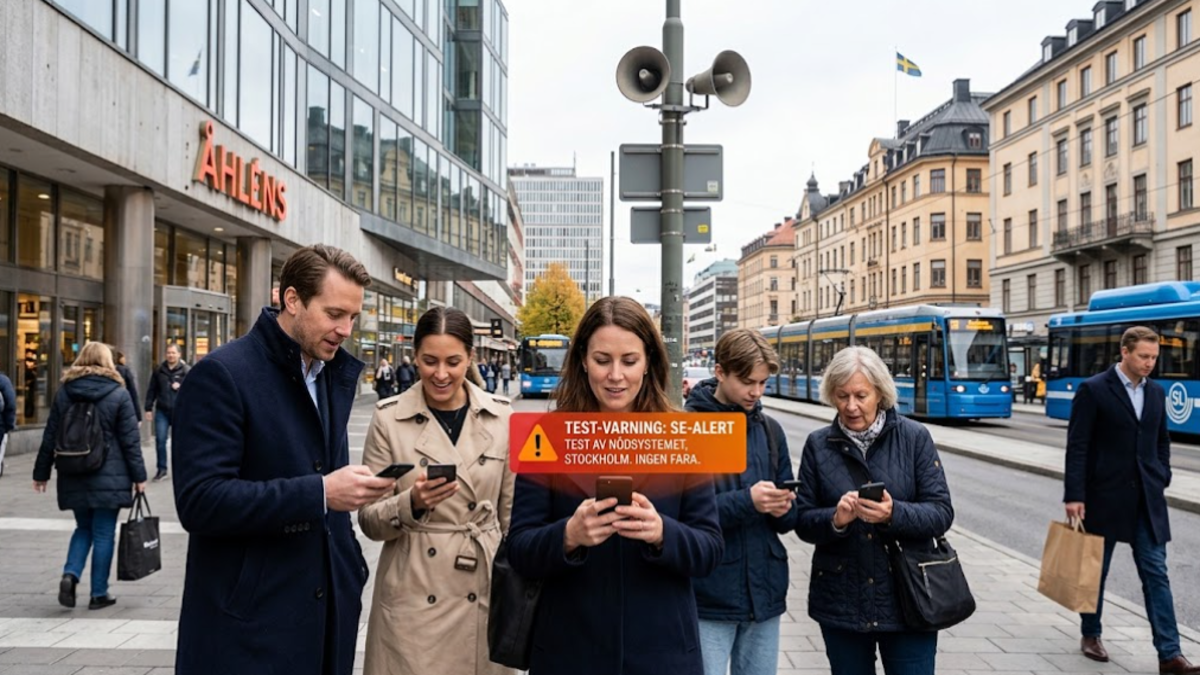
Stockholm – Swedist: SE-Alert test brings Sweden’s new emergency warning system to mobile phones

Stockholm is preparing for a new kind of public warning as Sweden tests SE-Alert at 15:00 today in Stockholm County and Gotland, alongside the familiar Hesa Fredrik outdoor sirens. The nationwide warning system is designed to send urgent public messages directly to compatible mobile phones without requiring an app or registration, but what exactly should residents expect when the alert arrives?
The test marks an important step in Sweden’s development of its public warning infrastructure. Authorities want to make sure that people can receive information quickly when a serious accident, major disruption or other dangerous event requires immediate attention.

The test is scheduled for 15:00 in Stockholm and Gotland counties. People in neighbouring counties may also receive the alert because the system uses mobile network infrastructure rather than administrative borders.
For residents, the most noticeable difference will be the location of the warning. Instead of relying only on outdoor sirens, radio, television or applications, the new system puts the warning directly on the screen of a mobile phone.
SE-Alert reaches phones without an app
One of the central features of SE-Alert is its simplicity. People do not need to download a dedicated application, register their telephone number or sign up for a separate service before receiving a warning.
The system uses cell broadcast technology to distribute public warning messages to mobile devices within a defined geographical area. According to Swedish authorities, this allows messages to reach a large number of phones within seconds.
That approach is particularly important during emergencies when authorities need to communicate with people who may not already be following official channels.
A person who happens to be in the affected area can receive the warning simply because their compatible device is connected to the mobile network. The test therefore includes not only permanent residents but also visitors, commuters and other people who happen to be in the relevant area.
For the test, the requirements are straightforward. The mobile device must be switched on, connected to the mobile network and sufficiently up to date to support the service. Authorities have advised users to update their phones before the test.
The warning itself is designed to be difficult to overlook. The test message will be accompanied by a loud alert sound and vibration. The sound is expected even when a phone has been placed in silent mode, making the system considerably more noticeable than an ordinary notification.
The purpose is not to create confusion but to reproduce the way the warning could work during a genuine emergency.
Why SE-Alert is being tested with Hesa Fredrik
The timing of the test is significant. At 15:00, SE-Alert will be tested at the same time as the quarterly test of Sweden’s outdoor warning system, commonly known as Hesa Fredrik.
Hesa Fredrik has long been one of Sweden’s most recognisable emergency warning mechanisms. The outdoor sirens are tested four times a year, normally at 15:00 on the first working Monday of March, June, September and December.
The September test therefore gives authorities an opportunity to examine two warning channels at the same time.
For people in areas covered by the test, the experience may be striking. They could hear the outdoor sirens while also seeing and hearing an emergency-style notification on their phones.
That combination reflects a broader principle in emergency preparedness: important information should be available through more than one channel.
Hesa Fredrik is particularly useful outdoors and within areas where sirens can be heard. Mobile alerts, meanwhile, provide a direct route to people carrying compatible devices.
The two systems serve different purposes but can complement each other. In a serious incident, authorities may need to warn people both outside and indoors, including those who are not close enough to hear a siren.
The test will therefore provide authorities with an opportunity to observe how the new mobile warning channel performs alongside an established part of Sweden’s public warning system.
The official Swedish crisis-information service says the test requires no action from people who receive the message.
Who can receive today’s SE-Alert message?
The main test area covers Stockholm County and Gotland County. However, authorities have warned that people outside those administrative boundaries may also receive the notification.
The reason is technical. SE-Alert relies on mobile network coverage and cell towers, which do not follow county borders precisely.
People in neighbouring areas, including parts of Uppsala, Södermanland and Västmanland, may therefore receive the test message if their phones connect to mobile infrastructure used for the broadcast. Sveriges Radio has also highlighted the possibility that parts of neighbouring areas could be reached.
This does not mean that the test has suddenly been expanded to all of those counties. Rather, it reflects the way mobile networks operate.
The distinction matters because some people outside Stockholm and Gotland may hear or see the warning and wonder whether they have received it by mistake.
Authorities have made clear that such a notification can be part of the test.
The system is designed around geographical targeting, but mobile coverage does not stop neatly at a county line. A mobile phone near a boundary can therefore connect to a cell serving an area included in the warning.
That characteristic is also relevant to the future use of the system. During a real emergency, the objective will be to reach people in the affected area as rapidly and reliably as possible.
What will happen when the phone alert arrives?
The test message is expected to appear directly on the mobile device.
Users should expect a text notification accompanied by a loud sound and vibration. The alert can be noticeable even when the telephone is set to silent mode.
There is also a linguistic detail that authorities have highlighted ahead of the first public test.
The headline of the message may appear in English, while the body of the test information is expected to contain Swedish followed by English. Authorities say this is connected to ongoing development and updates from Apple and Google, with improvements expected as the system evolves.
For that reason, recipients should not assume that an unfamiliar headline means the warning is a genuine emergency.
Today’s message is explicitly a test.
People who receive it do not need to call emergency services, leave their homes or take any other action because of the test notification. The purpose is to check the technology and allow the public to become familiar with how the warning appears.
The recommendation to update mobile phones before the test is nevertheless important. An outdated device may not handle the notification in the intended way.
Sweden adds another layer to public emergency warnings
The introduction of SE-Alert expands the way Swedish authorities can communicate with the public.
Public warnings have traditionally depended on several channels. These include radio and television, official websites and applications, text messages in certain circumstances, and outdoor warning systems.
SE-Alert adds another direct route to mobile phones by using cell broadcast technology.
The technology has a practical advantage during fast-moving incidents: authorities can target an area rather than relying on people to have previously downloaded a particular application or subscribed to a particular service.
That distinction could become important when an emergency develops quickly.
Someone visiting Stockholm for the day, for example, may not have any Swedish emergency-information application installed. A tourist on Gotland may not have registered for local alerts. A commuter may spend only a few hours in an affected area.
A mobile warning system based on the network can reach such people without requiring advance registration.
It also provides another way of communicating with people who may not be watching television or listening to the radio at the moment an incident occurs.
Sweden’s existing VMA system — the Important Public Announcement system — remains broader than any single delivery method. Authorities can distribute warnings through multiple channels depending on the circumstances. SE-Alert becomes an additional tool within that system rather than a replacement for every existing warning method.
What the Hesa Fredrik test means for residents
The simultaneous outdoor-siren test is part of Sweden’s established quarterly routine.
When Hesa Fredrik is tested, the familiar signal can be heard in areas equipped with outdoor warning sirens. The test normally begins at 15:00 and is followed by the signal indicating that the test is over at 15:05.
The system has a much longer history than mobile emergency alerts.
Outdoor warning sirens remain important because they can warn people who are outside or who may not have immediate access to a mobile phone. They can also function during circumstances in which other communications are disrupted.
At the same time, not every location has an outdoor siren. Municipalities determine where the installations are needed, meaning coverage is not universal.
That makes mobile-based warnings particularly relevant as an additional channel.
For people who hear the outdoor signal during an actual emergency rather than a scheduled test, Swedish authorities advise moving indoors, closing windows, doors and ventilation openings, and following further information through Sveriges Radio P4 and official crisis-information channels.
Today’s exercise is different because the authorities have announced it in advance.
A test designed to expose technical limits
No emergency warning system can be assessed only by whether a message is sent successfully.
Authorities also need to understand how the system behaves across geographical boundaries, different mobile networks and different devices.
Today’s test can provide information about how widely the alert travels, how quickly phones receive it and how the message appears to users.
The possibility of alerts reaching neighbouring counties is particularly relevant. Cell broadcast technology follows the coverage of mobile infrastructure rather than political geography.
That can be an advantage in a real emergency because a danger does not necessarily stop at a county boundary.
At the same time, it means that some people who are outside the primary test area can receive the notification. Today’s exercise can help both authorities and the public become familiar with that reality.
The first public test also gives users an opportunity to recognise the sound and appearance of a genuine mobile warning mechanism before it is needed in a real crisis.
That familiarity could matter.
A loud notification that interrupts a silent phone can be alarming if someone has never experienced it before. Knowing that the system exists — and understanding why the sound is different from an ordinary notification — can reduce uncertainty when a real alert eventually needs to be issued.
SE-Alert will eventually be tested nationally
Today’s exercise is not intended to be the final test of the system.
Sweden plans a national test of SE-Alert later in the year. Current information from Swedish authorities and recent reporting indicates that the September exercise is the first public test focused on Stockholm and Gotland, while a broader national test is planned for December.
That staged approach allows the authorities to test the service regionally before expanding the exercise.
The first test also comes after the system was introduced as an additional channel for VMA warnings during the summer.
In practice, today’s test is therefore part of a wider rollout rather than a standalone experiment.
For the public, the most important message is simple: if a phone suddenly makes an unusually loud alert sound at 15:00 today in Stockholm, Gotland or potentially nearby areas, it may be the planned SE-Alert test.
There is no need to panic.
There is also no need to install an application specifically for today’s test.
Instead, the exercise is intended to show what Sweden’s new mobile warning infrastructure looks and sounds like and to give authorities an opportunity to verify that the system works as intended.
What the new system could mean during a real emergency
The real value of SE-Alert will not be measured by today’s test alone.
Its importance will become clearer if authorities need to warn large numbers of people during a serious event where time matters.
A major accident, dangerous release, severe disruption or other threat can develop faster than traditional communication channels can reach everyone.
A mobile warning sent directly to devices in the affected area provides another way to get urgent information in front of people.
The system does not eliminate the need for radio, television, websites, applications or outdoor sirens. Instead, it gives authorities another instrument to use alongside them.
That layered approach is central to modern emergency communication.
People do not all receive information in the same way. Some follow radio broadcasts, others check their phones, while people outdoors may notice a siren first.
By using several channels, authorities can increase the chances that an important warning reaches people quickly.
The launch of SE-Alert also reflects the increasingly mobile nature of everyday life. Phones travel with their users, while traditional warning infrastructure remains tied to fixed locations.
That combination can give authorities more flexibility when communicating during an incident.
For residents and visitors, today’s test is therefore more than a new notification appearing on a screen. It is an introduction to another part of Sweden’s emergency preparedness system.
What people should remember today
The test takes place at 15:00 in Stockholm and Gotland, with neighbouring areas potentially affected.
A compatible and updated mobile device should be switched on and connected to the mobile network.
No application or advance registration is required.
The alert can produce a loud sound and vibration, including when the phone is set to silent.
The message is a test, so recipients do not need to take action.
The test is being carried out at the same time as the scheduled Hesa Fredrik outdoor warning test.
For anyone who receives the notification unexpectedly, the key point is that today’s alert has been planned in advance. The exercise is designed to test the system before authorities need to rely on it during a real emergency.
FAQ
What time is the SE-Alert test?
The SE-Alert test is scheduled for 15:00 today.
Where is SE-Alert being tested?
The main test areas are Stockholm County and Gotland County. Some neighbouring areas may also receive the alert.
Do I need an app to receive SE-Alert?
No. A compatible, updated mobile device connected to the mobile network can receive the warning without an app or prior registration.
Do I need to do anything when I receive the test?
No. Today’s notification is only a test. Recipients do not need to take any action.
Contact: info@alswedalyom.com