

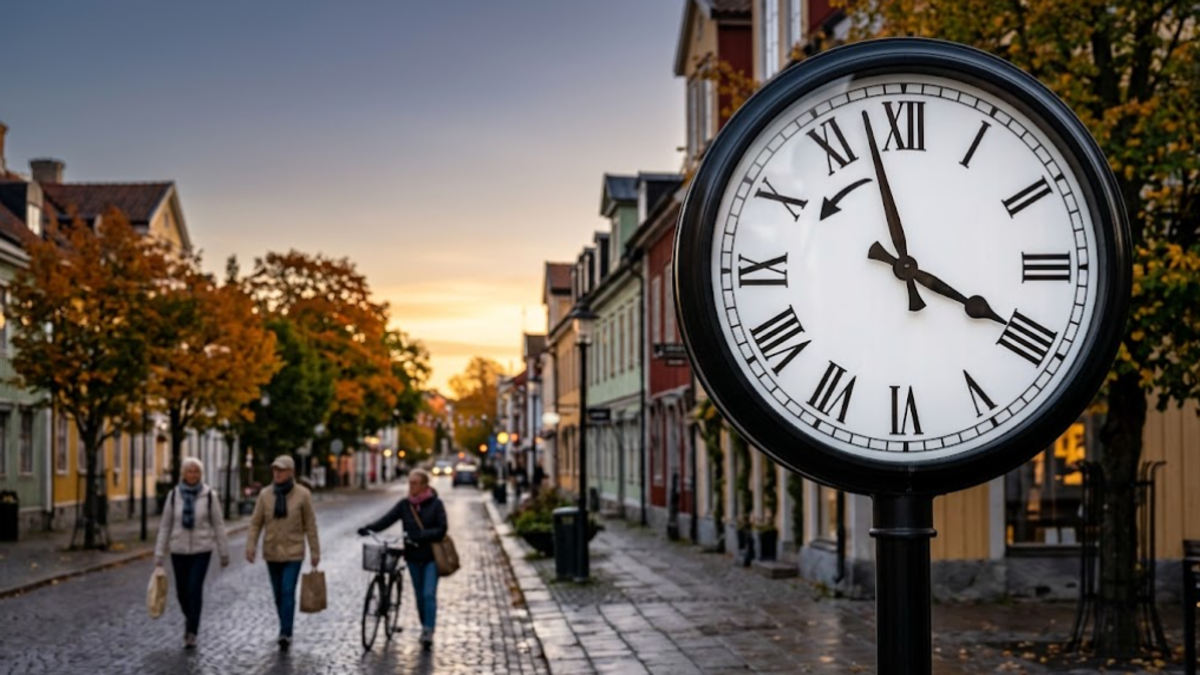
Sweden Changes to Winter Time on Sunday: What You Need to Know
Sweden will switch to winter time on Sunday, 25 October 2026, when clocks go back by one hour. At 3:00 a.m. summer time, clocks will return to 2:00 a.m. standard time, giving people an extra hour overnight. The change means lighter mornings but darker evenings, and most smartphones and connected watches should update automatically if their time settings are configured correctly.

The seasonal clock change follows Sweden’s established rules, which align with the European Union’s current daylight-saving schedule. Here is what residents, travellers and anyone arranging appointments in Sweden need to know.
When do clocks go back in Sweden?
The change takes place overnight from Saturday, 24 October, to Sunday, 25 October.

| Detail | What to know |
|---|---|
| Clock-change date | Sunday, 25 October 2026 |
| Time of change | 3:00 a.m. summer time |
| New time | 2:00 a.m. standard time |
| Clock direction | Back one hour |
| Effect on the night | One extra hour on the clock |
The hour between 2:00 a.m. and 3:00 a.m. will occur twice under the two time designations. This is why the night effectively lasts 25 hours rather than 24.
Sweden’s official regulations specify that summer time ends at 3:00 a.m. on the last Sunday in October, when the time is set back to 2:00 a.m. standard time.
Do phones and smartwatches change automatically?
For most people, there is no need to adjust every clock manually. Smartphones, computers and internet-connected devices generally update automatically when automatic time and time-zone settings are enabled.
However, it is worth checking your settings before going to bed on Saturday.
- iPhone: Check that automatic date and time settings are enabled.
- Android phones: Check that automatic time and time-zone settings are enabled.
- Smartwatches: Connected watches usually follow the time settings on their paired phones, although behaviour can vary by model.
- Computers and tablets: Devices connected to the internet normally update their clocks automatically.
- Wall clocks, car clocks and some household appliances: These may need to be adjusted manually.
If you are travelling, working an overnight shift or catching an early train, check the displayed time and your travel provider’s timetable rather than assuming every device has updated correctly.
Why will mornings be brighter and evenings darker?
The autumn clock change does not create more daylight. Instead, it changes how daylight hours line up with the time shown on the clock.
After the switch, sunrise and sunset will occur about an hour earlier by the clock than on the previous day. This means more daylight will be available earlier in the morning, while darkness will arrive earlier in the evening.
For people who commute to work or school early, brighter mornings may make the start of the day feel more manageable. However, those finishing work in the late afternoon may notice that it gets dark sooner.
The effect becomes particularly noticeable as autumn progresses and daylight hours continue to shorten. The exact sunrise and sunset times vary across Sweden, with northern locations experiencing more pronounced seasonal changes in daylight than southern parts of the country.
Why does Sweden still change its clocks?
Sweden follows the seasonal time-change system used across much of Europe. Under the current rules, clocks move forward on the last Sunday in March and back on the last Sunday in October.
The European Union has discussed ending the twice-yearly clock changes. However, no final decision has been adopted to abolish the current system, so the existing arrangements remain in place.
For now, residents should continue to expect the autumn change unless the applicable rules are formally amended.
What should you do before Sunday?
A few simple checks can help avoid confusion:
- Check automatic time settings. Make sure your phone and computer are set to update their clocks automatically.
- Check manual clocks. Remember household clocks, older appliances and other devices that may not update themselves.
- Review travel plans. Confirm departure times for early trains, buses and flights, especially if your journey crosses a time zone.
- Plan for darker evenings. If you walk, cycle or drive after work, make sure you can see and be seen in low-light conditions.
- Use the extra hour sensibly. The change can offer an opportunity for rest, although the effect on sleep varies from person to person.
Our assessment: A small change with practical consequences
The autumn clock change is straightforward, but it can affect travel, work schedules and daily routines. The most useful approach is to let connected devices update automatically while checking clocks and appointments that rely on manual settings.
The shift also marks a practical seasonal transition. Mornings gain an hour of daylight by the clock, but evenings become darker earlier. Planning for that change can help households adapt without unnecessary disruption.
Frequently asked questions
Do clocks go back in Sweden this weekend?
Yes. Clocks go back on Sunday, 25 October 2026, from 3:00 a.m. summer time to 2:00 a.m. standard time.
Do we gain or lose an hour of sleep?
The clock change gives an extra hour on the clock overnight. Whether you actually sleep for an extra hour depends on your routine.
Will my iPhone or Android phone change automatically?
Usually, yes, provided automatic date, time and time-zone settings are enabled. Check the settings if the displayed time does not update.
Will it be lighter in the morning after the change?
Yes, relative to the clock, sunrise will occur about an hour earlier. Sunset will also occur earlier, so evenings will become darker sooner.
Has the EU abolished daylight saving time?
No. Although ending seasonal clock changes has been discussed, the EU has not adopted a final decision ending the current system.
Official Sources
1. Swedish Parliament (Riksdagen) — Ordinance (2001:127) on Daylight Saving Time https://www.riksdagen.se/sv/dokument-och-lagar/dokument/svensk-forfattningssamling/forordning-2001127-om-sommartid_sfs-2001-127/
2. SVT Nyheter — Sommartid och vintertid (Summer Time and Winter Time) https://www.svt.se/nyheter/om/sommartid-och-vintertid
3. Council of the European Union — Seasonal Clock Changes in the EU https://www.consilium.europa.eu/en/policies/seasonal-time-changes/
4. Time and Date — Daylight Saving Time 2026 in Sweden https://www.timeanddate.com/time/change/sweden
Contact: info@alswedalyom.com