
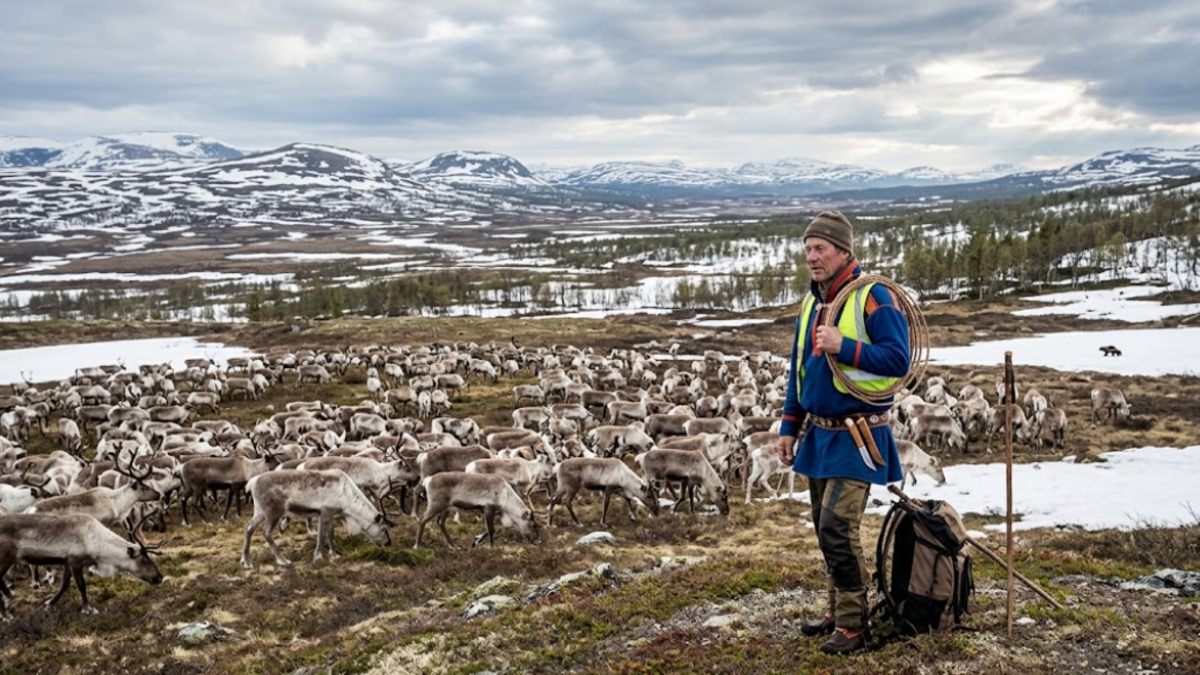
STOCKHOLM – Swedist: Sami reindeer herders :are facing renewed pressure as Sweden’s long-running effort to protect wolverines collides with the rising economic cost of reindeer losses, according to a Financial Times report published today and new research from the University of York and the Swedish University of Agricultural Sciences. Researchers say the compensation system that once helped create a rare model of coexistence has lost much of its real value, while difficult monitoring conditions and growing distrust are threatening the arrangement. What happens when a conservation policy designed to make coexistence possible no longer covers the cost of living with predators?

Sami reindeer herders caught between conservation and rising costs
The dispute centres on one of Sweden’s most distinctive wildlife policies. Instead of paying only for animals that predators kill, Sweden created a system that rewards Sami reindeer herding communities for the presence and reproduction of protected carnivores.
The approach aimed to make conservation economically meaningful for the people who share the landscape with predators. Wolverines, lynx and wolves became part of a compensation model intended to shift some of the financial burden of conservation away from herding communities.

The system began in the 1990s and was formally developed into the Conservation Performance Payment scheme. Researchers have described it as the oldest programme of its kind and one of the few financed directly through public funds rather than through a conservation organisation.
Under the arrangement, payments go to Sami herding communities rather than individual herders. The research identifies 51 such communities across northern Sweden. Payment levels depend primarily on documented carnivore reproduction, while the system also provides payments for regular and occasional predator presence.
The logic was straightforward. A breeding wolverine can cause losses among reindeer over time, but the same animal also has conservation value because Sweden and the European Union require protection for large carnivore populations. Rather than forcing herders to absorb the entire cost, the state would compensate communities for helping sustain the animals.
Swedish environmental authorities continue to operate within a legal framework that implements European species-protection obligations. The Swedish Environmental Protection Agency explains that EU Birds and Habitats Directive requirements are incorporated into national species-protection rules.
The arrangement once stood out internationally because it appeared to demonstrate that wildlife protection and traditional livelihoods could reinforce each other rather than exist in permanent conflict.
That achievement is now under pressure.
Sami reindeer herders say compensation no longer matches reality
The central problem identified by the new research is the gap between the payment rate and the cost of maintaining a viable reindeer operation in areas where wolverines are present.
For years, the compensation for a documented wolverine reproduction stayed at SEK 200,000. The researchers say that level remained unchanged from 2002 until 2023, even as the broader cost of living and the cost of reindeer husbandry increased.
A subsequent increase of SEK 25,000 did not solve the underlying problem.
Researchers from the University of York and the Swedish University of Agricultural Sciences say the real value of the payment has effectively been cut in half. Their analysis compares the fixed payment with changing economic conditions, including the Swedish price base amount and reindeer meat prices.
The issue is not simply inflation. For herding communities, the economic effects of predators can extend beyond the carcass of an individual reindeer.
Wolverines may kill reindeer, but they can also scatter herds and disrupt normal herding patterns. That can increase the amount of time and fuel needed to find, move and monitor animals. The resulting pressure affects production as well as the labour required to manage the herd.
The new study argues that compensation has therefore failed to keep pace with what the system was originally supposed to address.
The researchers point to an important legal detail. The Wildlife Damage Regulation provides for the payment level to be revised so that it can reflect changes in the value of reindeer. In practice, however, the researchers say that adjustment did not occur for more than two decades.
The study estimates that, under the calculation criteria in the regulation, the appropriate amount would have been close to SEK 525,000 for a wolverine reproduction based on a later calculation. That figure is far above the payment level that was eventually approved.
For communities already dealing with higher operating expenses, the difference is substantial.
It also changes the meaning of the conservation deal. A payment can create an incentive to tolerate a predator when the payment reflects the costs associated with that predator. When the amount stays fixed while those costs rise, the incentive becomes weaker.
That is precisely the concern emerging from interviews with herders and officials.
A conservation model that once delivered results
The controversy is striking because the Swedish system had previously been celebrated as a conservation success.
Earlier research found that payments linked to wolverine reproduction helped reduce incentives for illegal killing and contributed to a major recovery in the species. Researchers reported that adult female wolverines became less exposed to illegal killing, helping the population more than double over a decade.
The policy worked partly because it changed the economic relationship between herders and predators.
Instead of seeing every wolverine solely as a source of loss, herding communities could receive a direct financial benefit from the animal’s successful reproduction. That created a reason to support monitoring and discourage illegal persecution.
The new research suggests that success also produced a new challenge.
As the predator population recovered, the costs associated with coexistence did not disappear. Instead, they became more significant for communities living with the animals year after year. At the same time, the researchers say, the compensation system did not adapt sufficiently.
The study, titled The Paradox of Success in Conservation Performance Payments: Rising Costs and Declining Trust in Sweden’s Carnivore Policy, examines nearly three decades of ecological and policy records, alongside interviews and questionnaires.
Its conclusion is not that conservation payments cannot work. Rather, the researchers argue that such programmes require continuing adjustment as ecological conditions and economic circumstances change.
The contrast between earlier success and current dissatisfaction forms the heart of the dispute.
A policy designed to build trust depended on the state maintaining the credibility of its side of the agreement. When payments stagnate, monitoring becomes harder and communities question whether authorities are recognising the full scale of their losses, that trust can deteriorate.
Monitoring problems add to the pressure
The dispute is also tied to the way Sweden counts wolverines.
The compensation system traditionally relies on identifying reproductive events, such as a female wolverine with offspring or a documented den. The process often depends on snow conditions, tracks, observations and fieldwork carried out jointly by herders and government personnel.
That system has become more difficult in changing conditions.
The researchers examined monitoring records stretching over almost 30 years and found concerns about the reliability of current methods in some areas. Severe weather in one recent monitoring season, for example, restricted fieldwork in Norrbotten. Authorities subsequently used an estimate of 30 reproductions for the county, contributing to a national estimate of 106 reproductions.
The study also tested a DNA-based approach, using genetic material from faeces and urine to identify individual wolverines.
DNA monitoring could potentially provide a more flexible way of estimating the population, especially where traditional snow-based tracking becomes less reliable. But the researchers stress that monitoring is not just a scientific exercise.
The result affects money.
A single documented reproductive event corresponds to an estimated 6.25 wolverines in the population model. A failure to detect or approve a reproduction can therefore affect both the reported population and the compensation received by a herding community.
That creates a difficult situation for people who depend on the monitoring system while also bearing the consequences of predator activity.
Interviews conducted for the study show that some herders believe the criteria for documenting reproduction are too difficult to meet. Government personnel interviewed by the researchers also raised concerns about limited monitoring resources.
The resulting frustration goes beyond a disagreement over technical procedures.
For herders, an undercount can reduce compensation. For wildlife managers, an undercount can affect population estimates and decisions about predator management.
The same number can therefore have environmental, economic and political consequences.
Sami reindeer herders challenge unequal treatment
Another major element of the dispute concerns how Sweden compensates different forms of livestock production.
The researchers compare the system for reindeer husbandry with compensation available to other livestock sectors, including sheep and cattle farming.
For conventional livestock operations, compensation is linked to verified damage, with payments revised as circumstances change. The study argues that this creates a significant contrast with the system used for reindeer herding, where compensation is largely tied to the documented presence and reproduction of predators.
The difference matters because reindeer graze over large areas and spend much of their time in open landscapes. Finding every animal that dies is extremely difficult.
A recent Swedish environmental authority assessment illustrates the problem. In a separate national compensation process, the overwhelming majority of reindeer losses claimed as predator-related were not recovered as carcasses. Authorities noted that reindeer can disappear in difficult terrain and that carcasses may be lost because of scavengers, decomposition and snow conditions.
This makes a simple system based only on confirmed dead animals particularly difficult to apply to reindeer husbandry.
The compensation approach was intended to avoid that problem by paying for predator reproduction instead.
But according to the new research, that system now faces the opposite problem: compensation linked to predators remains too low, while proving reproduction can itself be difficult.
For some Sami representatives, the result is a system that protects predators more effectively than it protects the economic conditions needed to sustain herding.
The researchers describe declining trust among stakeholders as one of the most serious findings.
They found dissatisfaction among reindeer herders, government officials and researchers alike. The problem therefore cannot be reduced to a simple dispute between conservationists and herders. The study portrays a broader governance problem involving policy design, funding, monitoring and trust.
A wider fight over land and Sweden’s green transition
The wolverine dispute is developing against a much wider debate over land use in northern Sweden.
Sami communities face pressure from several directions, including forestry, mining, infrastructure and renewable-energy projects. The Financial Times report places the predator debate within this broader conflict over how northern landscapes are used.
Some herders describe the growing environmental and industrial demands on Sami territory as a form of “green colonialism”. In that view, climate and biodiversity policies can still impose costs on Indigenous communities when decision-makers treat land primarily as a resource for national environmental goals.
The argument is politically sensitive because Sweden is simultaneously promoting environmental protection and expanding its green transition.
For Sami reindeer herders, however, a transition is not necessarily experienced as environmentally neutral.
A wind farm can alter grazing conditions. A mine can change the use of land. A protected predator can increase pressure on a herd. Each measure may have its own policy justification, yet communities may experience them together.
That cumulative effect is one reason the compensation issue has attracted wider attention.
The wolverine itself has become a symbol of the dilemma. Sweden wants the species to remain secure, while Sami herders argue that conservation cannot be separated from the economic consequences imposed on those who share its habitat.
The European Union adds another layer because wolverines benefit from strict protection under European nature law. The European Commission identifies the wolverine as one of Europe’s protected large carnivores, while EU rules allow limited derogations under specific conditions, including circumstances involving serious damage to livestock.
That framework gives conservation policy substantial legal weight.
The dispute is therefore not simply about whether wolverines should exist. It is about how the cost of protecting them should be shared.
Complaint to the European Commission raises the stakes
The conflict has now moved beyond domestic policy criticism.
The Financial Times reports that Inger-Ann Omma, a Sami lawyer and reindeer herder, is filing a complaint with the European Commission. The complaint argues that Sweden is not adequately meeting its obligations toward Indigenous rights and compensation while maintaining strong protections for predators.
Such a move could give the dispute a wider European dimension.
The Commission has mechanisms through which individuals and interested parties can raise complaints concerning alleged breaches of EU rules, although a complaint itself does not determine the outcome of a legal case.
The underlying argument from the Sami side is that protection of a species should come with a credible system for sharing the economic burden.
The Swedish authorities, meanwhile, have acknowledged difficulties surrounding the existing model, according to the reporting and research. But researchers say political momentum to correct the compensation imbalance has remained limited.
The government has also faced a competing budget pressure. The research notes a SEK 10 million reduction in funding supporting the conservation payment system, which authorities associated with increased expenditure on wolf management.
For affected communities, that decision has reinforced the perception that predator policy remains a higher financial priority than compensating those living alongside protected wildlife.
There is also an important policy question about what replaces the current model.
Researchers say proposals are being considered that could connect payments more effectively to improved monitoring. The use of DNA-based methods could eventually make the system more responsive to actual predator presence.
Yet better monitoring alone will not resolve the underlying debate over the value of compensation.
The question now is whether Sweden will adjust the model
The research from York and SLU does not present the Swedish system as a failure from the beginning. Its findings are more complicated.
The conservation payment model helped create conditions in which wolverines could recover. It also offered a mechanism for involving Sami herding communities in that recovery.
But a policy that succeeded under one set of economic and ecological conditions may require substantial changes under another.
That is the core warning from the researchers.
The compensation payment remained largely fixed while prices and operating costs changed. Monitoring methods became more challenging in some areas. Confidence in the system weakened. At the same time, the ecological success of predator protection meant that herders continued to face the presence and impact of carnivores across their grazing areas.
The study describes this as a paradox: the programme’s earlier success helped create a conservation outcome that later exposed weaknesses in the way costs were distributed.
That raises a difficult question for environmental policy more broadly.
Can governments ask local communities to carry the practical costs of conservation while treating compensation as a static payment?
Researchers involved in the study argue that results-based conservation programmes need long-term institutional commitment. Payments must respond to changing costs, monitoring must adapt to new environmental conditions, and local participants must believe that the rules are fair.
Without those elements, a policy can lose legitimacy even if its environmental goals remain valid.
For Sweden, the future of the wolverine programme may therefore depend less on choosing between predators and reindeer than on whether the state can restore confidence in the bargain between them.
The Sami reindeer herders at the centre of the dispute are asking for that bargain to reflect present-day realities rather than an outdated payment level. The conservation community, meanwhile, has a clear interest in keeping a model alive that once demonstrated how wildlife recovery and local participation could work together.
The question now is whether Sweden will invest in rebuilding that balance before distrust becomes the defining feature of a once-celebrated conservation policy.
FAQ
What is the main issue facing Sami reindeer herders?
The main issue is that compensation linked to protected predators has not kept pace with the rising economic costs of reindeer husbandry and predator-related losses.
How much was the wolverine compensation payment?
The payment remained at SEK 200,000 for a documented wolverine reproduction for many years before being increased by SEK 25,000.
Why is wolverine monitoring important?
Monitoring determines documented reproduction levels, which influence both compensation payments and estimates used in predator-management decisions.
What could happen next?
The dispute could lead to changes in compensation and monitoring, while the reported complaint to the European Commission could bring additional scrutiny to Sweden’s approach.
Contact: info@alswedalyom.com