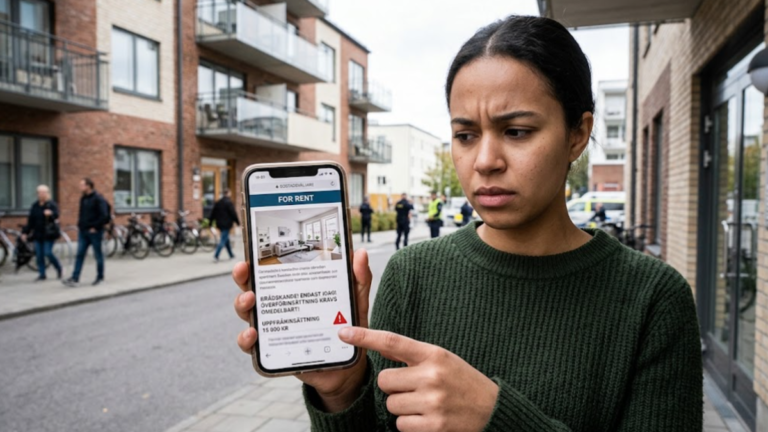

Stockholm – Swedist: Sweden housing queue rules can be difficult for newcomers to understand because there is no single national rental queue, and access to a first-hand apartment often depends on how long an applicant has been registered. So how does the system actually work for someone arriving in Sweden?

Sweden housing queue: How the system works
Sweden does not operate one nationwide housing queue. According to the Swedish National Board of Housing, Building and Planning, the most common way to look for a rental home is to apply directly to an individual housing company, whether it is publicly or privately owned.
Some municipalities, particularly in metropolitan areas, have a municipal housing agency that connects applicants with participating landlords. Housing companies can also operate their own queues, meaning the rules and requirements can vary considerably from one landlord to another.

Stockholm provides one of the clearest examples. Applicants aged 18 or older who have either a Swedish personal identity number or a coordination number can register with the Stockholm Housing Agency. The annual registration fee is SEK 200.
Once registered, applicants can search advertised apartments and submit an expression of interest. Apartments are generally allocated according to the amount of time the applicant has spent in the housing queue, provided the applicant also meets the landlord’s requirements.
For newcomers, this means that registering early can be important even when an immediate first-hand rental is not realistic.
Sweden housing queue and waiting times
The waiting period is not the same for every apartment. The Stockholm Housing Agency explains that each advertised apartment effectively creates its own group of interested applicants, so the required queue time depends on factors such as location, apartment type and rent.
The agency says waiting times can range from a few days to more than 20 years. Its published statistics show an average queue time of nine years based on its cited data, while the majority of successful applicants received an apartment after between 4.8 and 12.7 years.
The figures also vary by type of housing. The agency reports that newly built apartments can have shorter queues, while different categories, including student and senior housing, have their own waiting patterns.
For a newcomer arriving without accumulated queue time, the practical challenge is therefore not simply finding an advertised apartment. The applicant must also compete with people who may have been registered for years.
What newcomers need to know before applying
Joining a queue does not automatically guarantee an apartment. Applicants must still check the conditions attached to each property.
Landlords can impose different requirements. In Stockholm, for example, some landlords may require a minimum income, while others may accept applicants receiving income support. Applicants who reach the relevant stage can also be asked to provide documents confirming employment, income, current housing and household size.
The Stockholm Housing Agency allows applicants to register interest in up to three apartments at the same time. If an applicant receives an offer and does not respond before the deadline, the registration can be removed and the offer passed to the next person.
After a viewing, applicants normally have to confirm whether they remain interested. Once the applicant with the longest queue time also meets the landlord’s conditions and confirms continued interest, the housing offer can proceed to verification and a lease.
Renting before you have enough queue time
Because first-hand rentals can require substantial queue time, newcomers often need to consider other rental options while building their position in the system.
A first-hand contract means renting directly from the property owner or housing company. A second-hand arrangement involves renting from an existing tenant or another eligible party. The two arrangements have different conditions and should not be treated as interchangeable.
The official Swedish housing authorities also note that housing companies have considerable freedom to determine their own rental conditions. This is one reason newcomers should check the exact requirements attached to each listing rather than assuming that rules from one city or landlord apply everywhere.
The housing system also includes mechanisms that municipalities can use for people with particular housing needs. Boverket describes priority allocation, reserved housing and municipal rental guarantees among the tools available to municipalities.
These arrangements are locally determined and do not replace the ordinary housing queue for everyone.
New rules for some newcomers
Sweden is also changing parts of the system concerning housing for certain newly arrived immigrants.
The Swedish Government announced in June that a new law and regulation on settlement for certain newly arrived immigrants had been adopted. The new framework gives municipalities responsibility for arranging housing for newly arrived people who are assigned to them, while introducing a time-limited and conditional right to housing.
The government said municipalities will also be expected to inform newly arrived residents about the conditions and provide support in searching for housing.
The new law and regulation are scheduled to enter into force on January 1, with some provisions concerning the distribution of assignments able to be applied earlier.
This arrangement concerns people covered by the settlement system and should not be confused with the ordinary housing queue used by people searching for rental apartments on the wider market.
What the system means for a newcomer
For someone moving to Sweden, the main point is that there is no single application that puts a person into a national queue for all rental apartments.
Instead, newcomers may need to register with the relevant municipal housing agency, join individual landlord queues where available and monitor apartments that match their circumstances.
Stockholm’s official housing agency also provides an online account where applicants can check their queue time, applications, annual fee and viewing invitations. Applicants can update contact details and other information through the same service.
The Swedish housing authorities’ current information confirms that the system varies significantly between municipalities and landlords. For newcomers, understanding which queue applies to which property can therefore be just as important as the number of days already accumulated.
FAQ
Can newcomers join a Swedish housing queue?
Yes. Eligibility depends on the housing agency or landlord. Stockholm, for example, allows people aged 18 or older with a Swedish personal identity number or coordination number to register.
Is there one housing queue for all of Sweden?
No. Sweden has no unified national rental queue. Municipalities and individual housing companies can operate different systems and requirements.
Does joining a queue guarantee an apartment?
No. Applicants must compete for specific apartments and meet the landlord’s requirements.
Can newcomers get housing without long queue time?
Some apartments can have shorter waiting periods, and other housing arrangements exist outside the ordinary first-hand queue. Municipalities may also use special allocation mechanisms for particular housing needs.
Contact: info@alswedalyom.com