
Stockholm – Swedist: The Sweden cost of groceries has changed as food prices moved lower, while the official household budget for food remains an important reference for anyone planning monthly spending. So how much should one person or a family expect to spend on groceries in Sweden?

According to Sweden’s Consumer Agency, an adult can budget around SEK 2,730 per month for food, while a household consisting of two adults and two children can spend around SEK 8,440 per month. The figures are based on a 30-day meal plan designed to cover energy and nutritional needs.
The agency stresses that these figures are estimates rather than fixed household bills. Actual spending depends on factors including age, what people cook and the food they choose.

Sweden grocery budget for one person
For one adult, the official monthly food estimate is approximately SEK 2,730.
That works out to roughly SEK 91 per day when the monthly figure is divided across 30 days. The calculation is based on the cost of buying the ingredients needed for the agency’s planned meals rather than on an average spending figure collected from individual households.
The Consumer Agency says it developed a new meal plan for its latest calculations. The plan follows the Nordic Nutrition Recommendations and Sweden’s updated dietary guidance.
This distinction matters when using the figure for a personal budget. A person who regularly buys prepared food, chooses more expensive products or eats outside the home may spend more, while someone who selects cheaper ingredients and follows promotions may spend less.
Special dietary requirements can also increase the monthly cost. The agency estimates an additional SEK 50 to SEK 250 per month for gluten-free, lactose-free or milk-protein-free food.
Sweden grocery budget for families
For a family made up of two adults and two children, the Consumer Agency estimates food costs at approximately SEK 8,440 per month.
The calculation covers children in two age groups, 4–6 and 7–10, together with two adults. The figure is therefore a specific household example rather than a universal price for every family in Sweden.
The agency also notes that its food calculations changed because it introduced a new method and a new calculation basis. It says the reduction in the estimated food cost should therefore not be interpreted as an expectation that supermarket prices would fall by the same amount.
What is happening to Swedish food prices?
Recent data indicate that grocery prices have been moving lower.
Statistics Sweden reported that the country’s CPI inflation rate was 0.3%, while the CPIF measure was 0.7%. Statistics Sweden specifically said lower food prices contributed to reducing inflation during the month.
Grocery prices also showed movements at the retail level. ICA reported that prices in its stores fell 0.9% from July to August, although the company said seasonal effects accounted for much of the monthly decline. After adjusting for seasonal effects, prices were largely unchanged between the two months.
The Swedish government has also reported on the impact of the temporary reduction in food VAT. According to the government, food prices fell 5.5% from March to April, with the lower price level subsequently maintained.
The food VAT was temporarily reduced from 12% to 6%, with the change taking effect on April 1 and scheduled to remain in place until December 31.
Recent supermarket prices in Sweden
A recent comparison of major supermarket chains illustrates how much prices can vary between stores.
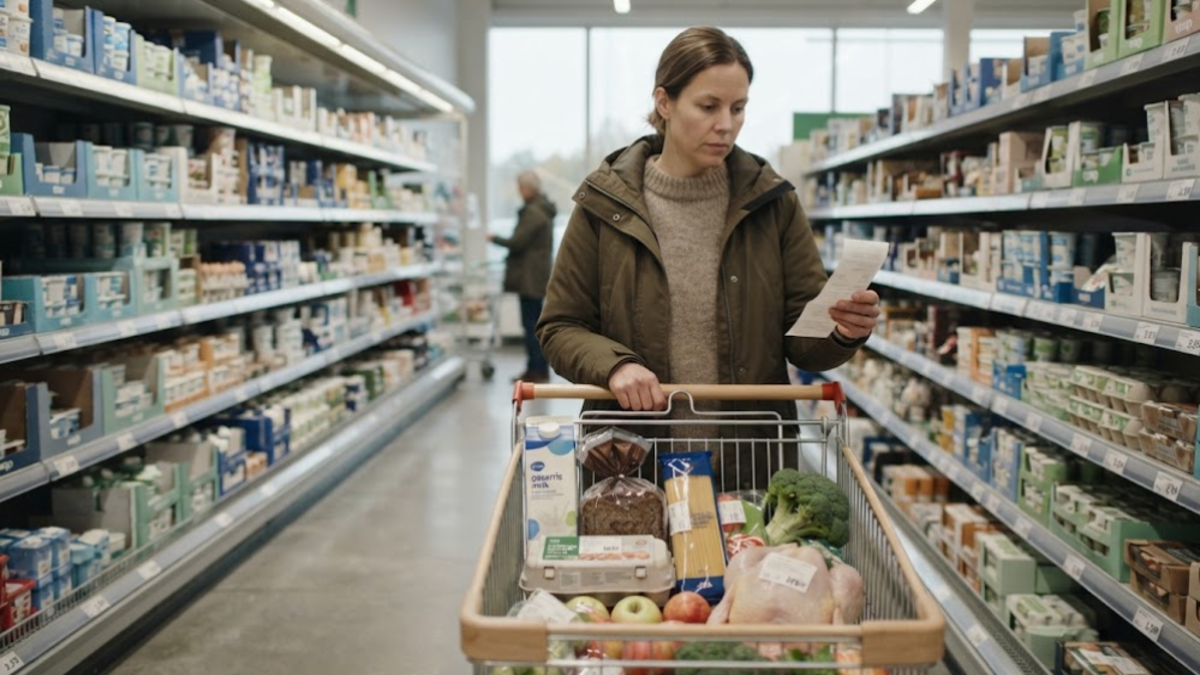
For a selected basket in Stockholm, prices included SEK 19.50 for 1.5 litres of lactose-free milk at Willys, SEK 26.90 for 1.1 kg of toast bread, SEK 15.50 for 400 grams of pasta, SEK 24.90 for six organic eggs and SEK 119 for one kilogram of Swedish chicken breast.
The same basket cost SEK 360.40 at Willys, SEK 418.27 at Coop and SEK 424.20 at ICA in that comparison. The figures included VAT and reflected prices and promotions available during the specified week.
These individual prices should not be treated as a national average. They demonstrate instead why a household’s monthly grocery bill can differ depending on supermarket, location, product choices and promotions.
How much should you budget for groceries in Sweden?
For a straightforward starting point, the official figures provide two useful benchmarks:
One adult: about SEK 2,730 per month
Two adults and two children: about SEK 8,440 per month
The figures represent food costs based on a planned diet and should therefore be used as budgeting references rather than guarantees of what a household will spend.
Recent price data add another element to the picture. Food prices have declined in several recent measurements, while supermarket prices continue to vary between products and retailers. This means households can see different results depending on where and how they shop.
FAQ
How much does food cost for one person in Sweden?
The Swedish Consumer Agency estimates around SEK 2,730 per month for one adult.
How much does food cost for a family of four?
The estimated monthly food cost for two adults and two children is approximately SEK 8,440.
Have grocery prices fallen in Sweden?
Recent official and retail data show declines in food prices, although the size of the change varies by product and retailer.
Does a special diet cost more?
Yes. The Consumer Agency estimates an additional SEK 50–250 per month for certain gluten-free, lactose-free or milk-protein-free diets.
Contact: info@alswedalyom.com