

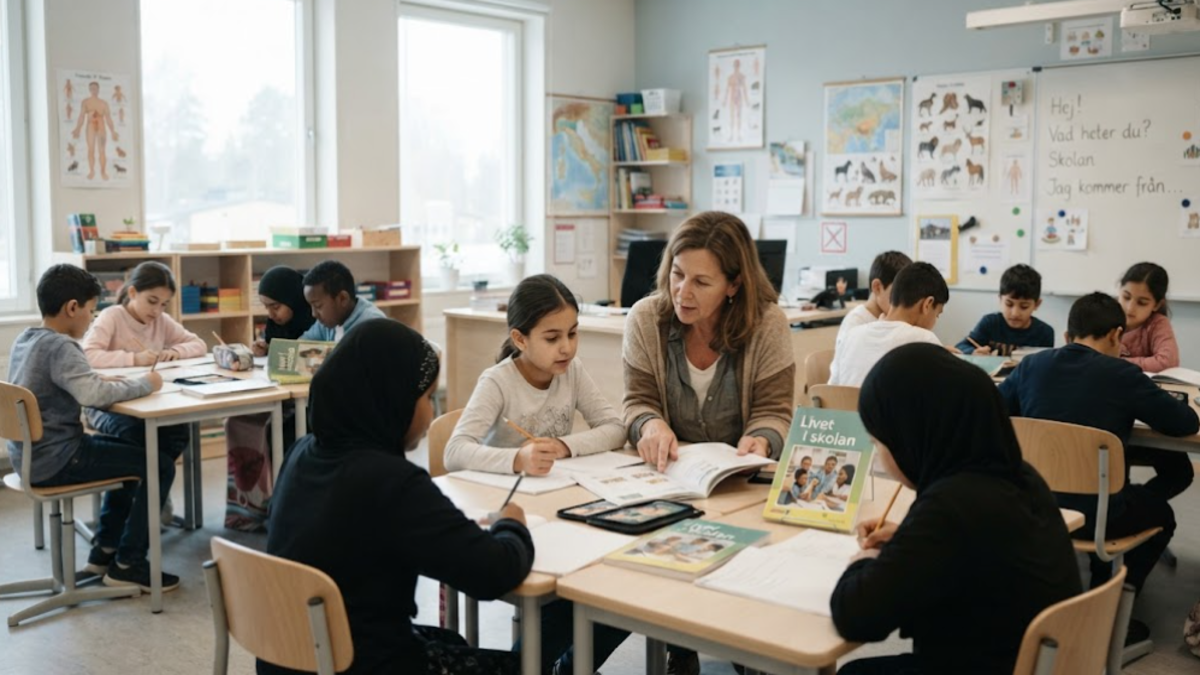
STOCKHOLM – Canadist: Sweden schools for immigrant children and enrollment

Swedish education authorities state that newly arrived pupils are covered by the same general school rules as other students. At the same time, specific provisions apply to newly arrived children, including an initial assessment of their knowledge and certain support measures.
The Swedish National Agency for Education, Skolverket, defines a newly arrived pupil under the school legislation as a child who has lived abroad, is now living in Sweden and began education in Sweden after the start of the autumn term in the calendar year when the child turns seven.

This means that a child’s previous education and knowledge can be considered when the school plans the pupil’s education. The authorities also provide guidance for schools on how to organize teaching for newly arrived students and how to follow their progress.
The system is not limited to placing a newly arrived child in a classroom. Swedish guidance emphasizes planning, follow-up and cooperation between schools, teachers and students. Skolverket also highlights cooperation between subject teachers and study supervisors as an important part of supporting newly arrived pupils.
Sweden schools for immigrant children and Swedish-language support
Language support is an important part of the Swedish education framework for pupils who have another first language.
In compulsory school and equivalent forms of education, pupils who have a language other than Swedish as their mother tongue can receive teaching in Swedish as a second language when they need it. The subject differs from ordinary Swedish because teaching takes a second-language perspective.
The support can also involve a pupil’s strongest school language. Newly arrived students may receive study guidance in their mother tongue or another language in which they have stronger academic skills. According to Skolverket, this support can help pupils develop knowledge in different school subjects while they continue developing their Swedish.
Schools can also provide mother-tongue instruction. Official guidance says that pupils with another mother tongue can have the right to mother-tongue teaching from the first year of compulsory school, subject to the applicable rules. Students belonging to a national minority have specific additional rights.
The approach therefore combines Swedish-language development with measures that allow children to continue learning through languages they already understand.
Recent focus on language development
Sweden is also examining how early language development can be strengthened for children who do not encounter enough Swedish at home.
The government has appointed an inquiry to develop proposals for compulsory preschool with language-development measures in certain cases. The assignment concerns children who are not sufficiently exposed to Swedish in their home environment and who show significant shortcomings in Swedish-language development as a result.
The inquiry is expected to present its proposals by the stated deadline in the government assignment. The measure concerns preschool rather than compulsory school, but it forms part of the broader discussion about language development before children enter school.
Research published by the Swedish Institute for Evaluation of Labour Market and Education Policy has also examined targeted support for newly arrived and multilingual pupils. Its evaluation found that a school-development program involving teacher professional development and support for school management improved results in national tests in mathematics and Swedish. The researchers reported particularly pronounced gains among pupils with a foreign background, boys and pupils toward the lower end of the test-score distribution.
The study evaluated a program implemented through a randomized rollout to 63 municipalities, with the intervention taking place between 2016 and 2019 and student outcomes followed over several years.
What language support can include
For newly arrived children, Swedish schools can combine several forms of support depending on the pupil’s needs.
These measures include Swedish as a second language, mother-tongue instruction and study guidance in a language the pupil understands well. Teachers are also encouraged to use language- and knowledge-development approaches across different subjects rather than treating language learning as separate from academic learning.
The Swedish National Agency for Education provides detailed guidance for schools on teaching newly arrived pupils and organizing cooperation between teachers and study supervisors.
FAQ
Can newly arrived immigrant children attend Swedish schools?
Yes. Newly arrived pupils are covered by the Swedish school system, with specific rules and support measures applying to newly arrived students.
Can immigrant children study Swedish as a second language?
Yes. Pupils who have another mother tongue can receive Swedish as a second language when they need it.
Can children receive support in their first language?
Yes. Newly arrived pupils can receive study guidance in their mother tongue or another language in which they have stronger school-language skills.
Is Sweden considering additional language support before school?
Yes. The government has commissioned an inquiry into compulsory preschool with language-development measures in certain cases.
Contact: info@alswedalyom.com