

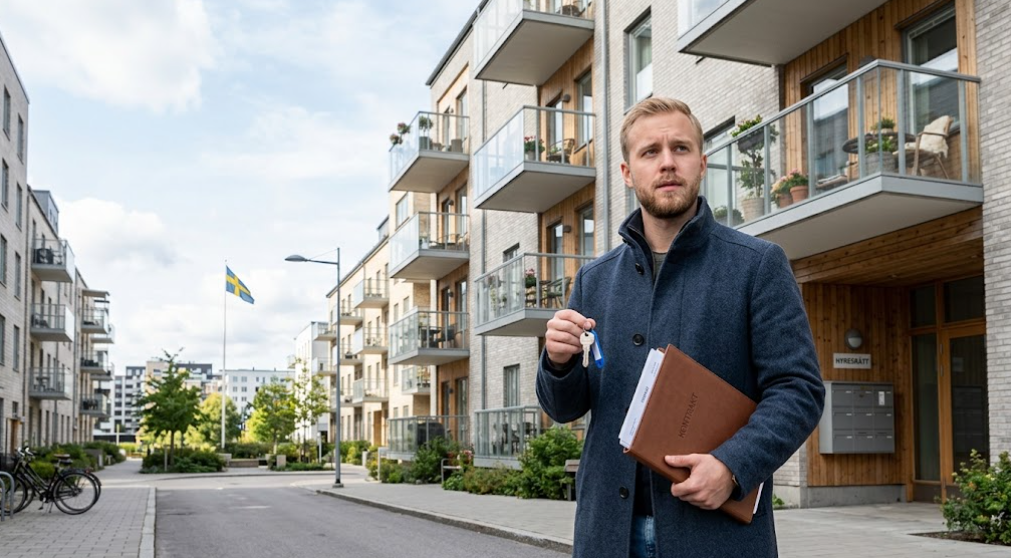
STOCKHOLM – Swedist: Sweden Renting an Apartment has become an important issue for people moving to Swedish cities, particularly those unfamiliar with the country’s rental system. Deposits, first-hand and second-hand contracts, notice periods and protection against unfair rental practices can all affect a tenant’s finances and security. With housing competition remaining a central concern in several Swedish markets, what should renters know before signing an apartment contract?

Sweden Renting an Apartment: What Tenants Need to Know
Renting a home in Sweden can look straightforward from the outside, but the system contains several rules that are different from those in many other European countries.
The first distinction concerns the type of rental. A tenant may hold a first-hand rental contract, known in Swedish as a förstahandskontrakt, or rent the property second-hand from another tenant or from a private owner.

First-hand contracts are generally associated with long-term rental housing and regulated rents. Access can be difficult because applicants often compete through housing queues, particularly in larger urban areas.
Second-hand renting is much more common among people who have recently moved to Sweden, students, workers on temporary assignments and others who have not yet secured a first-hand contract. However, the legal position can differ depending on the type of property and the agreement involved.
Recent guidance available to renters continues to underline the importance of understanding exactly what kind of contract is being offered before money changes hands.
The distinction matters because a second-hand tenant should establish that the person offering the apartment actually has the right to rent it out. In many cases, the original landlord or a housing association must approve a sublet.
A tenant who skips this verification can face problems later, including the risk that the arrangement ends earlier than expected.
The Swedish system also places importance on written documentation. A renter should not rely solely on messages, verbal promises or an advertisement. The contract should identify the apartment, the parties, the rent, the rental period and other important conditions.
For newcomers, this paperwork provides more than administrative certainty. It can become crucial evidence if a disagreement develops over rent, damage, notice or the return of a deposit.
Sweden Renting an Apartment and Security Deposits
Security deposits are another issue that frequently causes confusion.
In Sweden, deposits can be agreed between a landlord and tenant, particularly in private or second-hand rentals. However, there is no universal statutory rule establishing a standard deposit amount for every residential rental situation.
This means renters should pay close attention to the wording of the agreement.
A deposit should not be treated as simply another monthly rent payment. Its purpose is normally to provide security for obligations such as unpaid rent or damage that goes beyond ordinary wear and tear.
Before transferring money, tenants should ask what the deposit covers, when it will be returned and under what circumstances the landlord may make deductions.
The safest approach is to put those conditions in writing.
Tenants should also document the condition of the apartment when they move in. Photographs or videos showing walls, floors, appliances, bathrooms, windows and furniture can become useful evidence if the landlord later claims that damage occurred during the tenancy.
An inventory or written inspection report can provide additional protection.
The same principle applies when leaving the property. Tenants should record the condition of the apartment after their belongings have been removed and keep evidence of the date on which the keys were returned.
If a landlord intends to retain part of a deposit, the tenant should request an explanation and documentation supporting the deduction.
Current rental guidance also makes clear that renters should be cautious about demands for money connected to obtaining a rental contract. The sale or purchase of ordinary residential rental contracts is illegal in Sweden, and official Swedish information warns tenants about such arrangements.
That distinction is especially important in competitive markets, where people searching for an apartment may encounter offers that appear unusually urgent.
What a Swedish Rental Contract Should Contain
A rental contract should make the essential terms clear before the tenant moves in.
At minimum, renters should check the identity of the landlord or authorised sub-landlord, the address of the apartment, the rent, the rental period and the rules governing termination.
The contract should also clarify what is included in the rent.
Depending on the apartment, electricity, heating, water, internet, parking or other services may be treated differently. A tenant who assumes that all household costs are included can face unexpected bills after moving in.
The contract should therefore specify whether utilities are included and, where they are not, how those costs are calculated.
Furniture is another issue for second-hand rentals. If the apartment comes furnished, the agreement should describe the furniture and its condition. An inventory can help prevent later disputes.
The tenant should also check whether pets are permitted, whether smoking is prohibited and whether additional occupants can live in the apartment.
A particularly important question concerns subletting. If the person offering the apartment is themselves a tenant, the renter should establish that the sublet has been authorised where required.
A contract should never be accepted simply because the apartment appears attractive or the landlord says that formal approval is unnecessary.
The renter should also be wary of pressure to pay immediately.
A genuine landlord may have legitimate reasons for requesting payment before the move-in date, but the tenant should first verify the property, the landlord’s identity and the legal basis for the rental.
Copies of the advertisement, correspondence, contract, payment receipts and inspection photographs should be stored together.
These documents can become important if the parties later disagree.
First-Hand and Second-Hand Renting in Sweden
The difference between first-hand and second-hand renting is one of the most important features of the Swedish housing market.
A first-hand rental contract generally gives the tenant a direct relationship with the property owner or housing company. In Sweden’s established rental system, access to these homes can involve housing queues that may be particularly long in high-demand areas.
Second-hand renting works differently.
A person with a first-hand rental contract may rent the apartment to another person, subject to the applicable rules and permissions. Someone who owns a property may also rent it to another person, but different legislation can apply depending on the circumstances.
For a tenant, the practical lesson is simple: do not assume that every rental contract provides the same protection.
The legal framework can depend on whether the apartment is a traditional rental dwelling, a privately owned home, a condominium-style property or another form of accommodation.
Renters should therefore identify the property type before signing.
This issue is especially relevant to people moving to Stockholm, Gothenburg, Malmö and other cities where the supply of immediately available rental homes can be limited.
Earlier reporting on Sweden’s second-hand market has noted both strong competition and the prevalence of relatively short contracts.
That does not mean every second-hand agreement is problematic. It means tenants need to understand exactly what they are signing and who has authority to rent the property.
Tenant Rights When the Apartment Has Problems
Swedish tenants have legal protections concerning the condition and maintenance of rented homes.
A landlord generally has responsibilities for maintaining the dwelling and ensuring that it meets applicable standards. A tenant, meanwhile, must take reasonable care of the property and report problems that require attention.
The distinction between normal wear and tenant-caused damage is particularly important.
A carpet becoming worn through ordinary use is not the same as a tenant breaking a door through negligence. Similar distinctions can apply to walls, appliances, fixtures and other parts of the property.
Tenants should report significant problems promptly and preferably in writing.
Written communication creates a record showing when the landlord was informed and what response followed.
For serious defects, renters should not simply stop paying rent without obtaining appropriate advice. Disputes over repairs and rent can involve specific procedures, and withholding payment without understanding the legal consequences can create additional problems.
The same caution applies when a landlord threatens eviction or termination.
A tenant who receives a formal notice should read it carefully and seek appropriate assistance rather than assuming that the landlord’s demand automatically ends the tenancy.
The Swedish rental system provides tenants with important protections, but those protections do not remove the tenant’s own responsibilities.
Paying rent on time, respecting the property, following reasonable house rules and complying with the contract remain central obligations.
Notice Periods and Ending a Rental
Notice rules depend on the type of tenancy and the circumstances of the rental.
For this reason, tenants should not rely on a general rule found in an online forum or copied from another country’s housing system.
The agreement should be checked first, followed by the legislation that applies to that particular tenancy.
Tenants should give notice in the required form and keep evidence that the landlord received it.
Email can provide useful documentation, although the tenant should follow any formal requirements that apply to the contract.
The end of the tenancy should also involve a practical handover.
Renters should agree on the date for returning the keys, document the condition of the property and settle outstanding utility or other agreed charges.
If the landlord expects an inspection, the tenant should attend where possible and retain a copy of any inspection report.
These steps can reduce disagreements over cleaning, damage and deposits.
Tenants should also remember that moving out does not automatically eliminate legitimate financial obligations. Outstanding rent or documented damage can remain matters between the parties after the keys have been returned.
Illegal Rental Contracts and Key Money
One of the clearest warnings for people looking for housing in Sweden concerns the illegal market for rental contracts.
Official Swedish information states that landlords and tenants are not allowed to accept payment for or sell rental contracts. Rental contracts that are bought and sold are illegal.
This is different from an ordinary security deposit.
A deposit is connected to the tenancy and serves as security for specified obligations. Paying someone simply for the right to obtain a rental contract is a separate matter.
The difference may not always be obvious to someone unfamiliar with Sweden’s housing system.
For that reason, prospective tenants should ask exactly what every payment represents.
A request for unexplained cash, a transfer to a person unrelated to the landlord, or a payment described as a “fee” for obtaining a contract should receive particular scrutiny.
The tenant should also confirm that the person offering the property has the legal right to rent it out.
If an offer depends on avoiding the normal housing process or asks the renter to keep the arrangement secret, that should be treated as a warning sign rather than an opportunity.
How Renters Can Protect Themselves Before Moving In
Preparation can prevent many rental disputes.
First, verify the landlord’s identity. If the property is being sublet, ask for evidence that the person has permission to sublet.
Second, inspect the apartment before paying substantial amounts of money.
Third, make sure the contract is complete. Avoid signing documents containing blank sections that could later be changed.
Fourth, clarify the rent and every additional cost.
Fifth, record the condition of the property with dated photographs.
Sixth, keep proof of every payment.
Seventh, save the original advertisement and important messages.
These steps are especially useful for international tenants who may be unfamiliar with Swedish terminology.
Renters should also understand whether the apartment is covered by the Swedish Tenancy Act or by rules applicable to private residential rentals.
That legal distinction can affect rent, notice rights and other aspects of the relationship.
When in doubt, tenants should obtain advice from a recognised Swedish tenant organisation, consumer service or legal adviser before signing an agreement they do not understand.
Sweden’s Rental Market Remains Competitive
The wider housing market helps explain why rental scams and contract disputes can become serious issues.
In larger Swedish cities, people may face long waits for first-hand rental housing. That creates demand for second-hand apartments and short-term arrangements.
Earlier reporting has described the difficulties of obtaining first-hand contracts and the widespread use of second-hand rentals among people who cannot access the traditional queue system.
Current housing policy also continues to address access to rental housing. Boverket reports that municipalities have new responsibilities concerning rental guarantees for certain families, illustrating how housing access remains part of the broader national housing discussion.
For individual tenants, however, the immediate priority remains understanding the specific apartment and contract in front of them.
A competitive market does not remove the need for documentation.
Nor does urgency mean a renter should accept unclear conditions.
A tenant who takes a few additional steps before paying can often identify problems that would otherwise become expensive disputes.
A Practical Checklist for New Tenants
Before signing a Swedish rental agreement, renters should be able to answer several basic questions.
Who legally owns or controls the apartment?
If it is a sublet, has the required permission been obtained?
What type of rental agreement is being offered?
How much is the monthly rent?
What does the rent include?
Is there a deposit, and exactly when will it be returned?
What deductions can be made from the deposit?
What is the notice period?
Are electricity, internet, water and other services included?
Are pets or additional occupants allowed?
Has the condition of the apartment been documented?
Have all payments been made to the correct party?
Are receipts available?
If the answer to any of these questions is unclear, the renter should resolve the issue before signing or transferring money.
The most important principle is that a tenant should understand the agreement before becoming legally committed to it.
Sweden’s rental rules can provide meaningful protection, but those protections work most effectively when tenants keep documentation and understand the type of tenancy they have entered.
FAQ: Sweden Renting an Apartment
Can a landlord in Sweden ask for a deposit?
Yes. A security deposit can be agreed in a residential rental, particularly in private or second-hand arrangements. The contract should clearly state the amount, purpose, possible deductions and return arrangements.
Are rental contracts bought and sold legally in Sweden?
No. Swedish official information states that buying and selling residential rental contracts is illegal. Tenants should be particularly cautious about payments demanded simply for obtaining a rental contract.
What should I check before signing a rental contract?
Check the landlord’s identity, the landlord’s right to rent out the apartment, the rent, additional costs, rental period, notice terms, deposit conditions and the property’s condition.
Do Swedish tenants have legal protection?
Yes, but the protection depends partly on the type of tenancy and the legislation that applies. First-hand rentals, second-hand rentals and privately owned homes can be subject to different rules, so tenants should establish which legal framework covers their agreement.
Contact: info@alswedalyom.com