

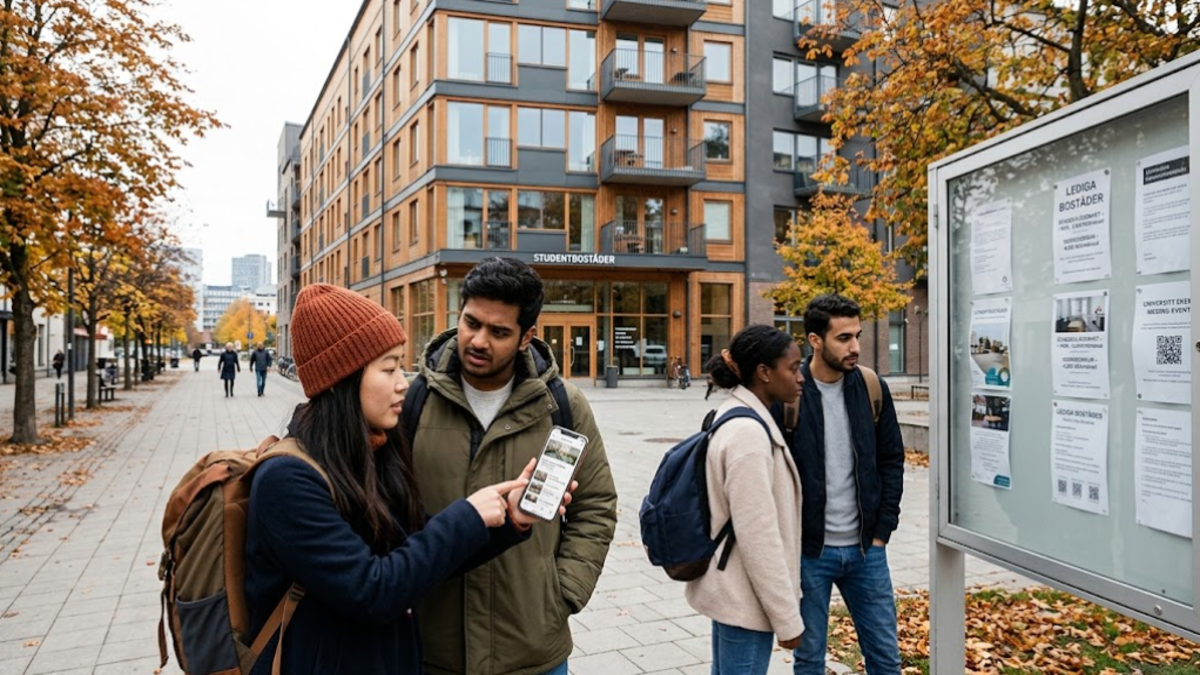
STOCKHOLM – Swedist: Sweden Bachelor’s Degree for International Students: Application Guide

Sweden is again attracting attention among international students looking for English-taught bachelor’s degrees in Europe, with recent education coverage highlighting the country’s range of universities, transparent tuition structures and growing appeal as an alternative study destination. At the same time, Swedish authorities have introduced important changes affecting international students, particularly around residence permits, financial requirements, academic progress and work alongside studies.
For prospective students, the challenge is not simply choosing a university. Applicants must understand academic eligibility, English-language requirements, application rounds, documentation, tuition fees and immigration procedures before committing to a Swedish degree. So, what exactly does an international student need to do to apply for a bachelor’s degree in Sweden?

Sweden Bachelor’s Degree for International Students: Where to Start
The first step is to identify an eligible bachelor’s programme and check its specific entry requirements. Sweden’s official admissions system brings together applications to higher-education courses and programmes across the country, including programmes taught in English.
International applicants should normally use the first admissions round. The Swedish admissions authority describes this round as the international application round because it takes place well before the semester starts and gives students more time to complete tuition payments, arrange housing and, where necessary, obtain a residence permit.
This timing matters particularly for students from outside the European Union and European Economic Area. Applying late can leave too little time for immigration procedures even if the applicant receives an academic offer.
The application system also allows students to rank their choices. Applicants should therefore consider the order of their preferred programmes carefully rather than treating the list as a simple collection of independent applications.
Most bachelor’s programmes begin in the autumn. The official admissions authority notes that comparatively few bachelor’s programmes begin in the spring semester.
That makes the autumn intake the principal target for many international applicants.
For students planning ahead, the next international autumn application period opens in October, with the main application deadline in January. Supporting documents and application-fee requirements follow shortly afterward, while admissions decisions for bachelor’s programmes are released in April.
The exact deadlines should always be checked before submission because universities can impose additional programme-specific requirements.
Academic Requirements for a Swedish Bachelor’s Degree
International applicants must demonstrate that they meet Sweden’s general entry requirements for bachelor’s-level study.
A key requirement is completion of upper-secondary education with final school grades. Applicants also need to satisfy the specific requirements attached to their chosen programme. These may include particular subjects, grades or other qualifications.
The distinction between general and specific eligibility is important. A student may have completed secondary education and still be ineligible for a particular degree if the programme requires subjects that the student did not study.
University Admissions Sweden evaluates qualifications according to the applicant’s educational background and country-specific documentation rules. Students should therefore avoid relying on comparisons such as “my grades are high enough” without checking the official requirements for their own qualification.
Applicants who are still in their final year of secondary education also need to pay attention to timing. The admissions authority warns that students without final grades may not be able to compete in the same way during an early autumn application round because selection can depend on completed upper-secondary results.
This can affect students following international curricula as well as applicants finishing school in their home countries.
Another major requirement is English proficiency.
Because many Swedish bachelor’s programmes aimed at international students are taught in English, applicants generally need to demonstrate that they meet the required level. The exact method of proving English proficiency depends on the applicant’s educational background and the admissions rules.
A student should not automatically assume that studying some subjects in English will satisfy the requirement. The admissions authority has specific rules governing which qualifications can demonstrate English proficiency.
How to Apply Through Sweden’s Central Admissions System
Once students identify their programmes, they can create an account with University Admissions Sweden and submit their choices online.
The central system is important because international applicants do not normally need to send separate general applications to every Swedish university simply to begin the admissions process. Instead, programmes are selected and ranked through the national admissions platform.
Applicants should begin by searching for suitable bachelor’s programmes. Programme pages provide information about subjects, universities, locations, study formats and entry requirements.
The next step is ranking.
Students should put their preferred programme first and arrange their remaining choices according to genuine preference. Ranking is not merely an administrative detail. The admissions system uses the order of choices when determining offers.
After submitting the application, students must ensure that all required documentation reaches the admissions system before the relevant deadline.
This is one of the most common points at which applications can fail.
An application may look complete from the student’s perspective while still missing an official transcript, diploma, English-language evidence or proof of citizenship needed for fee assessment.
International applicants should therefore prepare their documents before the application window closes rather than waiting until the final day.
The official admissions authority specifically advises applicants not to wait until the deadline to submit documents. An incomplete application cannot be processed properly, and late documentation can affect eligibility.
Documents International Students Need
The exact document list varies according to the applicant’s country and educational system, but international bachelor’s applicants should generally expect to provide evidence of their completed secondary education and academic results.
Typical documentation can include a secondary-school diploma, academic transcripts and proof of English proficiency where required.
Applicants may also need to provide identification or citizenship documentation for fee-status purposes.
Students should pay close attention to document-format rules. A document that is academically valid may still require a particular form of certification, translation or submission procedure.
This is especially important for applicants whose documents are not issued in English, Swedish, Danish, Finnish, Norwegian or another language accepted by the admissions authority.
Country-specific instructions are therefore more reliable than general study-abroad checklists.
Applicants should also keep copies of every document submitted. Maintaining a complete personal record can make it easier to respond if the admissions authority requests clarification.
Another important issue is the application fee.
Applicants who are not exempt from the Swedish application fee must pay it by the stated deadline. Citizens of the European Union, European Economic Area and Switzerland generally fall under different fee rules, but citizenship must be documented when required.
Failure to pay an applicable application fee can prevent an otherwise eligible application from being considered.
Tuition Fees and the Real Cost of Studying in Sweden
Sweden is not automatically tuition-free for all international students.
Students from outside the EU, EEA and Switzerland generally have to pay tuition fees for higher education. The amount depends on the university and programme.
Recent education coverage has highlighted the wide variation in tuition costs among Swedish institutions. One recent comparison, for example, identified bachelor’s-level tuition of roughly SEK 306,000 for a three-year programme at one institution, illustrating why applicants need to examine individual university fee schedules rather than rely on a single national figure.
The total cost of a degree is considerably broader than tuition.
Students need to budget for accommodation, food, transportation, study materials, insurance and everyday expenses. Stockholm is generally a more expensive student city than many smaller Swedish locations, while housing availability can also influence the overall budget.
The financial calculation should therefore be completed before accepting an offer.
Applicants should also check whether their university offers scholarships or tuition reductions. Funding opportunities vary significantly between institutions and programmes, and students should never assume that admission automatically includes financial support.
A scholarship may cover all or part of tuition, but students should verify whether it also covers living expenses.
Residence Permit Rules for Non-EU Students
Admission is only one part of the process for students from outside the EU and EEA.
In most cases, a non-EU/EEA student who plans to study in Sweden for longer than a short period needs a residence permit for higher education. The Swedish Migration Agency states that the permit must be issued before the student travels to Sweden in the relevant circumstances.
The immigration application requires more than an admission letter.
Students must normally have been finally admitted to full-time studies. For university and university-college studies, 30 credits per semester constitutes full-time study.
Tuition-paying students must also have paid the required tuition fees before applying for the residence permit. The Swedish Migration Agency receives confirmation from the institution once the payment has been made.
Financial maintenance is another central requirement.
For applications under the current rules, students must demonstrate sufficient funds to support themselves for the period covered by the permit. The Migration Agency currently sets a monthly maintenance figure and permits certain combinations of personal funds, scholarships, eligible grants or loans, sponsorship arrangements and employment income to satisfy the requirement.
This means students should not wait until after admission to consider their financial evidence.
Bank statements and other financial documents need to meet the authority’s specific requirements. A family member’s willingness to provide money is not automatically treated in the same way as funds held in the student’s own account.
Important Changes Affecting International Students
The latest Swedish immigration rules have introduced significant changes for higher-education students.
One of the most important changes concerns employment during studies. Students covered by the new rules generally face a maximum of 15 hours of work per week during the semester, while June, July and August have different rules.
This is particularly relevant to students who previously expected part-time employment to cover a substantial portion of their living expenses.
A student should therefore treat employment as supplementary income rather than the foundation of a residence-permit financial plan.
The rules also place greater emphasis on academic progress.
For students whose residence permit falls under the newer requirements, the Migration Agency states that students studying full time must complete at least 37.5 credits during the first year and 45 credits during each subsequent year to meet the stated progress threshold for an extension.
That makes academic performance an immigration issue as well as an educational one.
Students also face an address-notification requirement in relevant circumstances. The Migration Agency says students must notify the agency of their address within 30 days after receiving a permit and again after changing address, unless population registration means the obligation does not apply.
These changes make it especially important for international students to understand that immigration compliance continues after arrival.
Choosing the Right Swedish University
Sweden offers a broad selection of universities and university colleges, but applicants should select a programme rather than simply choosing an institution based on international reputation.
The first question should be whether the bachelor’s degree matches the student’s academic and professional goals.
The second is whether the programme is taught in English and whether the applicant meets its subject-specific requirements.
The third is affordability.
Tuition can vary substantially between programmes, and living costs can also differ according to location. A prestigious programme may not be the best practical choice if its total cost exceeds the student’s available resources.
Location matters for another reason: housing.
Students should investigate accommodation options as soon as they receive an offer. Finding housing in major university cities can be challenging, particularly near the beginning of an academic year.
Students should also consider teaching style.
Swedish higher education often places emphasis on independent learning, discussion, collaboration and critical thinking. Applicants who are accustomed to heavily teacher-directed education may need time to adjust.
That does not mean the system is easier or harder. It means students should understand the expectations before enrolling.
Application Timeline for Future International Applicants
Planning several months ahead can make the difference between a smooth application and a rushed one.
For the next autumn international admissions round, the application window opens in October. The main deadline falls in January, followed by deadlines for application fees and supporting documents in February. Bachelor’s admissions decisions are then scheduled for April.
Students should ideally begin preparing before the application portal opens.
A sensible preparation sequence is straightforward.
First, identify several programmes.
Second, check the general and programme-specific eligibility rules.
Third, review country-specific document instructions.
Fourth, arrange English-language evidence if necessary.
Fifth, prepare and submit the application through University Admissions Sweden.
Sixth, monitor the account for missing-document notifications and the eventual admissions decision.
For students who need a residence permit, the process continues after receiving the academic offer.
The student must satisfy the immigration requirements, including tuition payment where applicable and proof of financial maintenance.
Waiting until the last moment can create serious problems because admission, tuition payment, immigration processing and housing arrangements all have to fit together.
The official admissions authority specifically recommends the first international application round for international students because its earlier schedule leaves more time for these steps.
What International Students Should Avoid
One of the biggest mistakes is assuming that every Swedish university follows identical admissions rules.
The central admissions system provides the framework, but individual programmes can have additional requirements.
Another mistake is applying only to programmes that appear attractive without checking eligibility first.
Students should also avoid relying on outdated information about work rights, financial requirements or residence permits. Sweden’s immigration rules have changed, and current requirements can directly affect a student’s budget and study plans.
A third mistake is treating the application deadline as the only important date.
The documentation deadline, fee deadline, admissions decision and residence-permit process all matter.
Finally, students should not build their financial plan around a part-time job. The current residence-permit framework limits work during the semester for students covered by the new rules, making adequate financial preparation essential.
Final Checklist Before Applying
Before submitting a bachelor’s application to Sweden, international students should confirm five areas.
Academic eligibility: Have you completed the required upper-secondary education, and do you meet the specific requirements of the programme?
English: Can you document the required level through an accepted qualification or test?
Documents: Have you submitted every required transcript, diploma, certificate and identification document according to the rules for your country?
Money: Can you afford tuition and living expenses, and can you demonstrate sufficient financial maintenance if a residence permit is required?
Immigration: If you are from outside the EU/EEA, have you planned the residence-permit process, tuition payment and arrival timeline?
Getting these points right does not guarantee admission. Selection depends on the programme, applicant pool and available places. But careful preparation can prevent avoidable administrative problems.
For students who want an English-taught European bachelor’s degree, Sweden remains an option worth investigating. Recent coverage has also pointed to the country’s comparatively transparent tuition structures and its growing position among alternative destinations for international students.
The strongest applicants will be those who approach the process as a complete project rather than a single online form: academic preparation, programme selection, documentation, finances, immigration and housing all need to work together.
FAQ
Can international students study for a bachelor’s degree in Sweden?
Yes. Sweden offers bachelor’s-level courses and programmes for international students, including programmes taught in English. Applicants must satisfy the general and programme-specific entry requirements.
Do non-EU students pay tuition fees in Sweden?
Generally, students from outside the EU/EEA and Switzerland are required to pay tuition fees, although the amount varies by programme and university.
Do international students need a residence permit?
Students from outside the EU/EEA generally need a residence permit for longer higher-education studies in Sweden. The permit has academic, financial and other requirements.
Can students work while studying?
Students covered by the newer residence-permit rules generally have a 15-hour-per-week limit during semesters, with different rules applying during the summer months and to certain types of work.
Contact: info@alswedalyom.com