

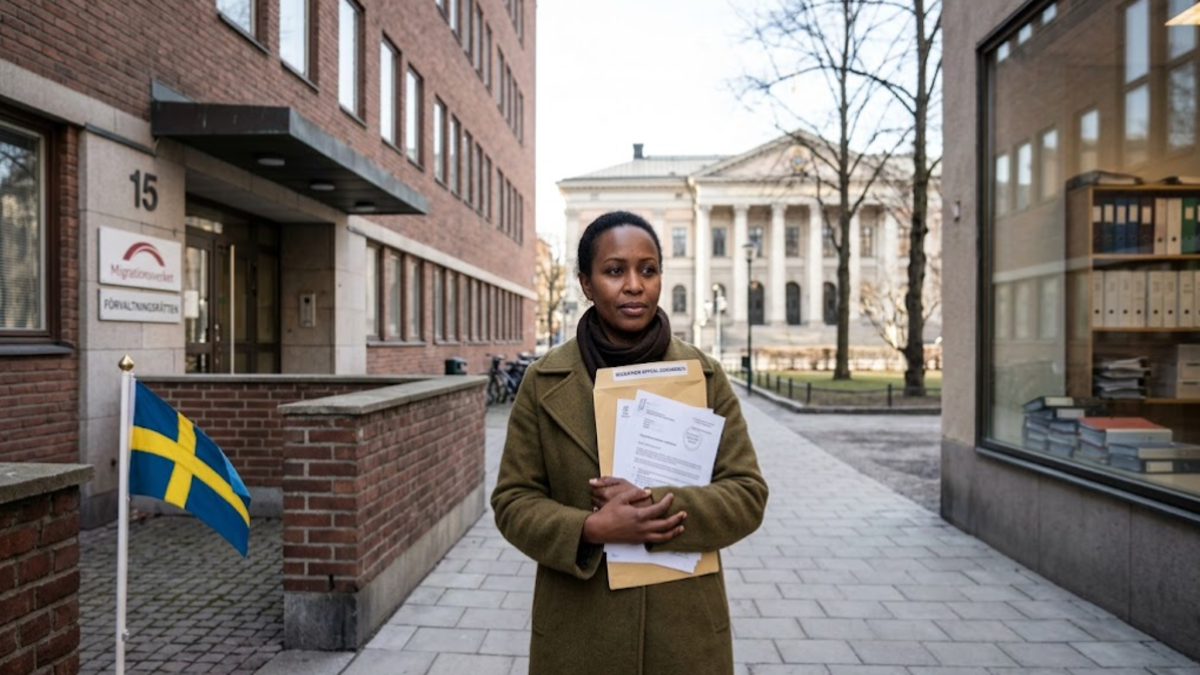
STOCKHOLM – Swedist: A rejected residence permit can be a major setback for anyone hoping to live, work, study or reunite with family in Sweden, but a refusal from the Swedish Migration Agency is not necessarily the end of the process. Recent cases involving foreign residents have again put the country’s migration appeal system under scrutiny, raising an important question: what can applicants actually do after Sweden rejects a residence permit?

For many applicants, the next step is an appeal to a migration court. Swedish rules generally allow people to challenge decisions made by the Migration Agency, although the exact procedure, deadline and right to remain in Sweden depend on the individual decision.
The issue has attracted renewed attention after several high-profile cases involving British citizens who have lived in Sweden for many years. Recent reporting has highlighted the difficulties faced by people whose residence applications were rejected, particularly those affected by post-Brexit rules.

The cases also illustrate why an appeal must address the specific reasons given by the authorities rather than simply repeat the original application.
Sweden Migration Appeal begins with the rejection decision
The first step for an applicant who wants to challenge a rejected residence permit is to read the decision carefully.
The Swedish Migration Agency states that most of its decisions can be appealed. The decision itself explains whether an appeal is possible, how it must be submitted and the deadline that applies to the individual case.
This detail matters because there is no single deadline that applies to every type of migration case. Applicants should therefore follow the instructions contained in their own decision rather than rely on a general timetable found elsewhere.
An appeal is submitted to the Swedish Migration Agency, even though a court normally examines the case. The agency first has an opportunity to reconsider the decision. If it does not change the decision, it forwards the appeal to the appropriate court.
In most cases, that court is the Migration Court. Some matters can instead go to an Administrative Court, while special cases can involve other authorities.
The distinction is important because an applicant does not normally send the initial appeal directly to the court. The Swedish Migration Agency remains the first recipient of the appeal.
The official agency’s guidance on the procedure is available through Swedish Migration Agency: How to appeal a decision.
What should a rejected applicant include in an appeal?
An effective appeal should respond directly to the reasons for refusal.
If the Migration Agency says that an applicant failed to provide sufficient evidence, the appeal should explain why the evidence supports the applicant’s position and, where possible, provide additional documentation.
The same principle applies when the refusal concerns employment, family ties, financial requirements, studies, residence status or another legal condition. Simply saying that the applicant disagrees with the decision is unlikely to explain why the authority should reach a different conclusion.
Applicants should identify the decision being challenged and clearly state what they want changed. They should also explain the grounds for the appeal and include relevant supporting documents.
The strongest appeals are therefore usually evidence-based. Employment contracts, salary information, proof of accommodation, family documents, study records or other material may become important depending on the grounds for the original application.
The applicant should also make sure that documents are presented in a way that allows the authorities and court to understand their relevance.
A person who believes the Migration Agency misunderstood a document, overlooked important circumstances or applied the rules incorrectly should address that point specifically.
Sweden Migration Appeal and the role of the Migration Court
Once the appeal reaches the court, the case moves beyond the initial administrative decision.
The Migration Court examines the appeal and decides whether the Migration Agency’s decision should remain in force or be changed. The court applies the relevant Swedish migration legislation and rules governing the particular type of application.
The court’s involvement does not mean that every rejected application will be overturned.
The Swedish Migration Agency itself warns applicants in asylum cases that courts apply the same laws and rules and that it is unusual for the court to change an agency decision.
That makes the contents of the appeal especially important.
A successful challenge normally needs to identify a concrete legal or factual reason for changing the original outcome. New evidence can be relevant, but applicants should explain why it matters and how it addresses the reasons for refusal.
The court may also consider information already contained in the case file. Applicants should therefore avoid treating the appeal as a completely separate application.
Instead, it should function as a focused challenge to the decision that has already been made.
Recent cases put Sweden’s migration appeals under the spotlight
The practical consequences of the appeal system have become particularly visible in recent cases involving British citizens affected by post-Brexit residence rules.
One of the cases concerns Horace Mason, a British man who has lived in Sweden for about 25 years and has advanced dementia and other serious health problems. His family challenged the decision requiring him to leave Sweden after authorities concluded that he had not demonstrated that he met the requirements for residence.
The case eventually reached the Migration Court of Appeal after an earlier appeal was rejected. Reporting on the case said the court considered Sweden’s interest in regulated immigration against Mason’s personal circumstances and concluded that his removal was proportionate.
Another case has involved Joyce Thomas, a 78-year-old British widow who lived in Sweden for more than two decades.
Thomas’s residence application was considered late under the post-Brexit system. Her supporters have argued that she was not adequately aware of the requirement to apply by the relevant deadline and that her long-standing family and personal connections to Sweden should have received greater consideration.
These cases demonstrate that an appeal can involve more than paperwork. Where the law permits consideration of personal circumstances, applicants may need to provide detailed evidence about their family life, health, residence history and connections to Sweden.
At the same time, courts must apply the legal framework governing residence rights, which means personal circumstances do not automatically result in permission to remain.
Why evidence can determine the outcome
A residence permit case can turn on a relatively specific requirement.
For a work-related application, for example, the relevant evidence may concern employment and the conditions attached to the job. For family reunification, documentation proving the family relationship and other applicable requirements can be central.
For students, evidence connected to admission and the conditions of the study permit may matter. For other applicants, the decisive issue can involve financial support, identity, residence history or another statutory requirement.
That is why an appeal should not become a general statement about why someone wants to live in Sweden.
The applicant needs to connect the evidence to the legal issue identified in the rejection.
This is also where professional legal assistance can become useful, particularly when the refusal involves complicated migration rules or a long procedural history. A lawyer or qualified representative can examine the decision, identify the relevant legal questions and help organize evidence.
However, applicants should still check the instructions in their decision even when they have legal representation. The formal deadline remains critical.
Can you remain in Sweden while an appeal is pending?
A common misunderstanding is that filing an appeal automatically gives everyone the right to remain in Sweden.
That is not necessarily the case.
The Migration Agency says that the decision will indicate whether the applicant has the right to remain in Sweden while the appeal is being examined. In some residence-permit cases, a person can remain during the court process, while other decisions may require departure.
Applicants therefore need to check the wording of their own decision.
This is particularly important when the refusal includes a departure deadline. An appeal should be submitted within the stated period, while the applicant should also understand what the decision says about their status during the proceedings.
The situation can become more complicated once a decision becomes legally binding.
The Migration Agency states that a decision can no longer be appealed after it has gained legal force.
Missing the appeal deadline can therefore have serious consequences.
What happens after the Migration Court?
A Migration Court decision may itself be appealable, but this does not mean that every case automatically reaches a higher court.
The decision from the Migration Court will state whether a further appeal is possible and the deadline for submitting it. If an applicant challenges a court decision, the appeal must be sent to the court that issued that decision rather than back to the Migration Agency.
The Migration Court of Appeal serves as the final court in the migration court system and has an important role in establishing legal precedent.
This means that access to the higher court can depend on the circumstances of the case and the conditions stated in the court’s decision.
Applicants should therefore read every new decision carefully rather than assuming that another automatic appeal is available.
Avoiding common mistakes after a residence permit refusal
One of the biggest mistakes is waiting too long.
The appeal deadline is set out in the decision, and applicants should treat it as a firm procedural requirement.
Another mistake is submitting an appeal without addressing the actual reason for refusal. A long personal explanation may not help if it fails to answer the legal or factual issue identified by the Migration Agency.
Incomplete documentation can also weaken a case.
Applicants should review the evidence they originally submitted and compare it with the reasons given for rejection. If something was missing, they should determine whether it can now be provided and explain its relevance.
A further problem can arise when applicants assume that appealing automatically suspends every consequence of the decision. The right to remain depends on the specific case and must be checked in the decision itself.
Finally, applicants should keep copies of everything they submit and make sure they can demonstrate when the appeal was sent.
A rejected permit does not always mean the end of the case
Sweden’s migration system gives many applicants a formal route to challenge an adverse decision.
The process, however, requires precision. The appeal must arrive within the applicable deadline, follow the instructions in the decision and explain why the original ruling should be reconsidered.
Recent cases involving British residents have shown how complex these disputes can become when immigration rules intersect with family life, long-term residence and humanitarian circumstances.
For anyone facing a refusal, the most important first move is to understand exactly what the Migration Agency decided and why.
From there, the applicant can determine what evidence is available, what part of the decision can be challenged and whether professional legal advice is appropriate.
The appeal process cannot guarantee a different result. But for an applicant who has a legal basis to challenge the refusal, missing the opportunity to appeal can remove an important avenue for review.
FAQ: Sweden Migration Appeal
Can I appeal a rejected Swedish residence permit?
Yes. Most decisions made by the Swedish Migration Agency can be appealed, but the decision will specify whether an appeal is available and provide the applicable instructions and deadline.
Where should I send my appeal?
An initial appeal against a Migration Agency decision should normally be submitted to the Swedish Migration Agency. The agency can reconsider the decision and, if it does not change it, forward the appeal to the appropriate court.
Can I stay in Sweden while my appeal is being considered?
It depends on the individual decision. The decision should state whether you have the right to remain in Sweden while the appeal is examined.
Can I appeal a Migration Court decision?
In some cases, yes. The Migration Court’s decision will state whether a further appeal is possible and how long you have to submit it.
Contact: info@alswedalyom.com