
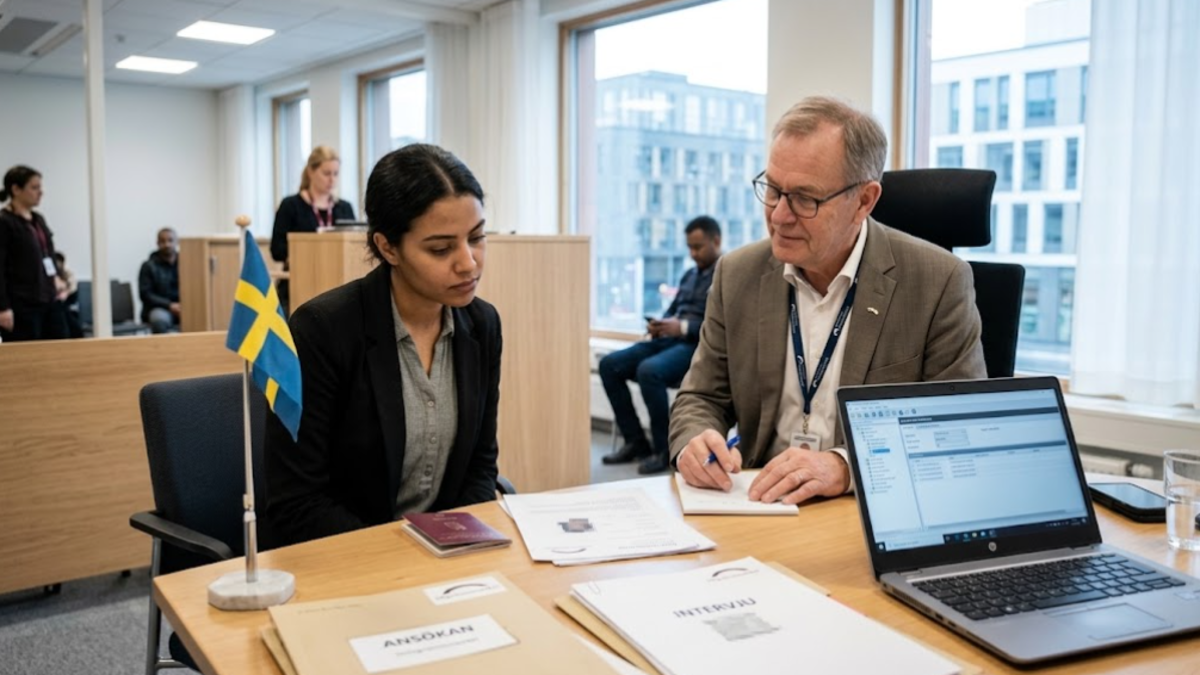
STOCKHOLM – Swedist: Sweden Immigration Interview procedures are drawing renewed attention among people preparing to move to the country for family, work, study or other residence purposes. Recent reporting on Sweden’s increasingly strict migration approach has also highlighted the importance of documentation and compliance, while official guidance shows that interviews can form an important part of some residence-permit applications. So, what questions should applicants expect when they sit down for a Swedish immigration interview?

For many applicants, the interview is not simply a routine appointment. It gives Swedish authorities an opportunity to compare the information provided in an application with the applicant’s own account and, where relevant, examine the circumstances behind a family relationship or plans to live in Sweden.
The exact questions depend heavily on the type of application. A person applying to join a partner can face very different questions from someone applying for a work or study permit. Applicants should therefore avoid relying on a single list of “official interview questions” and instead prepare around the information contained in their own application.

The Swedish Migration Agency, known as Migrationsverket, says applicants who are asked to attend an interview must normally present their passport and the original documents specified for the appointment. In applications to live with a partner or another relative, the agency specifically says the interview will include questions about the relationship.
Sweden Immigration Interview: Why Applicants May Be Questioned
An immigration interview allows officials to obtain information directly from the applicant. It can also help clarify details in the application or documents when the Migration Agency needs additional information before making a decision.
The interview requirement does not apply identically to every immigration case. The procedure depends on the residence permit category, the applicant’s circumstances and the information the agency needs.
For family-reunification applications, the process is particularly clear. After an application is submitted, the person living in Sweden may receive a questionnaire asking about income, housing and the relationship with the applicant. The person in Sweden normally has 14 days to answer the questions.
The applicant may subsequently receive instructions to book an interview at the Swedish embassy or consulate-general identified in the application.
That means applicants should treat the information supplied by both sides as important. Dates, addresses, family details and relationship history should be checked before the interview because inconsistencies can lead to requests for clarification.
Recent Swedish migration coverage has also illustrated how closely residence rights can depend on meeting formal requirements. Cases involving British citizens affected by post-Brexit residence rules have highlighted the consequences that can follow when applicants fail to meet requirements or provide the necessary evidence.
The broader political environment is also significant. Prime Minister Ulf Kristersson has publicly defended a stricter approach to immigration, while Sweden continues to debate migration, integration and the long-term consequences of earlier migration policies.
For an applicant, however, the interview remains focused on the individual case rather than on political arguments.
Sweden Immigration Interview: Questions About Personal Details
One of the most straightforward areas of questioning concerns the applicant’s personal background.
Officials may ask the applicant to confirm information already provided in the application, such as full name, date of birth, nationality, current address and family circumstances.
Applicants may also be asked about their education, employment history or previous residence in other countries, depending on the type of permit being considered.
Typical preparation questions can include:
- What is your full name and date of birth?
- Where do you currently live?
- What is your nationality?
- What do you currently do for work?
- What is your educational background?
- Have you previously lived in another country?
- Have you previously visited Sweden?
- Have you previously applied for a Swedish visa or residence permit?
- Why do you want to move to Sweden?
- What are your plans after arriving?
These should not be treated as a guaranteed script. The Swedish Migration Agency can request additional information whenever it considers that more information is necessary to assess an application.
Applicants should therefore answer the questions asked rather than trying to predict a particular wording.
The safest preparation is to reread the application and make sure the basic facts remain fresh. A person who cannot remember a date precisely should not invent one simply to sound confident. Giving an honest explanation is preferable to supplying a precise but incorrect answer.
Documents also matter. The Migration Agency says applicants attending a family-related interview should bring their passport and the original documents submitted with the application.
Questions About a Relationship and Family Life
For applicants seeking permission to live with a partner in Sweden, relationship questions can form the central part of the interview.
The authorities may want to understand how the relationship began, how it developed and how the couple maintains contact. Official Swedish material includes questions about when the couple considers the relationship to have started, what language they use to communicate and whether they are engaged or married.
Applicants should therefore be prepared to explain their relationship in chronological order.
Possible questions may include:
How did you meet?
Applicants may be asked when, where and how they first met their partner. The answer should correspond with information previously supplied in the application.
When did the relationship become serious?
Officials may ask when the couple began considering themselves a couple, became engaged or married.
How often have you met?
For couples who have lived apart, questions can focus on visits and periods spent together. Applicants may need to explain where meetings took place and approximately when they occurred.
How do you communicate?
The couple may be asked which language they normally use when speaking to one another.
What do you know about your partner?
Questions may cover a partner’s occupation, home, family circumstances and everyday life. The purpose is not necessarily to test the applicant’s memory but to establish the circumstances of the relationship.
Do you have evidence of your meetings?
The Migration Agency’s relationship questionnaire specifically refers to evidence such as tickets, passport stamps and photographs as examples of material that can demonstrate that a couple has met.
This makes organization particularly important for applicants whose relationship developed across borders.
A couple does not need to have an identical memory of every minor event. But major facts should not contradict the information already submitted.
Questions About the Person Living in Sweden
Another important area concerns the person already living in Sweden.
For family applications, the Swedish Migration Agency asks the person in Sweden to complete a questionnaire covering the relationship as well as financial and housing circumstances.
An applicant could therefore be asked questions about:
- Where does your partner live?
- What type of home does your partner have?
- What does your partner do for a living?
- When did your partner move to Sweden?
- What is your partner’s nationality or residence status?
- Have you met your partner’s family?
- How often do you communicate?
- Where do you plan to live after moving?
- What are your plans as a couple in Sweden?
The answers should match the actual circumstances of the family.
This is especially important because the person living in Sweden may have separate obligations connected to the application. The Migration Agency says that, in relevant cases, the person in Sweden must demonstrate that they can support both people and have a sufficiently large home, although exemptions can apply.
The applicant should therefore understand the basic financial and housing arrangements rather than arriving at the interview unfamiliar with where they are expected to live.
Questions About Your Plans in Sweden
The reason for moving to Sweden is another area applicants should be ready to explain.
For a family application, the answer may focus on the intention to establish a shared life with a partner or join a relative.
For other permits, the questions can naturally shift toward employment, education or another legal basis for residence.
The applicant should be able to explain the purpose of the move clearly and consistently.
A person applying to study, for example, should understand the course or programme they intend to attend. A worker should know the basic details of the employment that supports the application.
The Migration Agency has separate procedures for different categories. People from outside the EU/EEA generally need a permit to work in Sweden unless an exception applies, while applicants seeking higher-education study permits must meet requirements connected with their studies.
This distinction matters because there is no universal Swedish immigration interview.
Applicants should prepare for the permit they actually requested rather than memorizing generic answers from social media or immigration forums.
Documents Can Be Just as Important as Answers
An interview is only one part of the immigration process.
Applicants should make sure their documents support the information they provide. The Swedish Migration Agency says documents submitted for relevant family applications should be in Swedish or English, or accompanied by certified translations, with the original-language document also included.
At the interview, applicants should bring their passport and the original documents requested by the agency.
Depending on the case and the applicant’s nationality, fingerprints and a photograph may also be taken during the appointment. The Migration Agency says these can be used for producing a residence-permit card if the application is approved.
Applicants should also remember that additional questions can arise after the interview.
The agency says it will contact the applicant or the person in Sweden if it needs more information. The eventual decision therefore depends on the overall application rather than on a single conversation.
How Applicants Can Prepare Without Memorising Answers
Preparation is useful, but memorising a speech can create problems.
Immigration interviews are based on the applicant’s individual circumstances. Officials may ask follow-up questions when an answer requires clarification.
A better approach is to review the application carefully and make a simple timeline of important events.
For family applicants, that timeline might include the first meeting, the beginning of the relationship, major visits, engagement, marriage, periods of living together and the decision to move to Sweden.
Applicants should also review addresses, employment information and important dates.
If an applicant has submitted photographs, travel records or other evidence, it is sensible to understand what each document shows. The same applies to marriage certificates, birth certificates and other civil documents.
The key is consistency, not performance.
Applicants should answer directly, avoid unnecessary speculation and ask for clarification if they do not understand a question.
They should also distinguish between “I do not remember” and “I do not know.” Both can be legitimate answers when they accurately describe the situation.
Recent Migration Cases Highlight the Importance of Compliance
The attention surrounding Swedish immigration interviews comes at a time when migration policy remains politically sensitive.
Recent reporting has focused on cases involving British residents who have faced difficulties securing post-Brexit residence rights. One widely reported case concerns a British man who has lived in Sweden for decades and whose residence case was rejected after authorities found that the required evidence had not been provided.
Another recent case involved a British widow who faced removal after an unsuccessful appeal concerning a late residence application. The cases have prompted criticism from campaigners and renewed discussion about how Sweden applies post-Brexit residence rules.
These cases are different from a standard residence-permit interview, but they illustrate a broader point for applicants: immigration decisions depend on legal requirements and evidence, not simply on an applicant’s personal circumstances.
The Swedish government has meanwhile continued to promote a restrictive migration agenda. Kristersson has criticized policies that he believes could encourage irregular migration and has argued for tighter European coordination.
For people preparing an application, that political debate should not distract from the practical task of providing accurate information and following the instructions issued by the Migration Agency.
What Applicants Should Expect on Interview Day
The exact format can vary, but applicants should arrive prepared with the documents requested in their appointment instructions.
For relevant residence-permit cases, the Migration Agency says applicants attend an embassy or consulate-general, present their passport and answer questions connected with their application.
Applicants should allow enough time for the appointment and avoid arriving without required documents.
They should also remember that not every Swedish diplomatic mission handles migration cases. The Migration Agency says applicants select an embassy or consulate-general in their application, and some interviews may take place through a video link at a designated location.
For official instructions and the latest requirements, applicants should rely on the Swedish Migration Agency rather than unofficial interview-question lists.
The most important preparation, ultimately, is straightforward: know your own application, understand why you are moving to Sweden, bring the requested documents and answer honestly.
FAQ
1. Does every Sweden immigration applicant have an interview?
No. Interview requirements vary according to the type of residence application and the circumstances of the case.
2. What questions are asked in a family immigration interview?
Questions can focus on the relationship, including how the couple met, their history together, communication, visits and future plans.
3. What documents should applicants bring?
Applicants should follow the appointment instructions and bring their passport and the original documents requested by the Swedish Migration Agency.
4. Can applicants prepare for the interview?
Yes. Reviewing the application, important dates, relationship history, documents and plans in Sweden can help applicants answer accurately and confidently.