

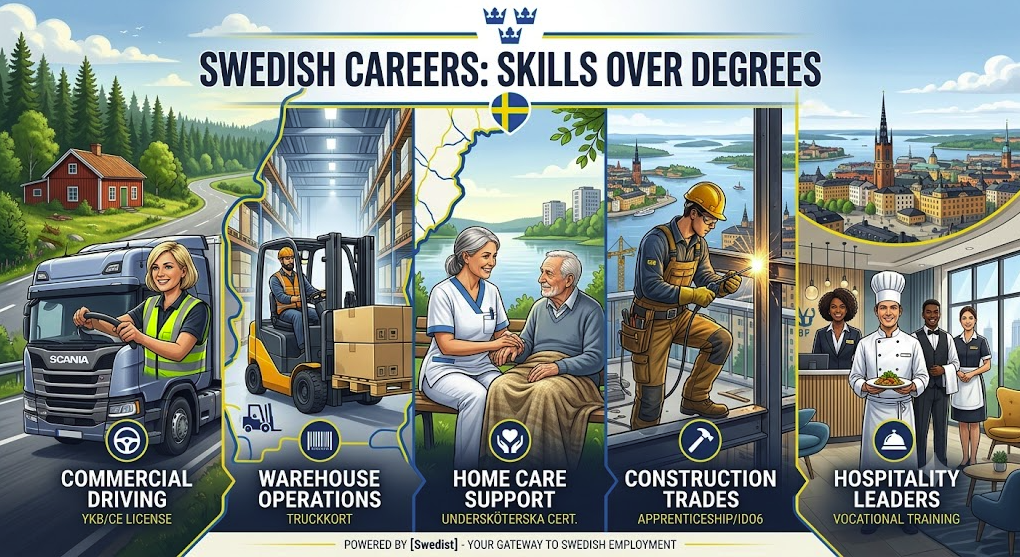
Stockholm – Swedist: 10 In-Demand Jobs in Sweden with No Degree Required represents a massive shift in the Scandinavian labor market, as employers increasingly prioritize practical skills over traditional academic credentials. With numerous sectors facing notable labor shortages, both local residents and newcomers are finding lucrative career paths without spending years in university lecture halls. Have you ever wondered which professional sectors offer the fastest entry into the Swedish workforce while securing a stable financial future?

The modern Nordic job market values efficiency and specialized expertise, allowing individuals to build sustainable careers without accumulating massive student debt. According to recent employment trends, key industries like logistics, healthcare support, and infrastructure development are driving national growth. This comprehensive guide explores the top employment sectors where practical capabilities trump formal degrees, providing a clear roadmap for job seekers aiming for long-term career stability.
What Does the Shift Toward Skills-Based Hiring Mean?
The traditional belief that a university degree is the sole gateway to financial security is rapidly evolving across Sweden. Economic pressures, shifting demographics, and technological advancements have forced Swedish organizations to re-evaluate their hiring criteria, focusing primarily on what a candidate can do rather than the credentials on their resume. This transition, known as skills-based hiring, democratizes the employment market and opens sustainable pathways for diverse talent pools.

For job seekers, this means that vocational training, short-term certifications, and demonstrable technical skills are now highly competitive. Industries are actively designing onboarding programs that prioritize practical assessments over academic backgrounds, allowing individuals to enter the workforce much faster than traditional academic routes permit.
Why Swedish Employers Prioritize Practical Experience
Swedish companies face immediate operational demands that theoretical knowledge cannot always solve. Employers require individuals who can operate machinery, manage supply chains, or provide essential care from day one. Consequently, having practical experience or a specialized license makes a candidate immediately valuable, reducing the training time and costs for businesses.
The Role of Yrkeshögskola and Vocational Training
Instead of spending four years completing a theoretical degree, many professionals opt for higher vocational education, known locally as Yrkeshögskola (YH). These targeted, tuition-free courses combine classroom learning with workplace training, tailored directly to current market shortages. They provide specific competencies required for regulated industries, offering a high return on investment and quick entry into the job market.
10 In-Demand Jobs in Sweden with No Degree Required
+----------------------------+--------------------------+----------------------------+
| Occupation Sector          | Average Monthly Salary   | Key Required Training      |
+----------------------------+--------------------------+----------------------------+
| Commercial Truck Drivers   | 30,000 - 38,000 SEK      | CE / YKB Certification     |
| Warehouse & Logistics      | 26,000 - 32,000 SEK      | Truckkort (Forklift License)|
| Home Care Support Workers  | 25,000 - 31,000 SEK      | Undersköterska / Care Cert.|
| Construction & Trades      | 32,000 - 45,000 SEK      | Apprenticeship / ID06      |
| Hospitality Management     | 28,000 - 36,000 SEK      | Food Safety / Experience   |
+----------------------------+--------------------------+----------------------------+
Commercial Truck Driving and Logistics
The transportation sector forms the backbone of the Swedish economy, ensuring the steady movement of goods across vast domestic and European distribution networks. Commercial truck drivers are in exceptionally high demand, with both long-haul and local delivery routes facing constant personnel shortages. This profession offers excellent earning potential early on, making it a top choice for individuals who enjoy independence on the road.
To enter this field, candidates must obtain a commercial driver’s license (such as a Class C or CE) along with the mandatory professional competence credential known as Yrkesförarkompetensbevis (YKB). Training programs focus heavily on vehicle operation, eco-driving, and strict safety regulations. The investment is minimal compared to university education, yet the starting salaries remain highly competitive.
Warehouse Operations and Supply Chain Specialists
With the exponential growth of e-commerce and global supply chains, fulfillment centers and warehouses across Sweden require a steady influx of organized personnel. Warehouse associates, material handlers, and logistics coordinators keep inventory moving smoothly. These roles are ideal for individuals who prefer structured environments and physical activity.
Progressing in this sector often involves acquiring a Truckkort (forklift license), which is highly valued by employers. Experienced workers frequently transition into team leader or warehouse management roles, demonstrating that strong organizational skills, reliability, and punctuality are the primary drivers of career advancement here.
Home Care and Personal Support Workers
Sweden’s aging population has created an unprecedented demand for compassionate individuals in the healthcare support sector. Home care providers (hemtjänst) and personal assistants assist elderly individuals and people with disabilities with daily living activities, ensuring they maintain independence and dignity within their homes or specialized care facilities.
While entry-level roles may not strictly require a formal degree, completing a short vocational program to become a certified assistant nurse (undersköterska) significantly boosts job prospects and pay. This profession offers deep emotional satisfaction along with exceptional job security, as the demand for healthcare support continues to outpace supply nationwide.
Construction Trades and Infrastructure Builders
The construction sector remains a powerhouse of employment, driven by continuous residential development and major public infrastructure projects. From carpentry and masonry to electrical work and plumbing, skilled trades offer some of the highest-paying opportunities without a university education.
Entry into the construction trades often begins through structured vocational training followed by an apprenticeship period, allowing individuals to earn a competitive wage while learning the trade under experienced professionals. Workers must hold a valid ID06 card for site access, ensuring safety standards are met. As experience builds, independent contracting becomes a highly profitable option.
Hospitality and Food Service Leaders
The hospitality industry offers dynamic career paths for individuals with exceptional communication, problem-solving, and interpersonal skills. From hotel guest services to restaurant management, this sector rewards hard work, adaptability, and leadership capabilities over formal academic backgrounds.
Most professionals in this field start in entry-level positions and advance by demonstrating strong operational capabilities and a commitment to customer satisfaction. Short, targeted courses in hospitality management, guest relations, and kitchen operations can accelerate promotion into managerial roles, where leaders oversee staff, budgets, and guest experiences.
How Does the Swedish Certification and Licensing System Work?
Navigating the pathways to employment without a university degree involves understanding local regulations and training systems. Sweden utilizes a robust framework designed to train, assess, and certify workers through standardized practical systems. This ensures that safety and professional quality remain uncompromised across all sectors.
For those pursuing employment, the Swedish Public Employment Service, Arbetsförmedlingen, serves as a primary resource for finding subsidized training programs and validating existing foreign skills. Understanding how to leverage these programs can significantly shorten the job hunt and boost long-term income potential.
The Mechanism of Paid Work Placements
Many vocational routes incorporate structured work placements, known as LIA (Lärande i arbete), within the vocational school framework. This model allows students to spend a substantial portion of their studies directly at a company, gaining hands-on experience under the supervision of industry professionals. This model allows workers to minimize debt while building immediate industry connections.
[Vocational/YH Application] ➔ [Theoretical Basics] ➔ [LIA Work Placement] ➔ [Professional Certification]
Validating Foreign Experience
Labor regulations in Sweden offer pathways for validating skills acquired abroad through a process called validering. If you have years of experience in construction, driving, or healthcare from another country, authorities can assess your practical knowledge through practical tests, bypassing the need to complete full length educational tracks.
Why This Trend Matters for Immigrants and Career Changers
The transition toward valuing practical skills provides a massive advantage to newcomers arriving in Sweden and individuals looking to pivot into a new industry. Traditional academic credential recognition can take a long time and require advanced language proficiencies. In contrast, practical sectors allow for faster integration into the Swedish economic fabric.
According to labor data analyzed by Swedist, industries prioritizing short-term licensing show significantly shorter onboarding times for international applicants. This enables families to establish financial stability much faster than if they pursued traditional academic retraining pathways.
Fast Track to Economic Integration
For immigrants, finding immediate, viable employment is vital for successful settlement. By focusing on sectors like transport, logistics, or healthcare support, newcomers can bypass lengthy university admissions processes and start earning a stable income within months of arrival, contributing directly to their local communities.
Resilience Against Economic Downturns
Many of the occupations that do not require a university degree fall under the category of essential services. Infrastructure, food supply chains, logistics, and healthcare support remain operational during shifting economic cycles. Choosing a career in these sectors offers a layer of job security that many office-based, corporate roles cannot guarantee.
Step-by-Step Guide to Landing a High-Paying Job Without a Degree
Identify Your Strengths: Assess whether your natural aptitudes lean toward physical technical work, logistics, or interpersonal care and service.
Research Local Licensing: Check the specific certification requirements for your chosen field, such as getting a Truckkort or a YKB qualification.
Optimize Your Resume for Skills: Rewrite your resume to highlight practical competencies, machinery operations, tools mastered, and safety certifications prominently.
Utilize Labor Programs: Register with the employment office to see if you qualify for subsidized labor market training (arbetsmarknadsutbildning).
Network Within the Industry: Connect with local businesses directly, use professional platforms, and look into staffing agencies (bemanningsföretag) for quick entry.
The Long-Term Outlook for Practical Careers in Sweden
The structural demand for skilled, hands-on professionals is projected to grow steadily over the coming years. As large segments of the workforce reach retirement age, the need for qualified individuals to step into essential operational roles becomes critical. This ensures that wages for practical professions will remain competitive and rising.
Investing time into mastering a specific trade, obtaining a specialized driving license, or entering essential healthcare support roles guarantees a viable, prosperous future. By focusing on continuous skill development and adaptive training, anyone can build an exceptional career under Swedish skies without ever setting foot in a traditional university classroom. As new insights emerge, the research team at Swedist will continue to track these shifts to keep job seekers ahead of the curve.
Frequently Asked Questions
What are the highest-paying jobs in Sweden that do not require a university degree?
Skilled construction trades like electricians and specialized industrial workers, alongside heavy truck drivers, consistently rank among the highest-earning professionals without a university background. Salaries in these fields can comfortably grow as specialized experience accumulates.
Can newcomers to Sweden get vocational training immediately?
Yes, newcomers can apply for various vocational courses or municipal adult education (Komvux) programs, provided they meet basic residency and language prerequisites. Some labor market training programs are specifically designed to fast-track immigrants into industries facing shortages.
How long does it take to get a forklift license in Sweden?
A standard forklift license course (Truckkort A+B) is highly efficient and usually takes between two to four days to complete. It includes both theoretical safety regulations and practical driving evaluations.
Are professional driving licenses from outside the EU valid in Sweden?
Driving licenses from countries outside the EEA are typically valid for a limited period after registering in Sweden. To drive commercially, individuals generally need to exchange their license where legally permissible or pass local Swedish driving tests and complete the YKB certification.
Contact: info@alswedalyom.com