
Stockholm – Swedist: perfect migrant: The gates of Europe are not slamming shut, but they are certainly narrowing. For decades, the narrative of migration to the European continent was built on the foundation of humanitarian duty and the protection of those fleeing conflict. However, a quiet, profound shift is underway. Across the continent, policies are pivoting toward a model that prioritizes the “economic utility” of the newcomer. In this shifting landscape, the question emerges: Is Europe still a sanctuary, or is it becoming an exclusive club for the “perfect migrant”?

The modern European approach, particularly in nations like Germany and the United Kingdom, now favors the engineer over the refugee, and the programmer over the asylum seeker. This transition raises a fundamental ethical dilemma: has the value of a human being in the eyes of European policy become synonymous with their marketability?
The Shift: From Humanitarianism to Selective Selection
Europe is currently trapped in a demographic vice. With an aging population and plummeting birth rates, the continent faces a labor shortage that threatens its economic stability. To solve this, European governments have moved toward Skilled Migration.

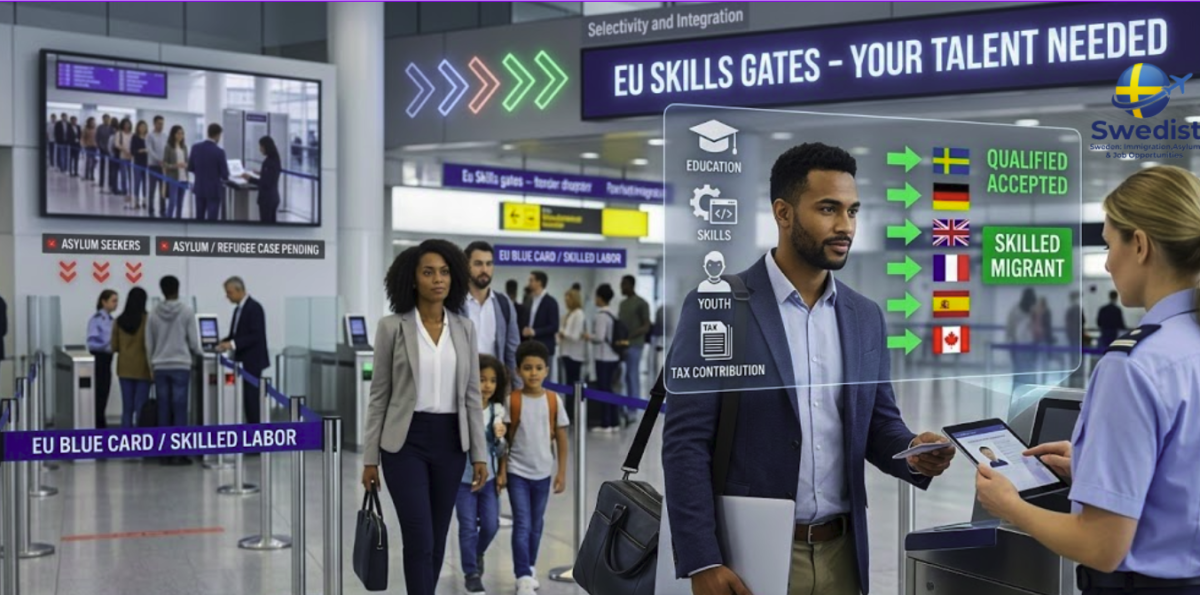
Instead of waiting for individuals to navigate the complex asylum system, countries are aggressively headhunting talent. Programs like Germany’s Chancenkarte (Opportunity Card) or Britain’s post-Brexit points-based system are designed to filter out anyone who doesn’t offer an immediate return on investment.
The “perfect migrant” profile is clear: young, highly educated, fluent in local languages, and capable of filling critical gaps in the tech or healthcare sectors. They are seen as a solution, while the traditional refugee is increasingly framed as a burden on the social welfare system.
The Swedish Perspective: A Nation at a Crossroads
Sweden, long considered the moral compass of European humanitarianism, is undergoing its own difficult introspection. Historically, the Swedish model was rooted in openness and the integration of those fleeing war and persecution. However, this has recently faced a massive political and social recalibration.
The Swedish view on migration has hardened as the country struggles with the challenges of integration in parallel societies. The current discourse within Sweden suggests that the era of “open-door” policies is effectively over. The focus is shifting toward Labor Migration that emphasizes self-sufficiency.
As a Swedist analysis suggests, the Swedish debate is no longer about whether to accept people, but whom to accept. There is a growing consensus that the sustainability of the Swedish welfare model depends on immigrants who are “work-ready” and can contribute immediately to the tax base. This shift away from humanitarian priority toward economic necessity reflects the broader European trend, placing Sweden in the middle of a delicate balance between its liberal values and the practical demands of its economy.
The Human Cost: Are We Creating a Two-Tier System?
This transition creates an uncomfortable reality: a two-tier system of human worth. A software developer from Mumbai may find a red carpet rolled out for them, complete with a “Talent Visa” and relocation support. Meanwhile, a displaced person from an African nation, fleeing the same global instability, is met with barbed wire, detention centers, and policy-driven rejection.
This “Brain Drain” is a double-edged sword. By poaching doctors, nurses, and engineers from developing nations to fill the gaps in European hospitals and tech firms, Europe may be inadvertently destabilizing the very countries that need this expertise the most.
The Paradox of Choice
Europe finds itself in a paradox. It preaches human rights and international protection, yet it crafts legal barriers that make those rights accessible only to the economically privileged. The migration of the future is not about escaping misery; it is about proving one’s value in a globalized labor market.
Whether this selective approach will actually solve Europe’s demographic crisis remains to be seen. What is clear, however, is that the definition of the “migrant” has changed. The focus has moved from “who is in need?” to “what can you do for us?”
To deepen the analysis of how these nations are redesigning their migration landscapes, it is essential to observe the specific legislative shifts occurring in Sweden, Spain, France, and Canada. In Sweden, the government has moved aggressively to tighten asylum criteria, emphasizing stricter permanent residency requirements to ensure that only those who can prove economic self-sufficiency gain a long-term foothold, effectively distancing the country from its historic “humanitarian superpower” status. Similarly, France has recently passed controversial legislation that toughens immigration rules, making it significantly harder for foreign nationals to access social benefits while streamlining the processes for specialized professionals, signaling a clear strategic pivot toward a more utilitarian approach to cross-border movement.
Meanwhile, Canada and Spain offer slightly different yet equally calculated trajectories. Canada, despite its reputation for inclusivity, has begun to recalibrate its famous points-based system to prioritize specific regional labor demands, occasionally capping entries in fields that were previously open to ensure that incoming talent does not oversaturate the local market. Conversely, Spain has increasingly utilized “arraigo social” and specialized work permits to bridge the gap between irregular migration and economic integration, yet it faces persistent internal pressures to align its policies with the broader EU stance of privileging highly skilled workers over spontaneous arrivals. Collectively, these nations demonstrate a global convergence: the transformation of migration into a highly managed economic tool where the “perfect migrant” is no longer just a guest, but a strategic asset.
Frequently Asked Questions
What is meant by the “perfect migrant” in Europe?
The “perfect migrant” refers to a candidate who fits Europe’s specific economic needs: young, highly skilled, fluent in local languages, and able to integrate and pay taxes immediately without relying on social services.
Why is Europe shifting toward selective migration?
Europe is facing a severe demographic crisis characterized by an aging population and a shrinking workforce. To maintain economic competitiveness and fund welfare systems, governments are prioritizing skilled labor migration over humanitarian-led asylum.
How does this affect developing countries?
This selective approach often leads to a “brain drain,” where developing nations lose their most talented healthcare workers and professionals to Europe, potentially hindering their own economic and social development.
Is Sweden still a humanitarian leader?
Sweden is redefining its migration identity. While it remains committed to international norms, the current domestic policy focus has shifted heavily toward labor market integration, prioritizing skilled migrants to ensure the sustainability of the Swedish welfare state.
Contact: info@alswedalyom.com