

Stockholm – Swedist: Sweden sword attack leaves 17-year-old girl dead as police investigate suspect’s motive and online connections

A Sweden sword attack at Brinell School in Fagersta has left a 17-year-old girl dead and three other people injured, including two boys who remain seriously hurt, after an 18-year-old former student allegedly entered the school carrying a sword and attacked people inside. Police arrested the suspect within minutes and are now examining his background, previous behaviour and possible links to online communities that glorify school violence. What is known so far about the suspect, the victims and the unanswered question of why the attack happened?
Sweden sword attack: What happened inside the Fagersta school?
The attack took place at Brinell School in Fagersta, a town in central Sweden, while students were at the school. Police received the emergency call at 14:06 after the incident was assessed as ongoing deadly violence.

Officers were sent to the school immediately. According to Swedish police, the suspect had been stopped by 14:16 and was taken into custody. Police also used their firearms during the intervention. The authorities later confirmed that the arrested suspect is a man in his late teens and that investigators have no reason to believe another attacker was involved.
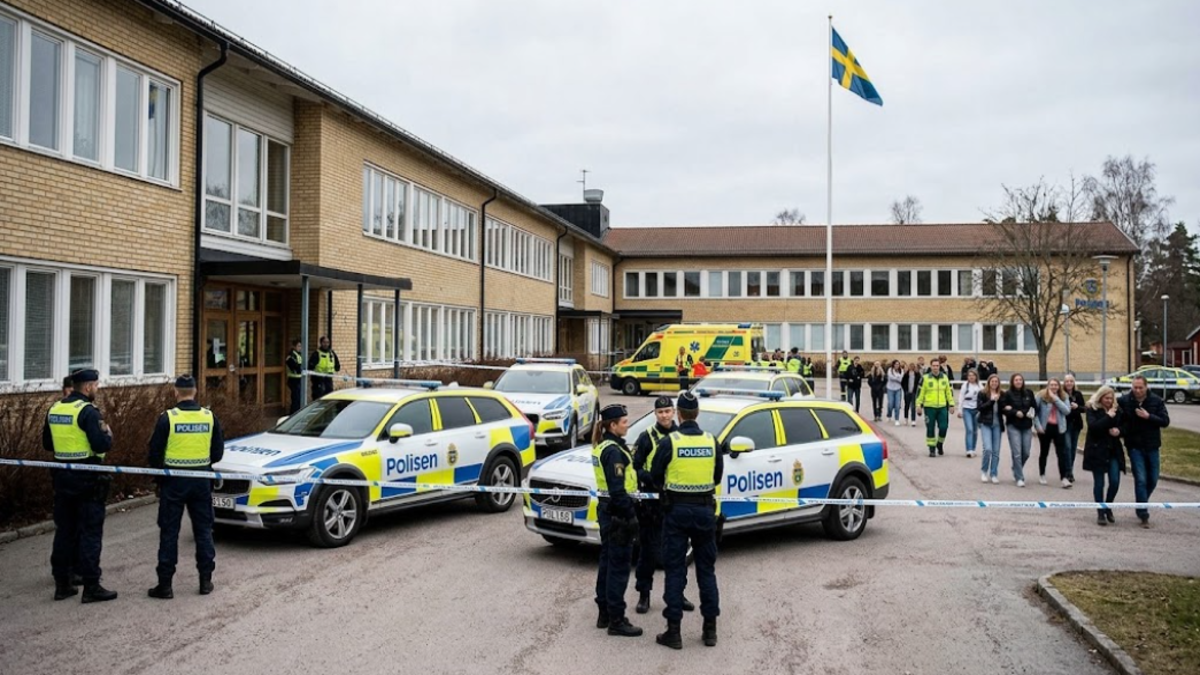
The scale of the emergency response reflected the seriousness of the situation. Police deployed a large number of officers while emergency medical teams treated the injured. Parts of the school and surrounding area were sealed off so investigators could collect evidence and speak to witnesses.
Police also searched several properties connected to the suspect. The searches formed part of the early investigation into his movements, background and possible preparations before the attack.
The authorities initially urged the public to avoid spreading unverified information, a warning that became particularly important as reports about the suspect, his condition and the circumstances of the attack circulated rapidly online.
The school had recently reopened following the summer break, adding another painful dimension to the incident. Students, teachers and parents had returned expecting the beginning of a new term. Instead, the school became the scene of a major police and medical operation.
The attack also led to precautionary measures at other nearby schools and buildings as authorities worked to establish whether there was any continuing danger.
Sweden sword attack victims: One teenager killed and three injured
The most serious consequence of the attack was the death of a 17-year-old girl. Her death was reported after the emergency response at the school, turning what began as a major security operation into a fatal school attack.
Three other people were injured. Two boys suffered serious injuries, while another injured person was described as having less serious injuries. Swedish police confirmed that the injured victims had left the school when officers entered the building.
The precise medical details of the victims have not all been publicly disclosed. Authorities and health officials have limited information while the investigation continues and families deal with the consequences.
The death of the 17-year-old has triggered grief across Fagersta and attracted national attention. The incident has also revived difficult questions in Sweden about how schools can protect students from sudden attacks and how authorities can identify warning signs before violence occurs.
Prime Minister Ulf Kristersson expressed condolences to the victims and their families. Other political leaders also suspended or altered activities in response to the tragedy, reflecting the national significance of the attack.
The local community has established support for students and others affected by the incident. Witnesses and students were confronted with scenes of panic as police entered the school, while parents faced uncertainty as information about their children was initially limited.
The human impact therefore extends well beyond the people physically injured. Classmates, teachers, families and emergency workers are also dealing with the psychological consequences of what happened.
Who is the suspect in the Sweden sword attack?
Police have arrested an 18-year-old man who Swedish media report was a former student at Brinell School. His previous connection with the school is now an important part of the investigation.
According to reporting from Swedish public broadcaster SVT, the suspect had previously been convicted of assault involving another student at a different school. SVT has also reported that he had previously received care under Sweden’s youth-care legislation, known as LVU. These details form part of the background investigators are examining, but they do not by themselves explain why he allegedly attacked the school.
Reports also say the suspect wore dark clothing, a helmet and a mask during the attack and carried a sword. Swedish investigators are examining whether the clothing and other elements of his appearance were significant.
The suspect was detained after police intervention. Early reports differed over precisely how he was stopped and whether he had been injured by police gunfire. Later reporting indicated that police used firearms during the intervention, while some media reports described a gunshot wound to the leg. Authorities have sought to distinguish confirmed information from early reports as the investigation develops.
The suspect now faces investigation on suspicion of murder and attempted murder. At this stage, those allegations remain accusations, and a court has not established guilt.
Police have also searched addresses associated with him. Investigators are expected to examine digital devices, communications, social-media activity and other material that could help establish whether he planned the attack and whether anyone else knew about his intentions.
The suspect’s identity has been reported by some media outlets, but the authorities have not publicly established a motive. For that reason, identifying him by name would risk presenting unverified reporting as established fact.
Why did the attack happen? Police still do not know
The central unanswered question is why the 18-year-old allegedly went to Brinell School with a sword.
Police have not announced a confirmed motive. Investigators are therefore examining several possible lines of inquiry rather than attributing the attack to a single cause.
One of the most closely watched areas concerns the suspect’s possible activity online.
SVT has reported that a TikTok account shared an image of a sword at 13:41, approximately 25 minutes before police received the call about the attack at 14:06. The same account had previously published material that investigators could interpret as praise for violent acts. The account was later removed following police intervention, according to SVT.
Police are investigating whether the account belonged to the suspect and whether its activity has any direct connection to the attack.
That distinction is important. The existence of an account, a sword photograph or material referencing previous attacks does not, on its own, prove that online content caused the attack. Investigators must establish who controlled the account, when material was created and what relationship, if any, existed between the online activity and the violence at the school.
Swedish media have also reported possible connections between the suspect’s behaviour and earlier school attacks.
SVT has reported that investigators are examining whether the suspect may have taken inspiration from the school attack in Trollhättan, where Anton Lundin Pettersson killed three people with a sword. Reports have noted similarities in clothing and equipment, including dark clothing, a mask and a helmet.
That reported similarity does not establish motive or prove that the earlier attack directly influenced the suspect. It is one of the questions investigators are examining.
What does the TikTok investigation reveal?
The social-media investigation has become one of the most significant developments following the attack.
The reported timing of the sword image is particularly relevant because it appeared shortly before the police received the emergency call. Investigators therefore want to determine whether the post represented advance preparation, an unrelated image, or something else.
The account reportedly contained other material that could be interpreted as glorifying previous acts of violence. Swedish authorities are examining the account, while journalists have also reported on its contents.
However, the investigation has not established publicly that the suspect operated the account. Nor has it established that an online community ordered, encouraged or directly caused the attack.
This distinction matters because the motive remains officially unresolved.
Investigators will likely need to compare digital evidence with witness accounts, physical evidence from the school, the suspect’s movements and information obtained during searches. They may also examine whether he communicated with other people before the incident.
The investigation is consequently broader than simply determining whether a TikTok account belonged to the suspect. Police need to understand what happened before he entered the school, what he intended to do and whether anyone else had knowledge of his plans.
The authorities have stressed that rumours should not be treated as facts while this work continues.
Was the 17-year-old girl specifically targeted?
There is currently no confirmed evidence that the 17-year-old girl was specifically targeted by the attacker.
That point is especially important because speculation about a victim’s relationship with an alleged attacker can spread quickly after a high-profile crime.
The available reporting establishes that the girl was killed during the attack and that several other students were injured. It does not establish that the suspect entered the school with the intention of killing her personally.
Investigators are still working to determine whether the victims were selected deliberately, encountered randomly or became targets for another reason.
Until police provide evidence showing otherwise, it would be inaccurate to state that the girl was the intended target.
The same caution applies to claims about the suspect’s ideological motivation. Reports about online communities, previous attacks and possible references to violent figures are investigative leads, not proof of a completed motive.
The police response and damage at Brinell School
The physical damage from the incident is only one part of the wider impact.
Police sealed off a large area around the school and carried out searches as forensic investigators began collecting evidence. Officers also conducted interviews with a large number of witnesses.
According to police, the emergency call came in at 14:06 and the suspect had been stopped by 14:16. That ten-minute period became the critical window in which officers responded to reports of deadly violence.
Three victims were injured, two seriously, and one person died. The suspect was also taken into custody following the police intervention.
The school itself became a crime scene. Investigators needed to preserve evidence while emergency services dealt with injured students and staff.
Nearby schools were also temporarily placed under restrictions as a precaution. The measures were designed to ensure that police could establish whether any additional danger existed.
Authorities later said they had no reason to believe there were multiple attackers.
The incident nevertheless created widespread fear among parents. Some struggled to establish contact with their children while police operations were underway. Witness accounts described students seeking safety and calling for help as the emergency unfolded.
Local authorities established crisis support for people affected by the attack, recognising that the consequences would continue long after the police cordons were removed.
Sweden’s painful history of school attacks
The Fagersta attack has also reopened debate about school safety in Sweden.
The country has experienced several serious attacks at educational institutions. The most prominent recent cases include the deadly attack at a school in Örebro and the sword attack at a school in Trollhättan.
The Trollhättan case is particularly relevant to the current investigation because it also involved a sword and occurred inside a school. Swedish authorities and media are therefore examining whether there are meaningful similarities between the two incidents.
At the same time, investigators must avoid drawing conclusions based solely on similarities in weapons or clothing.
Every attack has its own circumstances, and establishing motive requires evidence specific to the individual suspect.
The wider debate now includes questions about school access, emergency procedures, online radicalisation, warning signs and cooperation between schools, police and social services.
Another issue concerns how authorities respond when young people display violent behaviour or troubling online activity before an attack occurs.
The suspect’s reported previous assault conviction and history of youth care will therefore receive close attention. Investigators will need to establish whether those earlier events had any connection with the later violence or were unrelated parts of his background.
What happens next in the investigation?
The investigation remains active, with police collecting physical and digital evidence and interviewing witnesses.
The suspect has been detained on suspicion of murder and attempted murder. Prosecutors and police will continue to assess the evidence before further legal decisions are made.
Swedish police have asked the public to respect cordons and avoid spreading information that has not been verified. The official police account of the incident is available through the Swedish Police Authority.
Investigators are expected to focus on several key questions: what motivated the suspect, whether he planned the attack in advance, whether he acted alone, whether the online activity was connected to him and whether previous violent incidents influenced his actions.
The police have already said they have no reason to believe that another attacker was involved.
But the most difficult question remains unanswered: why did the suspect allegedly enter a school carrying a sword and attack students?
For the families of the victims, the immediate concern is no longer simply understanding what happened. They must now face the consequences of the death of a 17-year-old girl and the serious injuries suffered by other young people.
For Fagersta, the attack has transformed a school community into the centre of a national investigation. For Sweden, it has once again forced attention onto the vulnerability of schools and the challenge of identifying violent intentions before they become deadly.
FAQ
Who was arrested after the Fagersta school attack?
Police arrested an 18-year-old man who Swedish media report was a former student at Brinell School. He is being investigated on suspicion of murder and attempted murder.
How many people were killed?
One 17-year-old girl died in the attack. Three other people were injured, including two who suffered serious injuries.
Why did the attacker allegedly do it?
Police have not confirmed a motive. Investigators are examining the suspect’s background, possible preparation and potential links to online communities that glorify school violence.
Was the 17-year-old girl specifically targeted?
There is no confirmed evidence at present that she was the intended target. Investigators are still determining how and why the victims were attacked.