

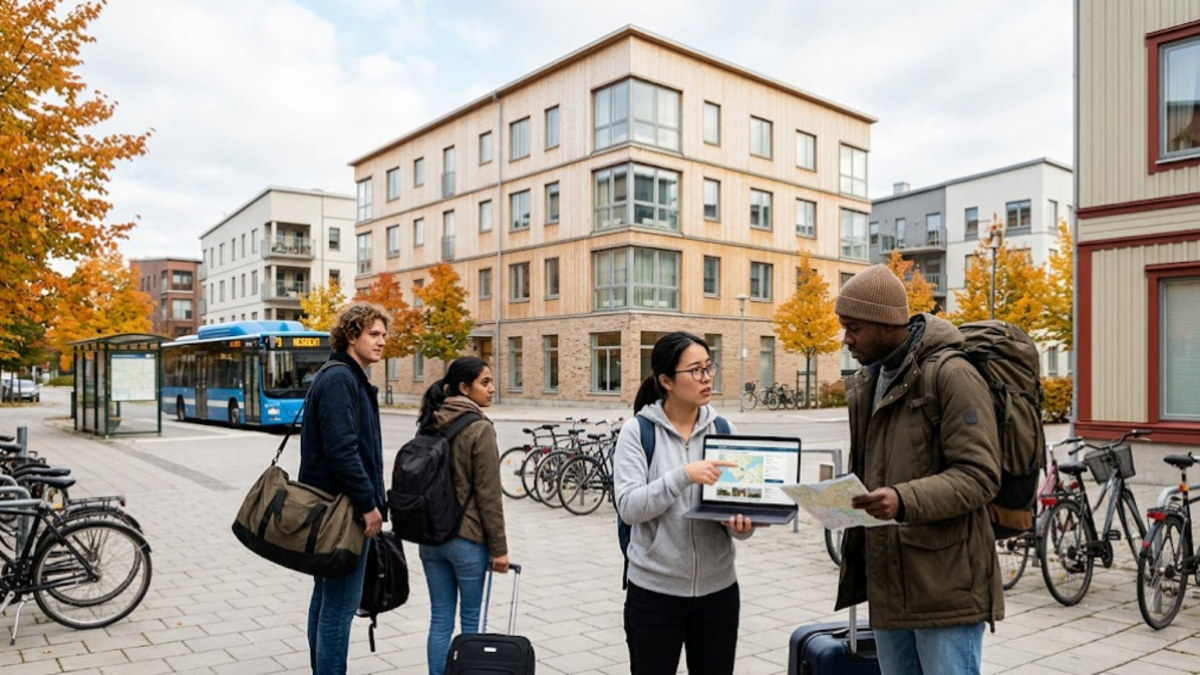
STOCKHOLM – Swedist: Sweden International Student Housing is becoming one of the most important practical concerns for students preparing to study in the country, with limited university accommodation, strong demand in major student cities and long rental queues making early planning essential. For international students arriving without local contacts or a Swedish housing history, the challenge can be particularly difficult — so what is the most effective way to secure a room or apartment before studies begin?

Sweden International Student Housing: Why the Search Can Be Difficult
Finding a place to live is often one of the first major challenges international students face after receiving admission to a Swedish university. The country has a strong reputation for higher education, but accommodation does not automatically come with a university offer.
Recent guidance from Swedish universities and student organisations continues to point to the same problem: demand for student housing remains high in several major study locations. The University of Gothenburg, for example, warns international students that housing in the city has become scarce as more people move there to study or work. The university advises students to begin their search as early as possible.

The situation is especially important for newcomers because established tenants and students may already have access to local housing queues, contacts or knowledge of the rental system.
The Swedish National Union of Students has also repeatedly highlighted the pressure on student accommodation. Its housing reports have shown that many study locations struggle to provide enough accommodation, while rising rents add another layer of difficulty for students.
That does not mean every international student will be left without a home. Universities, student housing companies, private landlords and second-hand rental markets provide several routes into accommodation.
The key, however, is not to rely on a single option.
Students who wait until shortly before arrival can find themselves competing for a much smaller number of available rooms. Those who begin looking immediately after receiving an admission decision have more time to join queues, compare neighbourhoods and consider temporary accommodation if necessary.
Sweden International Student Housing Options for International Students
The first place students should check is their university.
Some Swedish universities provide accommodation directly or have agreements with housing organisations. Availability varies considerably, and eligibility can depend on whether a student is an exchange student, an international degree student, a doctoral researcher or belongs to another category.
Stockholm University, for example, offers a limited number of furnished rooms and apartments to eligible international students. The university states that its accommodation is located in or near central Stockholm and is generally rented by semester. It also stresses that university housing is limited and encourages students to look for other accommodation as early as possible.
Other universities operate different systems.
The important lesson for applicants is to read the housing information provided by the university immediately after admission. A student should not assume that accommodation will be assigned automatically simply because the university has a housing service.
In some cases, students must submit a separate housing application. There can also be strict deadlines.
Another common option is a corridor room. This type of student accommodation normally gives the student a private bedroom while residents share facilities such as a kitchen and, depending on the property, other communal areas.
For students arriving from abroad, corridor accommodation can offer an additional advantage: it can make it easier to meet other students and establish a social network during the first months in Sweden.
Shared apartments provide another alternative. Students may rent a room while sharing a kitchen and living space with other tenants.
Private rentals can offer greater independence, but they can also require more research. A private landlord may ask for documentation concerning identity, income, studies or the ability to pay rent.
For students who cannot immediately obtain a long-term contract, a short-term or second-hand rental may provide a bridge until more permanent accommodation becomes available.
Which Swedish Cities Are Most Challenging?
Location can make a major difference.
Stockholm is one of Sweden’s most competitive housing markets. The city’s size, employment opportunities and concentration of universities create strong demand for rental properties. Students who restrict their search to central neighbourhoods may face even greater competition.
Recent reporting on Stockholm’s wider rental market illustrates the scale of the problem. One recent report noted that the average queue time for a rental apartment can stretch to years, although applying directly to property owners or considering newly developed housing can sometimes provide alternatives.
For students, however, a conventional long-term rental queue is not always the only route.
Student-specific accommodation can operate through separate systems, and some properties are designed specifically for people enrolled at universities.
Gothenburg also presents challenges. The University of Gothenburg’s current guidance tells international students that accommodation has become scarce and recommends starting the search as early as possible.
Lund and Uppsala are also important student destinations where demand for housing can be high. Official Study in Sweden guidance identifies Stockholm and Gothenburg, as well as traditional student cities such as Lund and Uppsala, as places where student housing is in high demand.
This means the cheapest or easiest option is not necessarily located in the centre of the city where a student studies.
A student may need to consider surrounding districts or nearby towns, provided public transport makes the daily journey realistic.
How to Start the Housing Search Before Arrival
The strongest strategy is to treat accommodation as part of the university application process rather than something to solve after landing.
Students should begin by checking their university’s official accommodation page. They should identify whether the institution offers housing, whether international students receive priority and whether an application must be submitted separately.
The next step is to register with relevant student housing organisations and queues.
In some cities, queue points accumulate over time, meaning that students who register earlier can have an advantage later. This makes early registration particularly valuable for international students who have no existing housing history in Sweden.
Students should also search beyond university-managed accommodation.
Private rental platforms, local housing companies and student-focused services can offer additional rooms. Social media groups are another source frequently used by students, although they require extra caution because the person advertising a property may not be the legal owner or authorised landlord.
The safest approach is to verify the property, the landlord and the rental agreement before transferring money.
Students should never allow the pressure of a competitive market to push them into an immediate payment without checking what they are actually renting.
Understanding Rent and the Cost of Accommodation
Housing will normally represent one of the largest items in a student’s monthly budget.
Study in Sweden’s accommodation guidance places typical student rent at roughly SEK 3,000 to SEK 7,000 per month, although actual costs vary according to city, accommodation type, location and facilities.
A room in a student corridor can therefore have a very different price from a private apartment in a central district.
Students should calculate the total housing cost rather than looking only at the advertised monthly rent.
Questions about electricity, internet, furniture, deposits, laundry facilities and other charges should be answered before signing an agreement.
The deposit is another important consideration. Students should establish exactly how much must be paid in advance and under what circumstances it will be returned.
A rental contract should clearly identify the landlord, the property, the rental period, the monthly rent and any additional charges.
International students should also make sure that the rental period matches their academic situation. A contract that ends before the end of the semester can create an unnecessary second housing crisis.
Similarly, a student should understand whether the accommodation is a first-hand contract, a second-hand rental or a temporary arrangement.
What International Students Should Know About Second-Hand Rentals
Second-hand rentals can be particularly useful for students who cannot immediately secure a first-hand student apartment.
Sweden’s housing system includes a significant second-hand rental market, including furnished rooms and short-term arrangements. Official Swedish guidance notes that many second-hand rentals are offered for limited periods, while furnished short-term rentals and rooms in shared homes are also available.
For an international student, flexibility can be valuable.
A temporary room can provide somewhere to live while the student continues searching for a longer-term solution. It can also give newcomers time to understand the city and decide which neighbourhood best fits their schedule and budget.
But temporary accommodation should not be treated casually.
Students should request a written agreement and understand exactly who is renting the property to them. They should also check whether the landlord has the right to sublet the accommodation where such permission is required.
A suspiciously cheap offer, pressure to pay immediately or a landlord who refuses to provide documentation should be treated as warning signs.
Sweden International Student Housing: A Practical Search Strategy
The most effective housing search is usually a combination of several approaches rather than a single application.
First, contact the university’s international or accommodation office.
Second, register with student housing providers in the relevant city.
Third, monitor private rental listings regularly.
Fourth, investigate shared accommodation and rooms rather than focusing exclusively on entire apartments.
Fifth, consider neighbourhoods outside the city centre if public transport provides a practical connection to campus.
This strategy is especially important in cities with strong competition.
Students should also keep their documentation ready. Depending on the landlord or housing provider, applicants may need proof of admission, identification and other information.
Having documents prepared can reduce delays when an appropriate room becomes available.
Another useful step is to establish a realistic maximum monthly budget before beginning the search.
Without a defined budget, students can waste time viewing properties that are ultimately unaffordable.
The budget should include rent and any known additional housing expenses, while leaving enough money for food, transport, study materials and other daily costs.
What Students Should Do If They Have No Housing Before Arrival
Not every student will have a permanent contract before travelling to Sweden.
In that situation, the priority should be securing safe temporary accommodation rather than accepting an unverified rental simply because it appears available.
A temporary room, hostel or other legitimate short-term arrangement can provide time to continue the search after arrival.
Students should then use their university’s local resources, student unions and housing services to identify additional opportunities.
This approach can be more expensive in the short term, but it reduces the risk of losing money through a fraudulent rental agreement.
International students should also avoid assuming that a university’s housing guarantee applies to everyone.
Housing guarantees can have specific eligibility requirements, and some institutions provide accommodation only to particular categories of international students.
Students therefore need to check the exact terms attached to their admission and housing information.
Why Early Planning Matters for International Students
The housing problem is not simply about finding a roof.
Accommodation affects where students live, how long they travel to campus, how much money remains for other expenses and how quickly they can settle into university life.
For international students, the consequences can be even more significant because they are arriving in an unfamiliar country and may not have relatives or established contacts nearby.
This is why universities repeatedly advise students to begin searching early.
The current guidance from Gothenburg, for example, explicitly tells international students to start their housing search as soon as possible because of limited availability.
Stockholm University similarly warns that its own supply is limited and encourages students to explore other accommodation options early.
The message from these institutions is consistent: university accommodation can help, but students should prepare a backup plan.
The best housing strategy is therefore built around several possibilities.
A student might apply for university housing while simultaneously joining a municipal or student housing queue and monitoring private listings.
If one route fails, another may still succeed.
The Bottom Line for Students Moving to Sweden
Sweden remains an attractive destination for international students, but securing accommodation requires preparation.
The biggest mistake is waiting until arrival to begin looking.
Students should investigate housing immediately after receiving their admission decision, check university-specific rules, join relevant queues and remain open to shared or temporary accommodation.
They should also compare locations carefully. Living farther from campus may reduce housing pressure, but only if the transport connection remains affordable and practical.
Most importantly, students should verify every rental offer before making a payment.
The shortage of student accommodation in several Swedish university cities means competition can be intense. Yet a structured search, realistic budget and willingness to consider more than one type of housing can substantially improve the chances of finding a suitable place.
For official guidance on accommodation and student life, students can consult Study in Sweden’s official accommodation guidance.
FAQ
Is student housing guaranteed in Sweden?
No. Some universities provide or guarantee accommodation for certain groups, but availability and eligibility vary between institutions.
How much does student housing cost?
Official Study in Sweden guidance indicates that student rent commonly falls around SEK 3,000 to SEK 7,000 per month, although prices vary by location and accommodation type.
Which Swedish cities have high housing demand?
Stockholm, Gothenburg, Lund and Uppsala are among the major student locations where accommodation demand can be particularly strong.
What should international students do first?
They should contact their university’s accommodation service, check eligibility, join relevant housing queues and begin monitoring private accommodation options as early as possible.
Contact: info@alswedalyom.com