
Stockholm – Swedist: Best Cities to Live and Work in Sweden — Sweden’s largest urban centres continue to attract workers, students and international professionals, but which cities offer the strongest combination of jobs, quality of life and access to essential services?

Sweden remains one of Europe’s most attractive destinations for people seeking a combination of career opportunities and a high standard of living. Recent labour-market figures from Statistics Sweden show that 5.27 million people aged 15 to 74 were employed in April, while the employment rate among people aged 20 to 65 stood at 79.9 percent. At the same time, unemployment in that age group was 5.4 percent, indicating a labour market that continues to offer opportunities while also facing competition for jobs. (Statistikmyndigheten SCB)
For anyone considering a move, however, the question is not simply where jobs are available. Housing, transport, education, industry, salaries and the general pace of life can make one Swedish city a better fit than another.

The latest available population data also underline the importance of Sweden’s largest urban centres. Statistics Sweden’s figures for 2023 put Stockholm at more than 1.65 million residents in its urban area, followed by Gothenburg with about 674,500 and Malmö with more than 339,000. Uppsala, Västerås, Örebro, Linköping, Helsingborg and Jönköping also rank among the country’s largest urban areas. (Statistikmyndigheten SCB)
So, for people looking beyond the biggest names, which Swedish cities stand out as the best places to build a career while maintaining a comfortable everyday life?
Best Cities to Live and Work in Sweden: Stockholm Leads the Job Market
Stockholm is the obvious starting point for anyone looking for the broadest professional market in Sweden. The capital combines government, finance, technology, consulting, media and a large concentration of international companies.
The city’s scale gives workers access to a wide range of professions. It is particularly attractive to people working in technology, finance, communications, business services and innovation, although the capital’s employment base extends across many other sectors.
Stockholm’s position as Sweden’s largest urban area also gives it a major advantage in terms of connectivity. The city has an extensive public transport network and an international airport, making it easier for professionals to travel within Sweden and abroad.
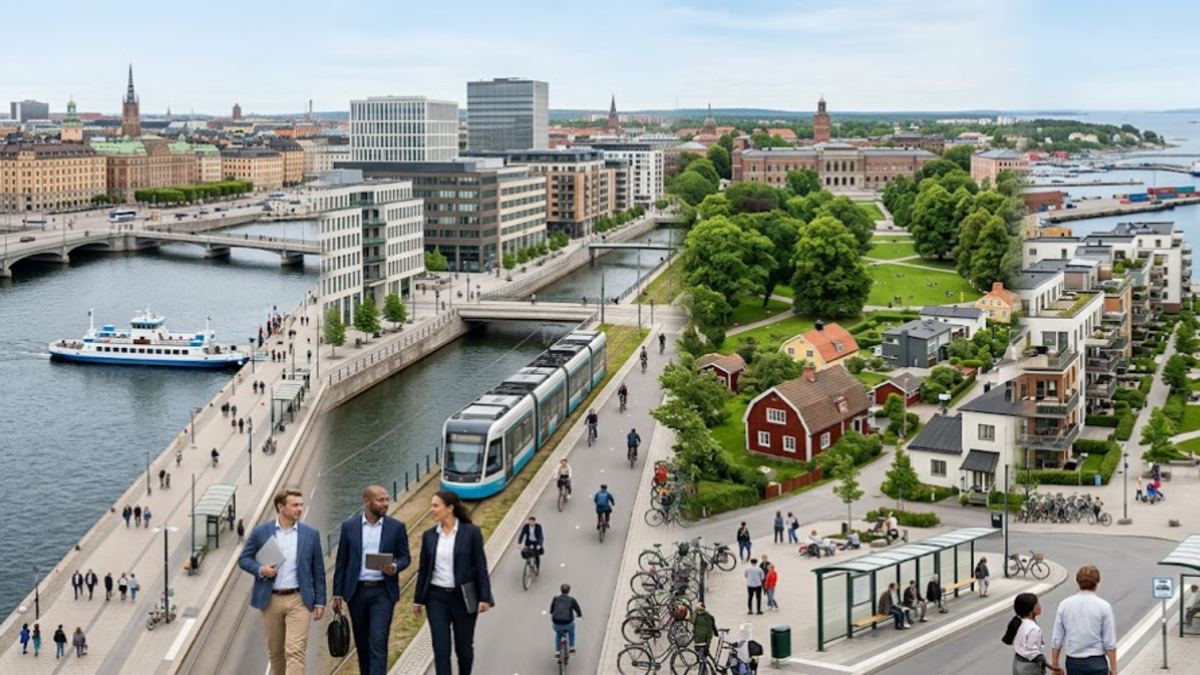
The capital also offers a strong cultural and social environment. Restaurants, museums, theatres, music venues and green spaces are all part of urban life, while the city’s location among islands and waterways gives residents access to nature without leaving the metropolitan area.
The main disadvantage is cost. Housing can be difficult to secure, particularly for newcomers who need to find accommodation quickly. Sweden’s official guidance for people moving for work advises prospective residents to arrange housing as part of the relocation process, alongside finding employment and completing other practical steps. (Sweden)
For highly skilled professionals with a job offer already in place, Stockholm is often the strongest all-round choice. For those prioritising lower living costs or a quieter lifestyle, however, other cities may provide a better balance.
Best Cities to Live and Work in Sweden: Gothenburg Offers Industry and Quality of Life
Gothenburg, Sweden’s second-largest urban area, offers a different profile from Stockholm. The city has a strong industrial and engineering tradition and is closely associated with automotive manufacturing, shipping, logistics and research.
That industrial base remains an important part of the city’s economic identity. Statistics Sweden has previously highlighted Gothenburg’s relatively large share of employment in manufacturing, while also identifying trade and health and social care among significant sectors in the country’s largest urban areas. (Statistikmyndigheten SCB)
For engineers and professionals in manufacturing, transport, logistics and research, Gothenburg can therefore be particularly attractive. The city also has a major port, strengthening its role as a centre for international trade and maritime activity.
At the same time, Gothenburg offers a more relaxed atmosphere than the capital. Its location on Sweden’s west coast, access to the archipelago and strong public transport network appeal to people who want urban opportunities without the intensity of a much larger capital region.
The city is also home to universities and research environments, creating opportunities for students and professionals in technical and scientific fields.
Housing remains an important consideration, but Gothenburg can appeal to people who find Stockholm’s housing market and metropolitan pace less suitable. The result is a city that combines a diversified economy with a strong connection to nature and the sea.
For workers in engineering, automotive technology, logistics and industrial research, Gothenburg is arguably one of Sweden’s most compelling choices.
A strong option for international professionals
Gothenburg’s international business links also make it relevant for foreign workers. English is widely used in many professional environments, particularly in multinational companies and research settings, although knowledge of Swedish can broaden employment opportunities.
The city’s combination of industry, innovation and lifestyle makes it particularly attractive to professionals who want a career-oriented environment without living in the country’s largest city.
Malmö: A Southern Swedish City With International Connections
Malmö has become one of the most internationally connected cities in Sweden. Its location in the south of the country and proximity to Copenhagen give it a distinctive position within the wider Öresund region.
The city is smaller than Stockholm and Gothenburg, but its economic connections extend across national borders. The Öresund Bridge has strengthened links between Malmö and the Danish capital, allowing the two metropolitan areas to function as a closely connected economic region.
This is an important advantage for workers who value international mobility. Malmö can offer access to a Swedish urban lifestyle while remaining closely connected to Denmark and the wider European market.
The city also has a diverse population and a strong presence in sectors including services, education, healthcare and business. Its relatively compact urban structure can appeal to residents who prefer shorter journeys and easier access to neighbourhood amenities.
Malmö’s size is another attraction. The city offers restaurants, cultural venues, parks and waterfront areas while remaining more compact than Stockholm.
The trade-off is that the city’s labour market is not as broad as the capital’s. People in highly specialised professions may find more opportunities in Stockholm, while others may benefit from Malmö’s regional links.
The city’s location also makes commuting a realistic consideration for some residents. Professionals who work across the Öresund region may be able to take advantage of employment opportunities on both sides of the strait, depending on their personal circumstances and the rules that apply to their employment and residence.
For international workers, entrepreneurs and people seeking a more compact city, Malmö deserves a place near the top of any list of Swedish destinations.
Uppsala: A University City With Strong Long-Term Appeal
Uppsala offers a different proposition from Sweden’s three largest cities. Located north of Stockholm, it is one of the country’s best-known university centres and has a strong academic identity.
The city is particularly attractive to students, researchers and professionals connected to education, life sciences and related industries. Its university environment also contributes to a younger and internationally minded population.
Uppsala’s location is another major advantage. The city has strong transport connections with Stockholm, allowing residents to consider employment opportunities in the capital while living in a smaller urban environment.
This creates an interesting compromise for people who want access to Stockholm’s labour market but prefer a less densely urban lifestyle.
The city also offers historic architecture, green spaces and a strong cultural identity. Its scale makes many parts of daily life feel more manageable than in the capital.
Housing availability and commuting costs should still be considered carefully. Living outside Stockholm does not automatically mean that every household will spend less, particularly if frequent travel is necessary.
Nevertheless, Uppsala stands out for people who value education, research and quality of life. It is especially attractive to professionals whose careers connect with universities, healthcare or life sciences.
Recent international coverage has also highlighted Uppsala’s quality-of-life appeal. A ranking reported by the Times of India placed Uppsala among the world’s happiest cities, citing factors including its history, natural surroundings and urban environment. Such rankings should be treated as one indicator rather than a definitive measure, but they reinforce the city’s growing international visibility. (The Times of India)
Linköping and Västerås: Alternatives for Skilled Workers
People searching for the best cities to live and work in Sweden should not overlook medium-sized urban areas.
Linköping has developed a strong reputation for technology, engineering and research. Its economy and academic environment make it a natural choice for professionals with technical backgrounds.
The city can offer a different lifestyle from Stockholm, with less metropolitan pressure while retaining access to skilled employment and higher education.
Västerås is another important regional centre. Its industrial history and location within central Sweden give it a strong economic role, particularly for professionals interested in engineering, energy, manufacturing and related sectors.
These cities may not offer the same breadth of international career opportunities as Stockholm, but that is not necessarily a disadvantage for everyone. A smaller city can provide a more manageable daily routine, potentially shorter commutes and a stronger connection to the surrounding region.
The choice often comes down to profession. Someone working in finance or international consulting may benefit from Stockholm, while an engineer or specialist in industrial technology may find excellent opportunities in a smaller regional centre.
Statistics Sweden’s urban population figures place Västerås and Linköping among Sweden’s largest urban areas, with populations of about 131,600 and 116,900 respectively in 2023. (Statistikmyndigheten SCB)
Helsingborg and Jönköping: Strong Choices for Regional Careers
Helsingborg and Jönköping offer further alternatives for people who want city life without the scale of Sweden’s largest metropolitan areas.
Helsingborg’s location in southern Sweden gives it an important position in transport, logistics and regional business. Its proximity to Denmark is also relevant for people whose professional or personal lives extend across the Öresund area.
Jönköping, meanwhile, sits in a strategically important position in southern-central Sweden and has a reputation for logistics and business activity. Its location can be attractive to companies that depend on road transport and distribution.
Both cities provide access to essential services and urban amenities while offering a smaller-scale environment.
For families, the decision may depend heavily on schools, housing and commuting. For professionals, industry and job availability will often be the deciding factors.
The lesson from Sweden’s regional cities is clear: the best place to live and work is not necessarily the biggest city. A person’s occupation, salary, housing needs and preferred lifestyle can completely change the answer.
What Makes a Swedish City Good for Work and Everyday Life?
Choosing between Swedish cities requires more than comparing job numbers.
Employment is the first consideration, particularly for newcomers. Statistics Sweden publishes detailed information covering employment and salaries across municipalities, regions and sectors, allowing workers to compare labour-market conditions by occupation and industry. (Statistikmyndigheten SCB)
Housing is equally important. A strong salary can lose much of its advantage if accommodation is expensive or difficult to find.
Transport should also enter the calculation. A city with a smaller labour market may become more attractive if it offers easy rail connections to a larger employment centre.
The nature of the job matters as well. Sweden’s major cities have diverse economies, while smaller cities often specialise more heavily in particular sectors.
The country’s official work guidance highlights several features of Swedish professional life, including work-life balance, collaboration and equal opportunities. It also points to research and innovation as important parts of the country’s working environment. (Sweden)
For international professionals, language can be another factor. Some multinational companies and technical workplaces operate extensively in English, but Swedish proficiency can increase the range of jobs available and make everyday integration easier.
Which Swedish City Is Best for You?
There is no single winner for everyone.
Stockholm is the strongest option for people who want the widest selection of jobs, particularly in technology, finance, business services and international companies. Its disadvantages are mainly linked to housing costs and the intensity of metropolitan life.
Gothenburg is particularly attractive to engineers and professionals in automotive, manufacturing, shipping, logistics and research. It combines a diversified economy with a strong coastal lifestyle.
Malmö is a compelling option for internationally minded residents who value its location in the Öresund region and its compact urban environment.
Uppsala is especially well suited to students, academics, researchers and life-science professionals, while also offering access to Stockholm.
Linköping and Västerås can be strong choices for technical and industrial professionals who prefer smaller cities. Helsingborg and Jönköping offer regional opportunities and strategic locations for logistics and business.
Ultimately, the best city depends on the balance between career prospects and personal priorities. Sweden’s labour market remains significant across the country, and the official statistics show that employment is spread across different regions, sectors and occupations rather than concentrated in a single location. (Statistikmyndigheten SCB)
For someone moving to Sweden, the smartest approach is therefore to begin with the profession, identify the strongest employment centres for that field, and then compare housing, transport and lifestyle.
That method may lead to Stockholm. It may point to Gothenburg, Malmö or Uppsala. Or it may reveal that a smaller city offers exactly the combination of career opportunities and quality of life that a particular worker is seeking.
FAQ
Which is the best Swedish city for jobs?
Stockholm generally offers the broadest and most diverse job market, especially in technology, finance and business services.
Is Gothenburg a good city for engineers?
Yes. Gothenburg has strong connections to engineering, automotive, manufacturing, shipping, logistics and research.
Is Malmö good for international workers?
Malmö can be an attractive choice because of its diverse population and its close links with Copenhagen and the wider Öresund region.
Which Swedish city is best for students and researchers?
Uppsala is one of the strongest choices because of its university environment and connections to research and life sciences.
Contact: info@alswedalyom.com