
Stockholm – Swedist: Sweden healthcare for newcomers can seem unfamiliar at first, especially for people who are used to going directly to a hospital or specialist when they need medical attention. In Sweden, most everyday healthcare begins at a local healthcare centre, while the national 1177 service helps patients decide where to seek care. So, how does the system work for people who have recently arrived?

Sweden healthcare for newcomers starts with the healthcare centre
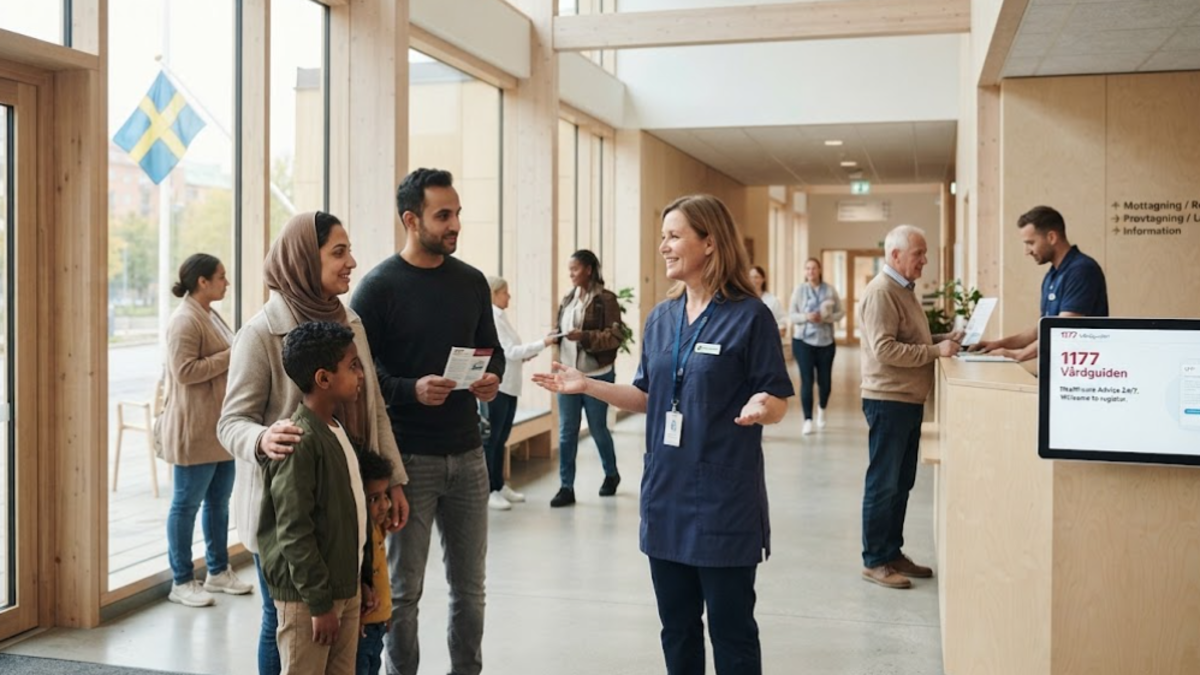
For most non-emergency medical problems, the usual first point of contact is a healthcare centre, known in Swedish as a vårdcentral. These centres provide access to doctors, nurses and other healthcare professionals and are generally located close to where people live.
Patients normally make an appointment before visiting. If someone is unsure where to seek care, they can call 1177, where a nurse provides medical advice and guidance on the appropriate type of care.

The healthcare system is organised through Sweden’s regions, which means some practical arrangements can differ depending on where a person lives.
Healthcare centres generally operate during the daytime on weekdays, although opening hours vary. When a healthcare centre is closed and the situation requires medical attention, an urgent care centre may be available during evenings and weekends.
For serious illness or injury, patients should go to a hospital emergency department. Emergency departments operate around the clock and do not require an appointment. Patients with the most serious conditions receive priority, so people with less urgent problems may have to wait.
In a life-threatening emergency, the emergency number is 112.
How much does healthcare cost in Sweden?
Healthcare in Sweden is mainly financed through taxes paid to regions and municipalities. Patients normally pay a fee when they receive care, but the amount depends on factors including the type of treatment, the patient’s age and whether the person is covered by the Swedish healthcare system.
A visit to an emergency department can cost more than a visit to a healthcare centre. Children and young people are often exempt from healthcare charges, although specific rules can vary by region.
People arriving from another country should not assume that the same fees automatically apply to everyone. The amount a person pays can depend on the country where they are insured and their status in Sweden.
People insured in a Nordic country can generally receive healthcare at the same cost as people insured in Sweden when they meet the applicable requirements. Patients insured in an EU country, Liechtenstein or Switzerland can use a European Health Insurance Card, commonly known as an EHIC, to receive healthcare at the applicable Swedish patient cost.
People from countries outside the EU, EEA and Switzerland may have to pay the full cost of healthcare themselves, although Sweden has agreements with some countries.
The official rules also distinguish between emergency, necessary and planned healthcare, meaning that the circumstances of treatment can affect both access and payment.
Sweden healthcare for newcomers who are asylum seekers
Asylum seekers and people who do not have permission to stay in Sweden have specific healthcare rights.
Adults who are seeking asylum are entitled to healthcare and dental care considered urgent. People under 18 have broader rights to healthcare and dental care.
Asylum seekers are also offered a health examination. The examination is free and is intended to identify healthcare needs and provide information about how the Swedish healthcare system works.
For people covered by the applicable rules, the UT card or other relevant documentation may be important when seeking care.
The Swedish Migration Agency states that adults covered by the Temporary Protection Directive are entitled to emergency care and care that cannot wait, while children are entitled to medical care. A health examination is also offered.
1177 is an important guide for newcomers
One of the most useful services to understand is 1177, the Swedish healthcare advice service.
A person who becomes ill or is injured can call 1177 and speak with a nurse for advice. The service can help determine whether the person should contact a healthcare centre, seek urgent care or go to an emergency department.
Information is also available through the 1177 website, including material in English and other languages.
For newcomers, this can be particularly useful when the appropriate healthcare provider is not immediately clear.
Language support and interpreters
Not speaking Swedish does not necessarily mean that a patient must handle a medical appointment alone.
According to 1177, patients who do not speak Swedish may be entitled to an interpreter. The patient should contact the healthcare clinic before the appointment and explain that interpretation is needed.
Interpreter assistance is free of charge under the applicable rules described by 1177. Interpreters are also bound by confidentiality.
Healthcare staff are similarly bound by professional secrecy. This confidentiality applies to healthcare personnel as well as interpreters and pharmacy staff.
When attending an appointment, patients should provide their name and, when available, bring documents that prove their identity.
Dental care follows different rules
Newcomers should also be aware that dental care is generally more expensive than ordinary medical care.
1177 advises patients to ask about the cost before receiving dental treatment. Children and young people normally receive dental care free of charge under the applicable rules.
The exact rights and costs for people arriving from other countries depend on their circumstances and insurance coverage.
What newcomers should remember
The Swedish healthcare system becomes easier to navigate when patients understand which service to contact for different situations.
For an ordinary health problem, the healthcare centre is usually the starting point. For medical advice and help deciding where to seek care, 1177 is available. For serious illness or injury, the emergency department is the appropriate route, while 112 is used for emergencies.
The most important point for newcomers is that healthcare access and costs can differ according to residence, insurance and immigration status. Checking the rules that apply to your particular situation before treatment can help avoid unexpected charges.
FAQ
How do I find a doctor in Sweden?
Most non-emergency healthcare begins at a local healthcare centre, or vårdcentral.
What number should I call for healthcare advice?
Call 1177 to speak with a nurse and receive guidance about where to seek care.
What number should I call in an emergency?
Call 112 when the situation is an emergency.
Can I get an interpreter at a healthcare appointment?
If you do not speak Swedish, you may be entitled to an interpreter. Contact the healthcare clinic before your appointment.
Contact: info@alswedalyom.com