
STOCKHOLM – Swedist: ETIAS Sweden application is drawing renewed attention among international travellers as European authorities prepare the next stage of the bloc’s digital border system. The key message for people planning a trip to Sweden is straightforward: the ETIAS application is not open yet, and travellers should be wary of websites claiming otherwise. So what should visitors know before the new travel authorisation comes into force?

The latest information available today shows that the European Travel Information and Authorisation System, known as ETIAS, remains outside operation. The European Union says it is not currently collecting applications, while Swedish police also warn travellers that no ETIAS application can yet be submitted.
The development matters particularly for visitors from countries whose citizens can currently travel to Sweden without a visa for short stays. Once ETIAS begins operating, those travellers will have to obtain an electronic travel authorisation before travelling to Sweden and other participating European countries.

For Swedish citizens, the change is different. Swedish passport holders do not need ETIAS when travelling within the system’s scope. The requirement concerns eligible travellers from visa-exempt countries outside the European Union and associated European travel area.
ETIAS Sweden application remains unavailable
For anyone searching online for an ETIAS Sweden application, the most important information is that there is currently no legitimate application to complete.
The official European travel information service states that ETIAS is not in operation and that applications are not being collected. Swedish police have issued a similar warning, noting that travellers should not provide passport, personal or payment information to websites that claim to offer an ETIAS registration service before the system officially opens.
This warning has become increasingly relevant as the planned launch approaches. Several private websites already advertise ETIAS-related services, creating the impression that travellers can secure approval immediately.
Swedish authorities specifically caution against such claims. An applicant should use the official European system once it becomes available rather than paying an intermediary for an application that the authorities are not yet accepting.
The distinction is important because ETIAS is not a conventional visa. It is designed as a pre-travel authorisation for people who already benefit from visa-free short-stay access to Europe.
The system will screen travellers before their journey and is intended to help European authorities identify potential security, irregular migration and public-health risks while facilitating travel for people who do not present such risks.
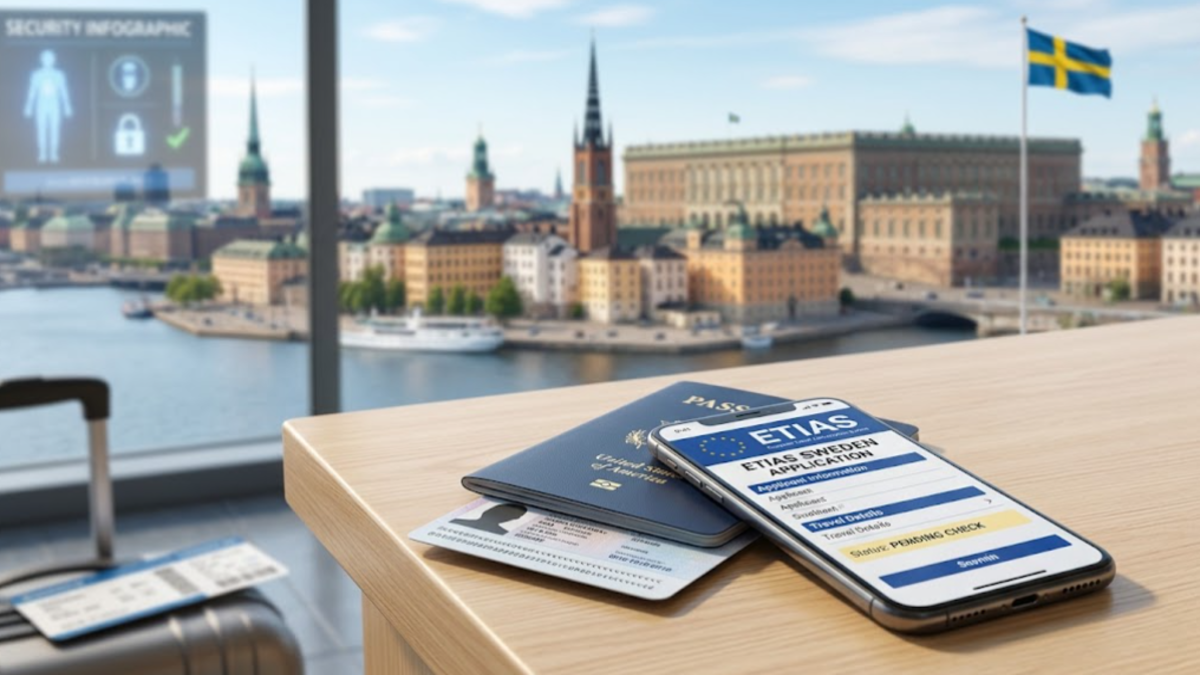
The authorisation will be electronically connected to the traveller’s passport. That means passengers will not receive a traditional visa sticker for ETIAS. Instead, border and travel authorities will be able to verify the authorisation through the passport details.
For travellers, that makes the accuracy of the application particularly important.
A passport number, name or other key detail entered incorrectly could create problems because the authorisation is linked to the travel document used in the application.
When will ETIAS start for travel to Sweden?
The current European timetable points to an introduction during the final quarter of the year, although the authorities have not yet published a precise launch date.
Swedish police say ETIAS is planned for introduction during the last quarter and confirm that the system is not yet operating. Visit Sweden has also advised travellers that no action is required at present and that the European Union will announce the specific starting date several months before the launch.
That uncertainty means travellers should avoid relying on unofficial websites that publish a specific opening date as though it were already confirmed by European authorities.
The European Commission has previously indicated that the exact starting date will be announced ahead of implementation. The latest official information therefore supports preparation rather than immediate application.
For people planning future journeys to Sweden, the practical approach is to monitor the official European travel information service and check the status again before departure.
The timing also needs to be understood alongside the Entry/Exit System, or EES. EES and ETIAS are separate measures, even though both form part of Europe’s broader effort to modernise external border controls.
EES concerns the registration of non-EU nationals crossing the external borders. ETIAS, by contrast, is a pre-travel authorisation for visa-exempt travellers.
Confusing the two systems could lead travellers to misunderstand what they need before a journey.
Who will need an ETIAS Sweden application?
The ETIAS requirement will apply to nationals of countries that currently enjoy visa-free travel to Europe for short visits.
The European Commission describes ETIAS as a new travel requirement for visa-free travellers visiting 30 European countries for short stays of up to 90 days within a 180-day period.
That means the system is particularly relevant to visitors travelling for tourism, business and other permitted short-stay purposes.
British, American, Canadian and Australian passport holders are among the nationalities expected to be affected, along with travellers from numerous other visa-exempt countries.
The requirement does not mean that every foreign national travelling to Sweden will suddenly use ETIAS.
People who already require a Schengen visa will continue to follow the visa process applicable to their nationality and circumstances. ETIAS is designed for travellers who qualify for visa-free short stays.
Likewise, EU citizens are not being asked to obtain ETIAS to travel as EU citizens. Swedish citizens themselves do not need the authorisation.
Dual nationals should pay particular attention to which passport they use when travelling. Swedish authorities have highlighted the issue for citizens with dual nationality because travel documents and nationality status can affect how the rules apply.
The safest approach is to travel with the same valid passport associated with the relevant travel status and to check the applicable rules before departure.
How the ETIAS Sweden application will work
Once the system is operational, travellers will be able to submit an ETIAS application through the official European system.
The European Union describes the process in several basic stages: completing the application, paying the applicable fee, receiving the travel authorisation and then travelling to Europe.
Applicants will need information from their travel document as well as other personal information requested by the system.
The application is intended to be largely automated. Most applications are expected to be processed quickly, although some cases may require additional time.
Swedish police advise travellers to apply well in advance rather than waiting until the last moment.
That advice is particularly relevant for passengers with fixed flight dates, hotel bookings or connecting travel.
An approval does not replace the normal border checks. ETIAS is a travel authorisation rather than a guarantee of admission. Travellers must still meet the entry conditions applicable when they arrive at the external European border.
The authorisation will also be linked to the passport used in the application.
Swedish police state that an ETIAS authorisation can remain valid for up to three years or until the linked passport expires, whichever comes first. If a traveller receives a new passport, a new ETIAS authorisation will be required.
That passport connection is one of the most important practical details for frequent travellers.
ETIAS Sweden application fee set at €20
The planned cost of an ETIAS application is €20.
Swedish police confirm the €20 fee and note that some travellers will be exempt from paying it.
Travellers should therefore be cautious about websites demanding additional charges or presenting an inflated fee as an official requirement.
The official application process will provide the relevant payment information once ETIAS goes live.
The existence of a fee also makes scam warnings especially important. Fraudulent websites can imitate government services and request personal details, passport information and payment-card data.
Swedish police have already warned about unofficial ETIAS websites and advise people not to submit sensitive information to services that claim applications are currently available.
For travellers, one simple rule can reduce the risk: do not pay for an ETIAS authorisation until the European authorities officially announce that applications have opened.
What travellers to Sweden should do now
For the moment, travellers who are planning a visit but cannot yet apply should focus on preparation.
The first step is to check the validity of the passport that will be used for the journey. Because ETIAS will be electronically connected to the passport, keeping travel-document information accurate will be essential.
The second step is to monitor official European announcements.
The European Union says travellers will receive information about the system and its launch through the official travel information channels. Visit Sweden likewise advises travellers that no action is currently required.
The third step is to avoid unofficial application portals.
A website offering an immediate ETIAS approval may look professional, but that does not mean it has government authority. Swedish police have explicitly warned that unofficial sites are already seeking sensitive information from travellers.
Travellers should also distinguish ETIAS from the visa process.
If a person’s nationality requires a visa for Sweden, an ETIAS authorisation will not replace that visa. ETIAS is intended for travellers who are exempt from the visa requirement for eligible short stays.
Finally, passengers should remember that an approved ETIAS does not remove the normal conditions for entering Sweden. Border officials retain responsibility for checking whether travellers meet the applicable entry requirements.
The authorisation should therefore be viewed as one part of the journey rather than a substitute for border control.
ETIAS and Sweden’s changing border procedures
The introduction of ETIAS comes as European countries modernise their external borders.
The EES is a separate digital border system that records information about non-EU nationals entering and leaving participating European countries. The EU says the system records travel-document information as well as entry and exit information, facial images and fingerprints in applicable cases.
ETIAS operates earlier in the travel process.
Instead of recording a traveller at the border, it assesses eligible visa-exempt travellers before they begin their journey.
The two systems therefore have different functions, but passengers may encounter both as European border procedures become increasingly digital.
For travellers entering Sweden from outside the EU, this could mean more reliance on electronic information, biometric checks and automated processing.
The change is intended to improve border management while making it easier to identify travellers who require additional checks.
For ordinary tourists, however, the most immediate concern remains simple: knowing whether ETIAS applies to their passport and completing the correct procedure when applications officially open.
Beware of fake ETIAS Sweden application websites
The warning from Swedish police deserves particular attention because the system has generated a growing online market of private information services.
Authorities say some unofficial websites present themselves as if they can register travellers for ETIAS even though the official system is not accepting applications. These sites may request sensitive information such as names, passport details and payment-card information.
Travellers should not assume that a website is official merely because it uses the word “ETIAS” in its domain name.
The safest source is the European Union’s official travel information service. The EU explains that applications will become available through the official ETIAS website and mobile application once the system goes live.
The advice is especially important for people who are unfamiliar with European travel procedures. A legitimate government application normally explains the fee, eligibility requirements, privacy information and application process clearly.
If a site claims to provide an immediate approval before official applications have opened, travellers should treat that claim as a serious warning sign.
What the latest ETIAS news means for visitors
Today’s picture is therefore clearer than some online reports suggest.
There is no need for eligible travellers to rush to complete an ETIAS application today because the European system is not accepting applications.
At the same time, the planned introduction means the issue should not be ignored by people arranging future travel to Sweden.
The most useful preparation is to understand the rules, check passport details and follow official announcements.
Travellers should also remember that the introduction is not a Swedish-only initiative. ETIAS is an EU-wide travel authorisation system covering the participating European countries, meaning that an authorisation obtained for travel to Sweden is part of a wider European framework.
The system is designed to remain linked to the traveller’s passport and can be valid for multiple journeys while that authorisation remains valid, subject to the applicable conditions.
That could make the process relatively straightforward for frequent visitors once the system is operating.
For now, however, the message from Swedish and European authorities remains consistent: the application has not opened, and travellers should not submit personal information to websites claiming that it has.
The next major development will be the official announcement confirming when ETIAS begins accepting applications.
Until then, anyone preparing for Sweden should rely on government information rather than advertisements or unofficial application services.
FAQ: ETIAS Sweden application
Do Swedish citizens need ETIAS?
No. Swedish citizens do not need an ETIAS travel authorisation when travelling as Swedish citizens.
Can I apply for ETIAS now?
No. The official system is not yet accepting applications.
How much will ETIAS cost?
The planned application fee is €20, although some travellers will be exempt from paying it.
How long will ETIAS remain valid?
An ETIAS authorisation can be valid for up to three years or until the linked passport expires, whichever comes first.
Contact: info@alswedalyom.com