
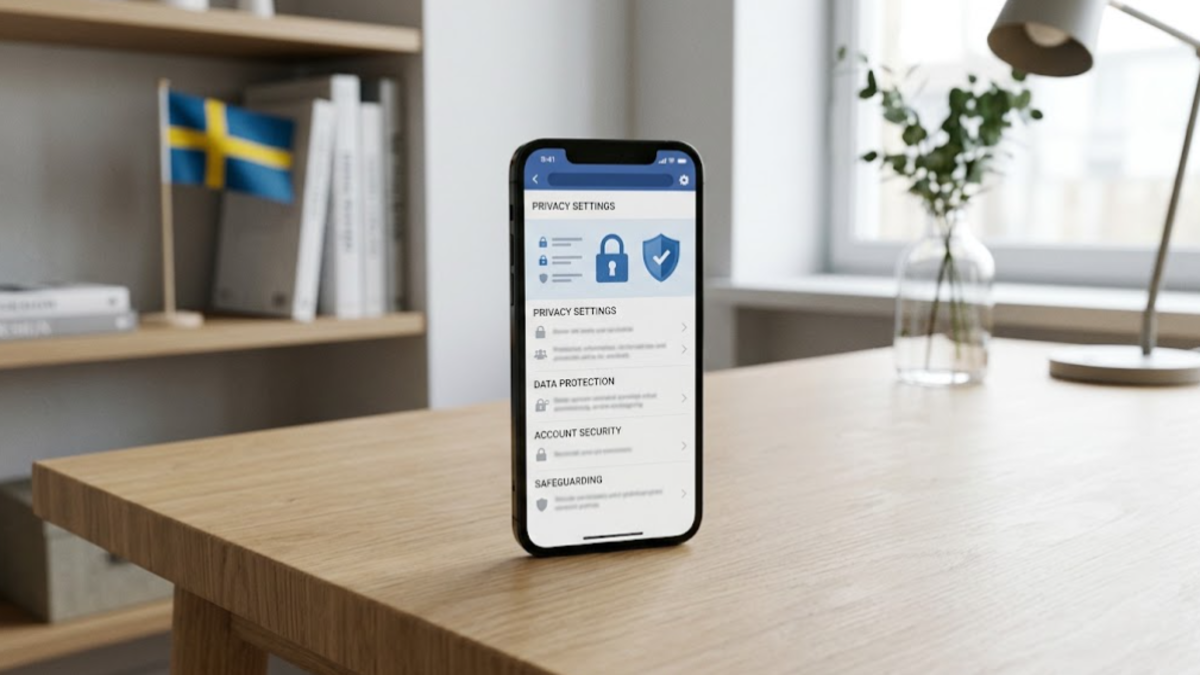
STOCKHOLM – Swedist: FantomApp has arrived in Sweden as a new digital safety tool designed to help young people protect their personal information on social media, giving children practical ways to strengthen account security, deal with online abuse and make more informed decisions about what they share online. But how does FantomApp work, and why has Sweden’s data protection authority decided that young users need a dedicated privacy tool?

FantomApp puts young users at the centre of online privacy
Sweden’s Authority for Privacy Protection, known as IMY, launched FantomApp in Sweden on Monday as part of an effort to make data protection easier for children and teenagers.
The application targets children between 10 and 15 years old and focuses on practical problems that young users can encounter while using social media. Instead of presenting privacy as a complicated legal subject, FantomApp offers interactive tools and step-by-step guidance aimed at helping young people take action themselves.

The launch comes as social media continues to play a major role in the daily lives of children and teenagers. IMY says its goal is not simply to warn young people about online risks but to give them useful knowledge about data protection and their rights.
Malin Blixt, head of IMY’s Department for Guidance, Innovation and Technology, said the authority hopes the application will make it easier for young people to understand data protection while also making their online lives safer.
The authority also points to concerns among parents. According to IMY, almost nine in ten parents worry that they cannot adequately protect their children online. That concern is one reason the authority sees a role for a tool that children and parents can use together.
The application is therefore not intended solely for children. Parents can also use its guidance as a starting point for conversations about social media, privacy and online behaviour.
How FantomApp helps teenagers protect their data
One of the central features of FantomApp is its practical approach to social media security.
The application can guide users through safer account settings on several major platforms, including Instagram, Snapchat, TikTok, WhatsApp and X, formerly known as Twitter. The aim is to help young users understand which settings can limit unwanted contact and reduce the amount of personal information visible through their profiles.
The app also includes a password-testing function. Users can check whether their passwords are sufficiently secure, giving them a simple way to think about account protection without needing advanced technical knowledge.
Another feature allows users to blur photographs. This can help young people remove or hide parts of an image, including people or other details they do not want visible before sharing a picture online.
FantomApp also offers a tool that helps users examine how much information their social media activity can reveal about them. That feature reflects a wider privacy concern: individual pieces of information can appear harmless on their own but may reveal more when combined.
The application goes beyond basic privacy settings. It provides guidance for situations in which something has already gone wrong.
For example, young users can find information about what to do if an account has been hacked, if they have been bullied or threatened online, or if they have been tricked out of money. The application also provides guidance for dealing with fake profiles and unwanted material involving them.
That makes FantomApp less like a conventional privacy information page and more like a practical troubleshooting tool.
From France to Sweden: how the app reached Swedish users
FantomApp did not originate in Sweden.
The application was developed by France’s data protection authority, CNIL, and was created with young people between the ages of 10 and 15 involved in the development process. The approach was intended to make the tool suitable for its target age group and easier for teenagers to use.
IMY has now translated and adapted the application for Swedish conditions in cooperation with CNIL.
This means Swedish users receive a version designed around the country’s language and context rather than simply being given an unchanged foreign application. The Swedish version is available in Swedish, while the underlying project reflects the cooperation between the two European data protection authorities.
The French origins are important because they show that the Swedish launch forms part of a broader European effort to improve children’s understanding of privacy.
The application does not require users to create an account before using it. Young people also do not need to log in through a social media account to access FantomApp, according to IMY.
That feature is particularly relevant to a privacy-focused service. A young person seeking advice about protecting personal information can use the application without first handing over additional account information simply to access its guidance.
The app is aimed specifically at 10- to 15-year-olds, although the information can also be useful to parents and others who want to understand how children can make their social media accounts safer.
Parents are being brought into the conversation
IMY’s launch also addresses a problem that goes beyond technical security: conversations between parents and children about social media can be difficult.
Parents may know that their children face risks online, but they may not always know how to begin a discussion about passwords, photographs, unwanted contacts or the amount of information a social media profile reveals.
Malin Blixt said the application can provide an opportunity to start those conversations rather than allowing concerns about online behaviour to remain unspoken.
The distinction matters because FantomApp is not presented as a substitute for parents, schools or social media platforms. Instead, it gives young people and adults a common set of practical issues to discuss.
For parents, that can mean looking together at account settings or discussing what information should remain private.
For teenagers, it can mean gaining a clearer understanding of why a strong password matters, why a photograph may reveal more than intended, or what steps to take after an account has been compromised.
The app’s structure also allows young users to take a more active role in their own privacy. Rather than relying entirely on an adult to identify a problem, they can use the tools to understand the problem and find possible steps to address it.
What young people can do when something goes wrong
A significant part of FantomApp focuses on incidents that can happen after information or content has already been shared.
If a young person’s account is hacked, for example, the app provides guidance on what to do. It also addresses cyberbullying, threats, online fraud and fake profiles.
The service can help users understand how to deal with unwanted contact and how to adjust settings that control who can reach them. Guidance also covers ways of blocking people and certain types of content.
Another function deals with photographs and other visual material.
Users can upload an image and blur parts of it, allowing them to remove or conceal details before an image reaches a wider audience. This can be useful when a photograph contains another person, a location or another detail that the user does not want to expose.
The broader message is that privacy does not begin and end with a password.
A person’s online privacy can also depend on what appears in photographs, who can contact them, which profile details are public and how much information can be pieced together from their online presence.
FantomApp attempts to bring those issues into one accessible service.
Social media settings become a practical lesson in privacy
For many teenagers, privacy settings can be difficult to understand because platforms regularly offer numerous options and menus.
FantomApp approaches the issue by providing guidance for individual social networks. IMY says the application can help users make their accounts more secure across Instagram, Snapchat, TikTok, WhatsApp and X.
The guidance includes settings that can reduce unwanted contact and limit the visibility of sensitive information.
The application also addresses the information contained in social media profiles. A user may know what they have deliberately posted but may not realise how much additional information can be inferred from their profile, photographs or other details.
The app encourages users to examine that information and consider whether it reveals more about them than they intended.
That is especially important for younger users, who may be experimenting with social media without fully understanding how widely information can circulate once it has been published.
FantomApp therefore combines technical instructions with basic privacy awareness. It does not simply tell teenagers to be careful; it shows them specific areas where they can make changes.
A wider European push to improve children’s data protection
The Swedish launch also reflects a growing European focus on children’s privacy.
CNIL developed the original FantomApp specifically for teenagers, working with young people to shape the service around their needs. IMY’s decision to translate and adapt the application means the same concept can now reach Swedish users in their own language.
The cooperation between the Swedish and French authorities also illustrates how data protection agencies can share practical solutions rather than developing completely separate tools for similar problems.
For young users, the benefit is straightforward: privacy advice becomes available in a format designed for their age group.
For authorities, the project provides another way to communicate data protection rights outside traditional legal guidance.
The Swedish authority has made children and young people one of its areas of focus, and the FantomApp launch places that priority into a concrete service that users can access directly.
Why the launch matters for Swedish families
The significance of FantomApp lies partly in its simplicity.
Young people do not need specialist knowledge to use the application. They can check a password, explore account settings, blur an image or look for advice after experiencing an online problem.
Parents can also use the application to turn general concerns about social media into specific discussions.
Instead of asking a child simply to “be careful online”, a parent can discuss who can contact the child, what information appears on the profile or whether a particular photograph should be shared.
That practical approach may also help teenagers understand that privacy is something they can actively manage.
At the same time, the launch does not remove the responsibilities of social media companies, schools, parents or other organisations that interact with children online.
A privacy application can help users make better choices, but the wider online environment still determines many of the risks young people face.
FantomApp’s role is more focused: it gives young people information and tools that can help them respond to those risks.
What comes next for FantomApp?
The Swedish launch gives IMY a new channel for communicating directly with younger audiences.
The authority has already indicated that some of the app’s functions could have uses beyond traditional social media. Sweden Herald reported that Malin Blixt sees potential for some of the tools to be useful in gaming environments as well.
That possibility is notable because children’s digital lives are not limited to social networks.
Young people communicate through games, messaging services and other online platforms, where many of the same privacy questions can arise.
Password security, unwanted contact, image sharing and exposure of personal information can all matter outside social media as well.
For now, however, FantomApp’s Swedish version remains focused on helping young users navigate social media more safely.
Its launch gives Swedish children and parents a new practical resource at a time when online privacy has become an increasingly important part of everyday digital life.
The message from IMY is clear: young people should not have to become technology experts before they can take basic steps to protect their personal information.
Frequently Asked Questions
What is FantomApp?
FantomApp is a privacy and online-safety application launched in Sweden by IMY to help young people protect their personal information and social media accounts.
Who is FantomApp designed for?
The application is aimed at children between 10 and 15 years old, although parents and other users can also benefit from its guidance.
What can FantomApp do?
It can provide guidance on social media security settings, test password strength, blur photographs and offer advice about hacked accounts, cyberbullying, fraud, fake profiles and unwanted contact.
Does FantomApp require a social media login?
No. IMY says users do not need to create an account or log in through a social media service to use the application.
Contact: info@alswedalyom.com