
Stockholm – Swedist: Sweden visa and job scam networks: Across Sweden’s growing labor migration system, a parallel underground economy has emerged where fake job offers, fraudulent recruiters, and impersonated agencies are targeting foreign applicants who are seeking work and residency opportunities.

The investigation by Swedist reveals a structured pattern of digital deception that closely mirrors global migration scam ecosystems. These networks exploit Sweden’s strong demand for skilled labor, combined with complex immigration procedures that many applicants struggle to navigate.
What makes these schemes particularly dangerous is their ability to appear legitimate at first glance. Victims are often convinced they are dealing with registered companies or licensed consultants before discovering that the entire process was designed to extract money or personal data.

According to official guidance from the Swedish Migration Agency, no employer or intermediary can guarantee a work permit or residency approval outside the formal process.
But how exactly do these networks operate, and why are they becoming more common in Sweden’s migration landscape?
What Sweden Visa and Job Scam Networks Actually Are
Sweden visa and job scam networks are coordinated fraud systems that impersonate legitimate recruitment agencies or employers. Their goal is simple: to convince applicants that they have secured a job in Sweden, then extract payments under the guise of processing fees, permits, or documentation.
These schemes typically present themselves in several forms:
False job offers in Swedish companies
Fake employment contracts for work permits
Impersonated recruitment agencies abroad
Fraudulent migration consultancy services
Counterfeit invitation letters for visa applications
Swedish authorities consistently warn that legitimate employers cannot guarantee visa approval, nor can they bypass the Swedish Migration Agency’s official process.
Despite these warnings, the scams continue to evolve, often adapting their language and presentation to mimic real corporate communication.
Swedist researchers observed that most victims do not question authenticity at first, especially when documents appear professionally designed and emails use realistic corporate branding.
How the Scam Ecosystem Operates Online
The operational model behind Sweden visa and job scam networks follows a predictable structure, but each stage is carefully designed to build trust and reduce suspicion.
Digital attraction phase
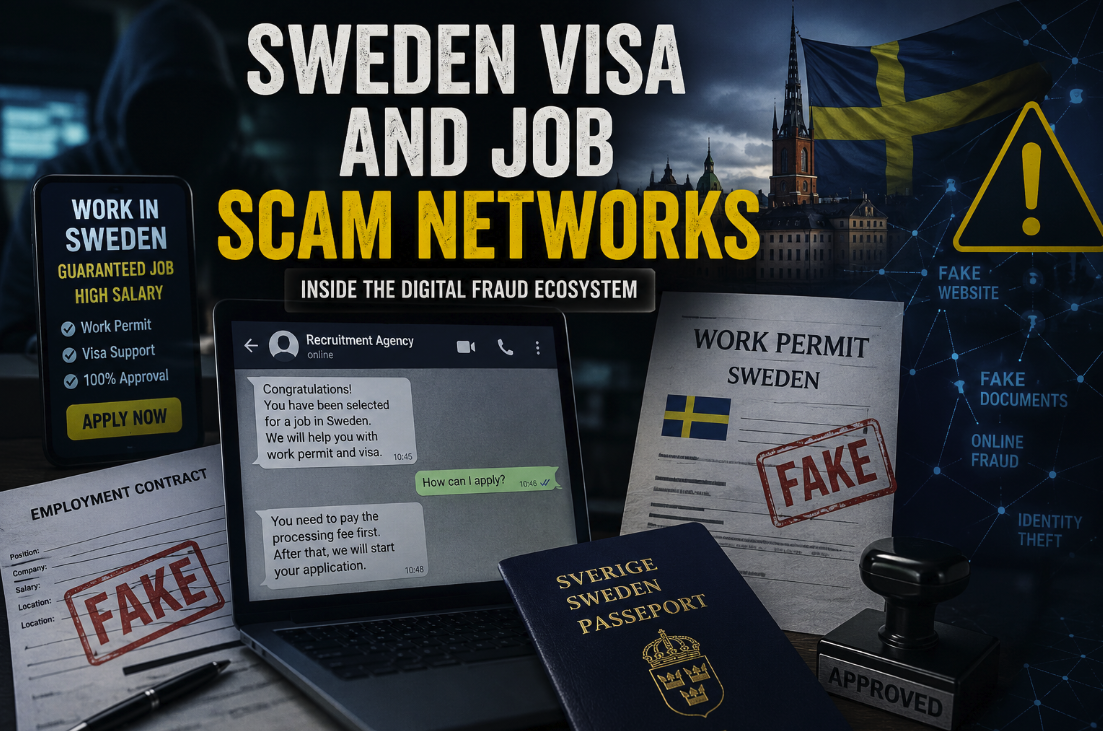
The process usually begins on social media platforms such as Facebook, Instagram, TikTok, or LinkedIn. Victims are targeted through advertisements offering:
Guaranteed jobs in Sweden
Fast-track work permits
No experience or language requirements
High salaries in “urgent hiring” campaigns
These messages are tailored to individuals actively searching for migration opportunities, making them highly effective.
Private transition phase
Once a user responds, communication is quickly moved to private channels such as WhatsApp, Telegram, or email. This shift removes the interaction from public scrutiny and platform moderation systems.
Trust building phase
At this stage, scammers introduce fabricated legitimacy:
Fake employment contracts
Forged approval letters
Cloned company identities
Digitally altered government-style documents
Some even create professional-looking websites that imitate real Swedish recruitment firms.
Financial extraction phase
Victims are then asked to pay staged fees, often labeled as:
Work permit processing
Visa application support
Administrative costs
LMIA-like certification charges
Payments are typically split into multiple installments to avoid raising suspicion too early.
Swedist analysis shows that once payments begin, victims are often pressured to continue paying additional “final approval” or “urgent processing” fees until communication eventually stops.
Why Sweden Is a Target for Migration Fraud
Sweden has become a key target for visa and job scam networks due to several structural factors.
First, the country remains highly attractive for migrants because of its stable economy, strong labor protections, and high living standards. This creates consistent global demand for Swedish work permits.
Second, Sweden’s immigration system, while transparent, can be complex for first-time applicants. Work permits require employer sponsorship, documentation verification, and approval from the Swedish Migration Agency.
Official systems such as work permit applications are strictly regulated and cannot be bypassed through private intermediaries.
This complexity creates an information gap that scammers exploit by offering “simplified” alternatives that appear faster and easier.
Swedist notes that many victims are unaware that even legitimate employers must follow strict legal procedures, making fake “fast-track” promises highly convincing.
Common Types of Sweden Visa Scams
Fake job offer networks
These scams fabricate employment opportunities using real Swedish company names or slightly modified versions of them. Victims are told they have been selected without interviews or formal screening.
Fake recruitment agencies
Fraudulent agencies pose as international hiring firms, often claiming partnerships with Swedish companies. They request upfront fees for processing or placement.
Study and visa conversion scams
Some networks target students by offering fake university admissions or “guaranteed” study visas, which are later used as a gateway for financial exploitation.
Impersonated consultants
Scammers misuse the identity of licensed migration consultants or reference real regulatory bodies to appear credible. In reality, they have no legal authorization.
The Swedish Migration Agency explicitly warns applicants to verify employers and avoid paying unauthorized fees during the application process.
Financial and Psychological Impact on Victims
The financial losses associated with Sweden visa and job scams can be significant. Victims often lose thousands of euros through staged payment systems that escalate over time.
But the impact goes beyond money.
Many victims face:
Loss of future visa eligibility due to false documentation
Emotional stress and loss of trust in legal migration systems
Long-term financial instability from borrowed funds
Relocation delays and disrupted career plans
Swedist research indicates that the psychological manipulation used in these scams is highly structured. Victims are often made to feel that they are “close” to approval, encouraging continued payments even when warning signs appear.
Digital Investigation and Tracking Methods
Investigating Sweden visa scam networks requires a combination of digital forensics and behavioral analysis.
Swedist analysts use multiple methods:
Monitoring fake job advertisements across platforms
Tracking newly registered domains linked to recruitment offers
Analyzing communication patterns on messaging apps
Cross-checking company data with official Swedish registries
Identifying repeated templates used across scam networks
Authorities such as Swedish police and migration agencies also encourage individuals to verify employers directly through official channels before engaging in any financial transaction.
These methods have revealed that many scam operations are not isolated incidents but part of broader, adaptive networks that continuously rebrand and relocate.
Enforcement Challenges in Sweden
Despite increased awareness, enforcement remains difficult.
Scam networks often operate across multiple countries, using anonymous digital identities and rapidly changing domains. Even when authorities identify fraudulent activity, legal action can be slow due to jurisdictional limitations.
Additionally, scammers frequently use intermediaries in different regions, making it harder to trace financial flows or identify primary organizers.
Swedist highlights that this fragmentation allows fraud networks to persist even after individual operations are shut down.
The Human Side of Migration Fraud
Behind every scam case is a personal story of lost opportunity and broken trust.
Many victims are young professionals or students seeking better career prospects abroad. They are often targeted at moments of financial pressure or uncertainty.
The emotional impact can include:
Fear of reporting the scam
Loss of confidence in international job markets
Reluctance to apply for legitimate opportunities
Long-term skepticism toward migration systems
Swedist emphasizes that these scams do not only exploit money—they exploit ambition.
Conclusion: A Growing Digital Migration Threat
Sweden visa and job scam networks represent a rapidly evolving form of digital migration fraud. They combine psychological manipulation, fake documentation, and targeted advertising to exploit individuals seeking legitimate opportunities.
As highlighted by Swedist, the core vulnerability lies not in Sweden’s immigration system itself, but in the information gap between official processes and public understanding.
Strengthening awareness, improving verification practices, and relying only on official channels such as the Swedish Migration Agency can significantly reduce risk.
Without continued vigilance, these networks are likely to expand further within global migration systems, adapting quickly to new platforms and recruitment trends.
FAQ
What are Sweden visa scam networks?
They are fraudulent systems that impersonate employers or agencies offering fake jobs and visas to steal money from applicants.
How do these scams usually start?
They often begin with social media job ads or direct messages promising work in Sweden with easy visa approval.
Are these job offers real?
No, legitimate Swedish work permits must go through official government procedures without guaranteed approval promises.
How can applicants protect themselves?
By verifying employers through official Swedish sources and avoiding any upfront payments to private individuals or agencies.
Contact: info@alswedalyom.com
Tags
# cyber fraud investigation# digital migration scams# fake job offers Sweden# fake recruitment agencies# international job scams# job fraud Sweden# labor migration Sweden# migration fraud Europe# OSINT investigation Sweden# recruitment scams# Sweden visa scam# Swedish Migration Agency warning# Swedist news# Swedist report# visa fraud Europe