
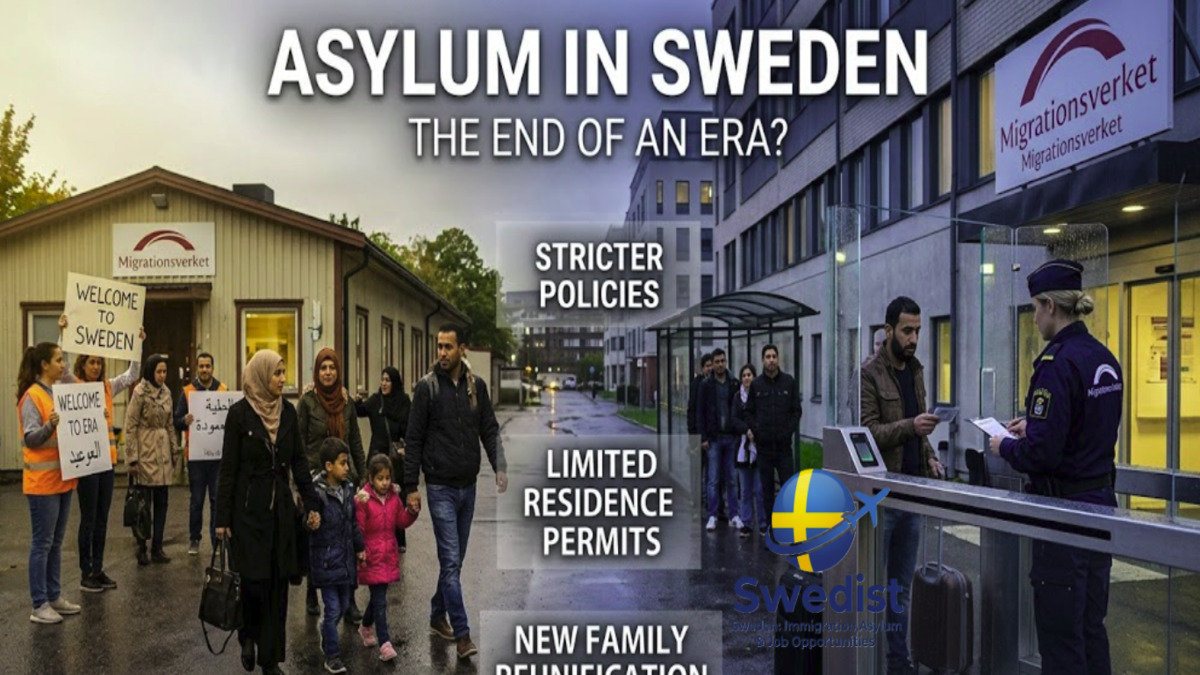
Stockholm – Swedist: Asylum in Sweden has undergone a tectonic shift, moving from a “humanitarian superpower” to one of Europe’s most restrictive regimes. For decades, the image of Sweden was synonymous with open borders and a generous welfare state that welcomed those fleeing conflict with open arms. However, the winds have changed. As the government implements a series of rigorous new measures, many are left wondering: has the era of open asylum officially come to an end?

The transformation is not merely a tweak in policy; it is a fundamental redesign of the Swedish social contract. Based on information gathered by the Swedist team, the focus has shifted from “reception” to “repatriation” and “stringent integration.” For the thousands who viewed Sweden as a final sanctuary, the reality on the ground in 2026 is increasingly complex and, for many, unwelcoming.
Is the Swedish model of solidarity being replaced by a fortress mentality?

The Tightening Net: Redefining Asylum in Sweden
The most visible change lies in the drastic reduction of residence permits. The era of permanent residency as a starting point is over; almost all new permits are now temporary, subject to frequent reviews and strict conditions. The government has signaled that the goal is to align asylum in Sweden with the absolute minimum levels required by EU law, removing any “pull factors” that once made the Nordic nation a primary destination.
New conditions for family reunification have added another layer of difficulty. The “maintenance requirement” has been sharpened, meaning that those already in Sweden must prove a high level of income and a sufficiently large home before their spouses or children can join them. According to data analyzed by Swedist, these hurdles have left thousands of families in a state of prolonged separation, creating a psychological toll that is felt across immigrant neighborhoods from Malmö to Kiruna.
This “chilling effect” is intentional. By making the path to a stable life more arduous, the authorities are sending a clear message to the world: Sweden is no longer the easy option. The focus has moved toward “volume control,” prioritizing the state’s capacity to integrate those already present over the arrival of new seekers.
The Arab Refugee Experience: Between Integration and Uncertainty
The impact of this policy shift is particularly acute within the Arab refugee community, which saw a massive influx during the crises of the last decade. Many who arrived with hopes of building a new life now find themselves caught in a web of shifting regulations. The transition from a “welcoming” atmosphere to one of “conditional stay” has created a sense of precariousness.
Language requirements and civic orientation tests are no longer optional—they are becoming prerequisites for any hope of long-term stay. While some argue that these measures encourage integration, others in the community feel they are being set up to fail. The narrative in Arab-Swedish circles is changing; where there was once gratitude, there is now a growing conversation about “Plan B” options in other countries or even returning to home regions if stability permits.
Furthermore, the rise of political rhetoric linking immigration to crime has stigmatized many who have worked hard to integrate. The social divide is widening, as the “Sweden for Swedes” sentiment gains more traction in the Riksdag, influencing everything from job opportunities to how people are treated in the local supermarket.
A Future of Conditional Belonging
Sweden’s evolution reflects a broader European trend, but it feels more dramatic here because of the height from which the country has fallen. The Swedish Migration Agency is now an institution focused on enforcement as much as processing. The dream of a multicultural utopia is being replaced by a pragmatic—and some say cold—evaluation of national interest.
For those still looking toward the North, the message is clear: the door is not locked, but the key is much harder to turn. Sweden remains a safe country with high standards, but the “open-door” policy is a relic of the past. Future residents must be prepared to prove their value to the state every step of the way.
The era of the “unconditional welcome” hasn’t just paused; it has likely vanished forever.
Why has Sweden changed its asylum policy so drastically?
The shift is driven by a combination of political pressure, concerns over social cohesion, and the strain on public services following the 2015 migration crisis.
What are the new rules for family reunification?
Applicants must now meet strict financial and housing requirements to prove they can support their family members without relying on state welfare.
How long do residence permits last now?
Most permits for those seeking protection are now temporary, typically lasting between 13 months and three years, depending on the specific case.
Can refugees still get permanent residency?
It is still possible, but it now requires meeting high bars for Swedish language proficiency, financial self-sufficiency, and a clean criminal record.
Sweden has entered a new chapter, one defined by boundaries rather than bridges.
Contact: info@alswedalyom.com