
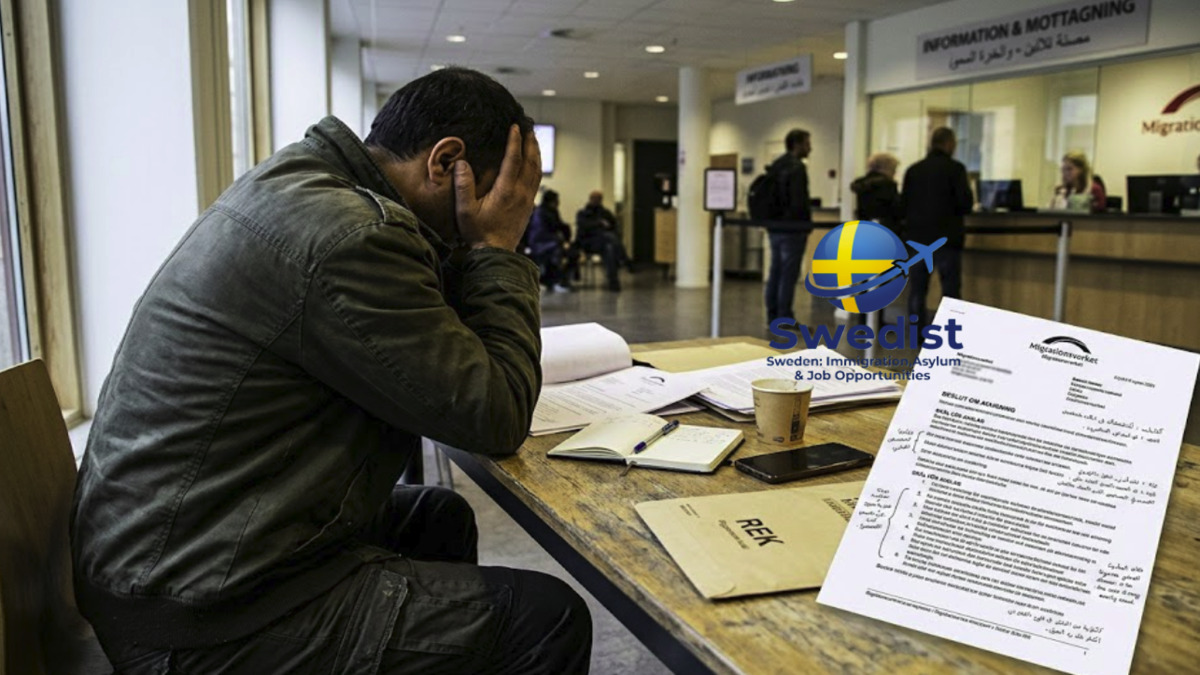
Stockholm – Swedist: Landing in Stockholm with a hope for safety is only the first step of a long and rigorous legal journey. In the past few years, the Swedish Migration Agency (Migrationsverket) has processed thousands of claims, but not all stories lead to residency. Why are so many applicants facing a “No” today? It isn’t just about the conflict back home; it’s about how that conflict is documented and defended in a system that values cold facts over emotional narratives.

If you are looking for the primary Sweden asylum rejection reasons, you will find that the devil is in the details. A single date forgotten or a missing document can derail months of waiting. We’ve looked into recent case trends to understand why the rejection bar feels higher than ever and how applicants are losing their cases before they even reach the courtroom.
H2: Common Sweden Asylum Rejection Reasons and Credibility Issues
The core of any asylum case in Sweden is “credibility.” If the caseworker doesn’t believe you, the case is closed. Statistics show that a large percentage of rejections stem directly from what the agency calls “lack of reliability.” Here is how this happens on the ground:

H3: 1. Significant Discrepancies in Oral Testimony
The most frequent of all Sweden asylum rejection reasons is the inconsistency between interviews. During the initial screening and the subsequent deep-dive interview, you will be asked the same questions in different ways. If you told the police at the border that you fled in March, but told the caseworker it was May, your credibility is compromised. Caseworkers are trained to flag these “minor” shifts as evidence of a fabricated story.
H3: 2. Failure to Prove Personal and Direct Threat
Sweden distinguishes between “general violence” and “personal persecution.” If you flee a war zone but cannot prove that you specifically were targeted because of your politics, religion, or identity, you might be rejected. The agency often suggests that you could have moved to a different, safer city within your own country—a concept known as the “Internal Flight Alternative.”
H3: 3. Lack of Physical or Documentary Evidence
While international law says an asylum seeker shouldn’t always be expected to have papers, the Swedish reality is different. Applications without photos, arrest warrants, medical reports, or digital evidence (like social media threats) are significantly harder to win. Without a paper trail, your story remains just a story, and in 2024, stories without proof are one of the leading Sweden asylum rejection reasons.
H2: Technical and Procedural Errors Leading to Rejection
Beyond the story itself, many applicants fail due to the way they handle the administrative side of their claim. These are avoidable but fatal mistakes.
H3: 4. Delays in Filing the Application
Why did you wait two months after arriving in Sweden to apply for asylum? This is a question that sinks many files. The Migration Agency views a delay as a sign that you were not in “immediate danger.” If the threat was real, they argue, you would have sought protection at the first possible moment.
H3: 5. Contradictions with Country of Origin Information (COI)
Swedish caseworkers use updated “Country of Origin” reports. If you claim that a certain group is haunting you in a specific city, but the official report says that group is no longer active there, your claim will be rejected. This mismatch between personal narrative and objective geopolitical facts is a high-ranking cause among Sweden asylum rejection reasons.
H3: 6. Incomplete Personal Data and Identity Doubts
If you cannot prove who you are with a passport or ID, the agency starts from a place of doubt. Any small error in your family tree, travel route, or previous residency can be seen as an attempt to hide your real identity or a previous asylum claim in another EU country under the Dublin Regulation.
H3: 7. Weak “Core Fear” Articulation
During the final interview, many applicants fail to clearly state: “If I go back tomorrow, X person will do Y to me because of Z.” Talking in generalities about “the situation” or “bad people” doesn’t provide the legal ground for protection. Inability to define the specific threat is a recurring theme in Sweden asylum rejection reasons.
H2: How to Navigate the Rejection Risk
The numbers are clear: a well-prepared file has a much higher success rate. The Migration Agency isn’t just looking for reasons to say no; they are looking for a legal basis to say yes. To provide that basis, your narrative must be a straight line—no deviations, no gaps, and no contradictions.
As we see more cases being scrutinized under stricter guidelines, the quality of the first interview has become the “make or break” moment. Once a statement is on the record, it is nearly impossible to change it later during an appeal.
Frequently Asked Questions
What are the main Sweden asylum rejection reasons?
The most common reasons include inconsistent statements between interviews, lack of physical proof of danger, and the Migration Agency’s belief that the applicant could live safely in another part of their home country.
How does “credibility” affect my asylum case?
Credibility is the foundation of your case. If the caseworker finds contradictions in your story, they may dismiss your entire claim, even if parts of it are true.
Can I appeal if I am rejected for “lack of evidence”?
Yes, you can appeal to the Migration Court. However, you must be able to provide new evidence or a logical explanation for why the initial assessment was wrong.
Is a general war in my country enough to get asylum?
Usually, no. You must demonstrate that you are personally at risk. General instability often results in a temporary stay or a rejection if a “safe zone” exists in your country.
Conclusion Understanding the Sweden asylum rejection reasons is the first step in building a stronger case. In a system that relies heavily on documentation and consistency, being aware of these 7 fatal mistakes can help applicants avoid the pitfalls that lead to a closed file.
Contact: info@alswedalyom.com