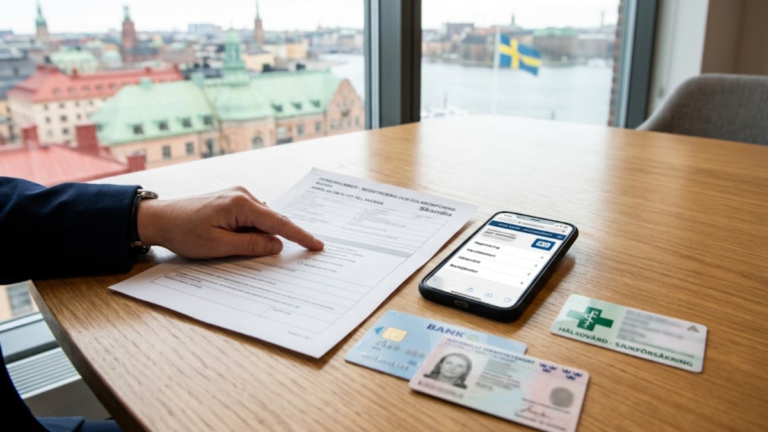


STOCKHOLM – Swedist: Sweden Work Visa Requirements have tightened, with foreign workers now facing a higher minimum salary threshold and additional conditions when seeking permission to work in the country. The latest rules also introduce changes affecting health insurance, seasonal employment and certain categories of international workers, making it more important than ever for applicants to check the conditions before accepting a job offer. What do foreign workers need to know before applying for a Swedish work permit?

Sweden Work Visa Requirements become stricter for foreign workers
Sweden has introduced significant changes to its work-permit system, creating a new set of requirements for people from outside the European Union and European Economic Area who want to take up employment in the country.
The changes affect both workers and employers. In particular, the salary threshold has become a central part of the application process, while employers must continue to provide employment conditions that meet Swedish collective agreements or established standards within the relevant profession or industry.

The Swedish Migration Agency says the new rules apply to people applying for work permits for the first time, while transitional arrangements exist for some workers who already hold permits and are applying for an extension.
The agency has also highlighted new requirements concerning comprehensive health insurance for certain applicants, alongside separate rules governing seasonal workers and employees arriving under the intra-company transfer system.
For anyone planning to move to Sweden for employment, the most important issue is now the relationship between the offered salary and Sweden’s median salary.
Sweden Work Visa Requirements and the new salary threshold
Under the current rules, a foreign worker applying for a Swedish work permit generally needs a monthly salary equal to at least 90 percent of the median salary in Sweden at the time the application is submitted.
The Swedish Migration Agency currently lists the median salary at SEK 38,300 per month. That places the standard work-permit salary threshold at SEK 34,470 per month.
The figure is not permanently fixed. It is linked to the median salary published by Statistics Sweden, meaning the applicable threshold can change when the underlying salary statistics are updated.
This makes the timing of an application particularly important. The median salary that applies is the figure in force when the work-permit application is submitted.
Applicants should therefore check the latest salary requirement before filing their application, particularly if they are negotiating an employment contract several months in advance.
The salary must also satisfy another important condition. Meeting the numerical threshold alone is not enough. The employment terms must also be at least comparable with Swedish collective agreements or what is considered customary in the relevant occupation or industry.
This means applicants should examine the complete employment offer rather than focusing only on the headline salary.
The Swedish Migration Agency’s official information on the salary requirement is available through its work-permit salary requirements page.
Who can apply for a Swedish work permit?
The Swedish work-permit route is generally intended for people from countries outside the EU and EEA who have secured employment in Sweden.
A job offer is therefore a fundamental part of the process. The worker cannot simply apply for a permit without an employment opportunity that meets the relevant requirements.
The employer also plays a major role in the application. The position must comply with Swedish employment standards, and the salary and other conditions must meet the rules that apply to the occupation.
Applicants should make sure that their employment agreement clearly sets out their salary and working conditions. Any discrepancy between the employment offer and the information submitted during the application process could create problems.
The application process also involves the Swedish Migration Agency, which assesses whether the requirements have been fulfilled.
In practical terms, prospective workers should establish three things before proceeding: that the employer is offering a qualifying position, that the salary meets the applicable threshold and that the employment conditions correspond with Swedish standards.
These checks are particularly important under the revised system because the salary requirement has become considerably more significant in determining eligibility.
Transitional rules for existing work-permit holders
The new salary rules do not affect every worker in exactly the same way.
People who already received a work permit under the previous rules may benefit from transitional arrangements when applying to extend their permits.
Under the transition rules, an existing permit holder who applies for an extension during the specified transition period may not have to meet the new 90-percent salary threshold.
Instead, the previous maintenance requirement can apply to qualifying extension applications.
However, the transition is temporary. Workers who plan to extend their permits should therefore pay close attention to the date on which they submit their application.
The Swedish Migration Agency has indicated that the new salary threshold will apply to relevant extension applications submitted after the transition period ends.
This distinction is important for foreign workers already living in Sweden. The rules for a first-time applicant are not necessarily identical to those for someone who has already received a work permit and is seeking an extension.
Applicants should also remember that other requirements can still apply to an extension. Meeting the transitional salary condition does not automatically guarantee approval.
The safest approach is to check the rules that apply specifically to the individual’s permit history, occupation and employment situation before submitting an extension application.
Sweden Work Visa Requirements include health insurance
Another important change concerns health insurance.
Applicants who plan to stay in Sweden for a maximum of one year must be able to demonstrate that they have, or have applied for, comprehensive health insurance.
The requirement adds another element to the preparation process for short-term foreign workers.
A qualifying applicant should therefore not focus exclusively on salary and the employment contract. Insurance documentation may also become an important part of the application.
This is particularly relevant to workers whose employment contracts cover a relatively short period. They should establish what insurance coverage is required and ensure that the necessary documentation is available.
The change reflects a broader effort to make the conditions attached to work permits more clearly defined, with applicants expected to meet requirements beyond simply securing a job.
For employers, the development also means that international recruitment may require additional preparation before a worker can begin employment in Sweden.
Special rules for seasonal workers and ICT employees
The revised framework also affects specific categories of international employment.
For seasonal work, the salary must correspond to at least the minimum level provided by Swedish collective agreements or what is customary in the relevant profession or industry.
The same principle applies to seasonal employment even when the worker is employed on a part-time basis.
The rules also introduce corresponding salary requirements for employees entering Sweden under ICT permits.
These provisions are important because seasonal employment and intra-company transfers can involve different recruitment models from ordinary work-permit applications.
Employers bringing workers to Sweden under these categories need to ensure that compensation complies with the relevant rules before the application is submitted.
Workers should also check whether their employment falls under the standard work-permit system or one of the special permit categories.
The distinction can affect both eligibility and the documents required during the application process.
At the same time, seasonal workers can benefit from a longer possible permit period under the revised rules. The maximum period for seasonal work has been extended from six months to nine months within a twelve-month period.
For international companies, the changes to ICT permits and other categories mean that immigration planning has become an increasingly important part of workforce management.
Exemptions from the salary requirement
Not every worker is subject to the standard 90-percent salary threshold.
The Swedish Government has identified certain occupations and groups that can qualify for exemptions.
For these exempt categories, the salary requirement is generally set at 75 percent of the median salary rather than 90 percent.
The Swedish Migration Agency has described exemptions covering around twenty occupational groups, while additional exemptions exist under specific provisions of the Aliens Ordinance.
The exemption system is therefore not a blanket reduction available to any applicant earning below the standard threshold.
Instead, an applicant must fall within a qualifying occupation or category.
Among the groups identified in the official guidance are certain foreign-trained doctors, dentists and nurses who are working toward Swedish professional certification.
Certain employees working for eligible technology or life-science companies may also qualify for an exemption. The company must meet specific conditions, including being in a start-up phase, being less than five years old and having fewer than one hundred employees.
Former students and researchers in Sweden can also fall within specific exemption arrangements when applying for a work permit for the first time.
People holding residence permits connected to temporary protection may likewise qualify under certain conditions.
The exemptions are therefore significant for some applicants, but they should not be interpreted as a general alternative to the standard salary threshold.
Applicants should confirm that their occupation and personal circumstances fall within an officially recognised exemption before relying on the lower threshold.
EU Blue Card rules also change
The revised system also brings changes for highly qualified international workers using the EU Blue Card route.
The maximum period for an EU Blue Card has been increased from two years to four years at a time.
This change may be particularly relevant to highly qualified professionals whose employment and qualifications meet the specific requirements of the EU Blue Card system.
However, the EU Blue Card is a separate immigration route from the ordinary Swedish work permit.
Applicants should therefore identify the correct permit category before beginning the application process.
The appropriate route can depend on factors including qualifications, salary, employment conditions and the nature of the job.
Choosing the correct permit category is important because the applicable requirements and benefits may differ.
What applicants should prepare before applying
Foreign workers considering employment in Sweden should prepare their application carefully and verify the requirements before submitting documents.
The first step is to secure a genuine employment offer from a Swedish employer.
The applicant should then check the salary against the latest applicable median salary and determine whether the position meets the required threshold.
The employment conditions should also be reviewed against Swedish collective agreements or normal practice in the profession or industry.
Applicants who intend to stay for no more than one year should pay particular attention to the comprehensive health insurance requirement.
Those applying under seasonal or ICT arrangements should verify the specific rules for their category rather than assuming that the ordinary work-permit conditions apply.
Workers who already hold a Swedish permit and are seeking an extension should also establish whether transitional provisions apply to their case.
The timing of the application can matter, particularly because the salary threshold is linked to the median salary applicable when the application is submitted.
Finally, applicants should ensure that information provided by the employer matches the employment contract and the details included in the immigration application.
What the latest changes mean for employers
The new framework also places greater responsibility on Swedish employers that recruit workers from abroad.
Companies must ensure that the salary offered meets the applicable threshold and that the employment terms correspond with Swedish standards.
Employers should also be aware that applications can be affected by deficiencies connected to the employer.
This means international recruitment requires more than simply finding a suitable candidate. Companies must ensure that the position itself complies with the immigration rules before beginning the process.
For businesses that depend on international talent, the salary threshold may be particularly important in sectors where wages traditionally fall below the national median.
At the same time, the exemptions for selected occupations and groups may provide additional flexibility in areas where Sweden needs specific skills.
Employers should therefore determine whether a vacancy falls within an exempt occupation before rejecting an international candidate because of the standard salary threshold.
A changing landscape for people seeking jobs in Sweden
Sweden remains an attractive destination for international workers, but the latest changes show that the country’s work-permit system is becoming more structured and demanding.
The most immediate issue for many applicants is the new salary threshold of SEK 34,470 per month based on the currently applicable median salary.
However, salary is only one part of the process.
Employment conditions, health insurance, occupation, permit category and the applicant’s previous immigration status can all influence the requirements.
The rules also demonstrate why prospective workers should rely on current official information rather than older articles or social-media advice.
The salary threshold can change when Sweden’s median salary is updated, while exemptions and transitional arrangements may depend on the applicant’s individual circumstances.
For anyone preparing an application, the key message is straightforward: secure a qualifying job, verify the salary, check the employment conditions and identify the correct permit route before submitting the application.
The latest changes mean that careful preparation is now more important than ever for foreign workers hoping to build their careers in Sweden.
FAQ
What is the current minimum salary for a Swedish work permit?
The current standard salary requirement is SEK 34,470 per month, based on 90 percent of the median Swedish salary of SEK 38,300.
Do all foreign workers need to earn SEK 34,470?
No. Certain occupations and groups are exempt from the standard threshold and may instead be subject to a salary requirement of 75 percent of the median salary.
Is health insurance required for a Swedish work permit?
Applicants planning to stay in Sweden for a maximum of one year must be able to show that they have, or have applied for, comprehensive health insurance.
Can existing work-permit holders benefit from transitional rules?
Yes. Certain people extending work permits granted under the previous rules may qualify for transitional arrangements, depending on when they apply and their individual circumstances.
Contact: info@alswedalyom.com