

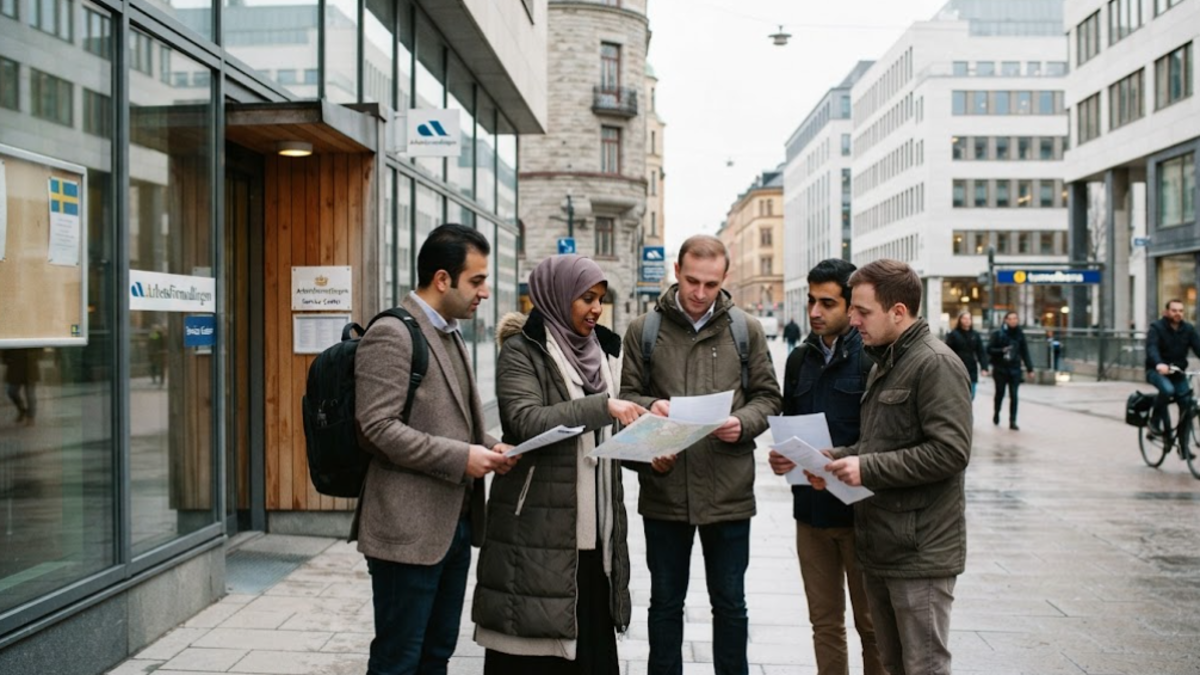
STOCKHOLM – Swedist: Sweden unemployment benefits for foreign workers are available under rules that can apply to both Swedish and foreign employees, but nationality alone does not determine eligibility. Recent labour-market figures show that unemployment among foreign-born residents remains considerably higher than among people born in Sweden, making access to unemployment insurance particularly important for many international workers. Who can actually qualify, and what conditions must foreign workers meet?

Sweden’s unemployment insurance system is built around the unemployment insurance funds, commonly known as a-kassa. The system provides compensation to people who lose their jobs and meet the applicable requirements while looking for new employment.
For foreign workers, the key issues include previous employment in Sweden, income, registration with the Swedish Public Employment Service and, in some cases, previous work in another European country.

Recent figures from the Swedish Public Employment Service show that unemployment has been falling, including among foreign-born workers. At the end of August, more than 349,000 people were registered as unemployed, equivalent to 6.5 percent of the labour force. Among foreign-born people, the unemployment rate was 13.4 percent, compared with 4.2 percent among people born in Sweden.
The figures underline why understanding the unemployment insurance rules matters for workers who have moved to Sweden for employment.
Sweden unemployment benefits for foreign workers: The basic rules
Foreign citizenship does not automatically exclude a person from Sweden’s unemployment insurance system. Workers who work in Sweden can generally join an unemployment insurance fund if they satisfy the membership conditions.
According to Sveriges a-kassor, people who work in Sweden have the right to join an unemployment insurance fund. A person normally needs either a Swedish personal identity number or coordination number, must work or have previously worked in Sweden, and the employer or the person’s own business must pay taxes and social contributions for the work.
Membership, however, is only one part of the process.
A person who becomes unemployed must also meet the conditions for receiving compensation. The unemployment insurance fund examines the individual’s circumstances and determines whether the requirements have been fulfilled.
The Swedish Public Employment Service says an unemployed person should register as a jobseeker on the first day of unemployment. This is important because the unemployment insurance fund assesses entitlement from the day the person registers and is unemployed.
A worker should therefore not wait several days before registering simply because an application for unemployment compensation has not yet been completed.
Registration also matters for people who need to protect other parts of their social-security position, including their qualifying income for certain benefits.
Who can qualify for unemployment compensation?
The current rules require more than simply having lost a job.
A person seeking unemployment compensation must generally be at least 20 years old, registered with the Swedish Public Employment Service and able and willing to accept work immediately. The person must also have nothing preventing them from applying for and accepting a job.
Previous employment and income are also central to the assessment.
Under the current income requirements, an applicant can qualify by having earned at least SEK 11,000 per month before tax for at least four months during the previous 12 months and a total income of at least SEK 120,000.
There is also an alternative route based on four consecutive months in which the applicant earned at least SEK 11,000 per month before tax during the relevant 12-month period.
These requirements are particularly important for foreign workers who have recently entered the Swedish labour market.
Someone who has worked in Sweden for only a short period may need to examine the income records carefully before assuming that unemployment compensation will be available.
The unemployment insurance fund obtains income information from the Swedish Tax Agency, which means the applicant’s declared income forms an important part of the assessment.
Does a foreign worker need to be a member of an a-kassa?
Membership can affect the level of compensation, but a person who is already unemployed is not necessarily prevented from applying simply because they were not previously a member.
The Swedish Public Employment Service states that a person who is not a member of an unemployment insurance fund can apply for membership after becoming unemployed. A person who does not want to become a member can instead apply through Alfa-kassan.
The amount of compensation depends partly on previous income and the individual’s membership circumstances.
Under the current rules, compensation can reach 80, 60 or 50 percent of previous income, with a maximum of SEK 27,200 per month before tax. The level can decrease as the compensation period progresses.
This makes the distinction between being eligible for compensation and receiving the maximum possible amount particularly important.
A foreign worker may therefore qualify for unemployment compensation without necessarily receiving an amount equal to the worker’s previous salary.
Sweden unemployment benefits for foreign workers and EU experience
International employment can create additional questions when a worker has moved between European countries.
Swedish unemployment insurance rules can, in certain circumstances, take periods of work in another EU or EEA country or Switzerland into account.
Sveriges a-kassor explains that the main rule is that a person normally needs to work in Sweden, or have had their latest employment in Sweden, to fall under the Swedish unemployment insurance system. There are special rules for certain groups, including frontier workers and some people returning to Sweden after employment in another Nordic country.
This can be especially relevant to workers who live in one country while working in another.
A person who previously worked in another EU or EEA country may, where the rules allow it, have those employment periods taken into consideration when applying for Swedish unemployment compensation.
The Swedish unemployment insurance fund can request information from the unemployment insurance authority in the previous country through the electronic EESSI system. Applicants may also use a U1 certificate in circumstances where it is applicable.
Keeping payslips, employment certificates and other records from previous employers can make the assessment easier.
What happens when a foreign worker loses a job?
The first practical step is registration.
The Swedish Public Employment Service advises unemployed people to register on their first day without work. The registration can be completed through its digital service, and people who need assistance can also use government service centres.
After registering, the worker applies for compensation through the relevant unemployment insurance fund.
The applicant will normally need information from the previous employer. An employer’s certificate is used to document employment and is an important part of the application process.
The worker must also continue meeting the conditions attached to unemployment compensation.
Receiving benefits does not mean that the person can simply remain outside the labour market. The applicant must remain available for work and follow the requirements connected with job seeking.
Failure to follow the conditions can result in suspension of compensation for one or more days.
Workers should also report changes that could affect their entitlement. The unemployment insurance fund warns that incorrect payments can result in an obligation to repay money that the person was not entitled to receive.
Does immigration status affect unemployment benefits?
Immigration and unemployment insurance are related but separate areas of Swedish law.
EU/EEA citizens generally have the right to work in Sweden without a work or residence permit under the applicable free-movement rules.
Workers from outside the EU/EEA and Switzerland generally need the appropriate work permit to work in Sweden.
For non-EU workers, the validity and conditions of a residence or work permit can therefore become important when employment ends.
A person should not assume that qualifying for unemployment insurance automatically gives the right to remain in Sweden indefinitely.
The unemployment insurance question concerns whether the worker satisfies the conditions for compensation. Immigration rules determine whether a foreign national has the right to stay and work in Sweden.
Foreign workers whose employment ends should therefore check both issues separately.
The Swedish Migration Agency also sets specific requirements for work permits, including employment conditions, insurance and salary requirements. Current rules state that non-EU/EEA nationals normally need a work permit to work in Sweden.
What if the worker has never joined an unemployment fund?
Not joining an a-kassa before unemployment does not necessarily mean that the worker has no possible route to compensation.
A person who becomes unemployed can apply for membership, while Alfa-kassan provides an alternative for people who do not wish to join a specific unemployment insurance fund.
However, the final entitlement and compensation level depend on the applicable conditions and the person’s work and income history.
Foreign workers should therefore avoid confusing membership with automatic payment.
Joining an unemployment insurance fund does not by itself guarantee benefits. The applicant must satisfy the conditions for compensation when unemployment occurs.
At the same time, foreign employees should not assume that unemployment insurance is reserved for Swedish citizens. The membership rules are connected to work in Sweden and the applicable insurance conditions rather than nationality alone.
Sweden unemployment benefits for foreign workers amid a changing labour market
The question of unemployment compensation comes at a time when Sweden’s labour market continues to show a significant gap between foreign-born and Swedish-born workers.
The Swedish Public Employment Service reported that unemployment among foreign-born people stood at 13.4 percent at the end of August, while the corresponding figure for people born in Sweden was 4.2 percent. At the same time, unemployment among foreign-born workers had continued to decline.
Recent data from Sveriges a-kassor also showed an increase in new applications for unemployment compensation. The organisation reported almost 26,300 first applications during August, 6 percent more than in the previous month.
The figures provide context for international workers navigating Sweden’s employment system.
The labour market also contains areas where employers report difficulties finding workers with the required skills. Recent Nordic labour-market reporting highlighted shortages in sectors including construction, sales, hospitality, electronics, IT, education, administration and health and social care in parts of the wider Öresund region.
For unemployed foreign workers, this means that unemployment insurance operates alongside the wider job-search system.
Compensation is intended to provide financial support while an eligible person searches for new employment. It does not replace the obligation to remain available for work.
Can foreign workers keep Swedish benefits while looking for work abroad?
In some circumstances, yes.
A person receiving Swedish unemployment compensation may be able to keep the benefit temporarily while travelling to another EU/EEA country or Switzerland to look for work.
Sveriges a-kassor states that an unemployed person in Sweden may apply for a U2 certificate allowing unemployment compensation to continue for a maximum of three months while searching for employment in another EU/EEA country or Switzerland.
The application must be made before the journey. It cannot be completed retrospectively after the person has already travelled.
This option can be relevant to foreign workers who maintain professional or family connections elsewhere in Europe.
However, the U2 process has its own requirements and should not be confused with a general right to receive Swedish unemployment benefits while living abroad.
Workers considering this route should obtain the necessary approval before leaving Sweden.
What documents should foreign workers prepare?
Documentation can make the unemployment claim easier to assess.
Applicants should be prepared to provide employment information and evidence of previous earnings. The previous employer may need to complete an employer’s certificate, while income information is also obtained through the Swedish Tax Agency.
Foreign workers with employment history outside Sweden should retain payslips, employment certificates and other records that show where and when they worked.
This can be particularly useful when an applicant wants previous EU/EEA or Swiss employment to be considered.
Workers should also keep their personal and employment information updated with the relevant authorities and unemployment insurance fund.
If circumstances change during a benefit period, the unemployment insurance fund should be informed promptly.
Where can foreign workers get official information?
The Swedish Public Employment Service provides information in English about unemployment registration and unemployment compensation.
Workers can also contact their unemployment insurance fund directly about membership, applications, payments and individual circumstances.
For immigration questions, foreign nationals should consult the Swedish Migration Agency rather than assuming that an unemployment insurance decision determines their immigration status.
For EU/EEA workers, additional coordination rules can apply when employment has taken place across national borders.
The central point is that there is no single rule based simply on nationality. Eligibility depends on employment, income, registration, availability for work and the specific circumstances of the applicant.
Foreign workers should therefore check their own record rather than relying on assumptions based on citizenship or residence status.
What foreign workers should remember
The Swedish unemployment insurance system can cover foreign workers, provided they meet the relevant requirements.
The most important steps are straightforward: register with the Swedish Public Employment Service when unemployment begins, apply to the appropriate unemployment insurance fund, document previous employment and income, and continue meeting the conditions for receiving compensation.
Foreign workers who have worked elsewhere in Europe may have additional options because employment periods from another EU/EEA country or Switzerland can, in certain circumstances, be taken into account.
The system also distinguishes between unemployment insurance and immigration law. A person may qualify for compensation while still needing to examine whether their residence or work status permits them to remain in Sweden.
For international workers, understanding that distinction can prevent costly misunderstandings.
FAQ
Can foreign workers receive unemployment benefits in Sweden?
Yes. Foreign workers can qualify if they meet the applicable unemployment insurance conditions.
Must I join an a-kassa before losing my job?
No. A person who becomes unemployed can apply for membership, although the compensation rules still apply.
Can previous EU work count?
In certain circumstances, employment periods from another EU/EEA country or Switzerland can be taken into account.
What should I do on my first day unemployed?
Register with the Swedish Public Employment Service and then apply for compensation through the relevant unemployment insurance fund.
Contact: info@alswedalyom.com