
STOCKHOLM – Swedist: Nursing Jobs in Sweden are drawing renewed attention as Swedish healthcare continues to face recruitment difficulties, particularly in professions where employers struggle to find qualified staff. Recent reporting has highlighted nurses among the occupations affected by shortages, while Sweden’s dependence on internationally trained healthcare professionals has also become part of a wider debate over migration and workforce policy. For nurses considering Sweden as a career destination, what does the latest situation actually mean for employment opportunities?

Nursing Jobs in Sweden remain in demand
Sweden’s healthcare sector continues to experience pressure from staffing shortages, creating employment opportunities for qualified nurses in different parts of the country.
A recent report from Sweden Herald on labour-market shortages identified nurses among the professions for which employers have particular difficulty finding suitable workers. The report placed the nursing shortage within a broader Swedish labour-market problem affecting a significant number of occupations.

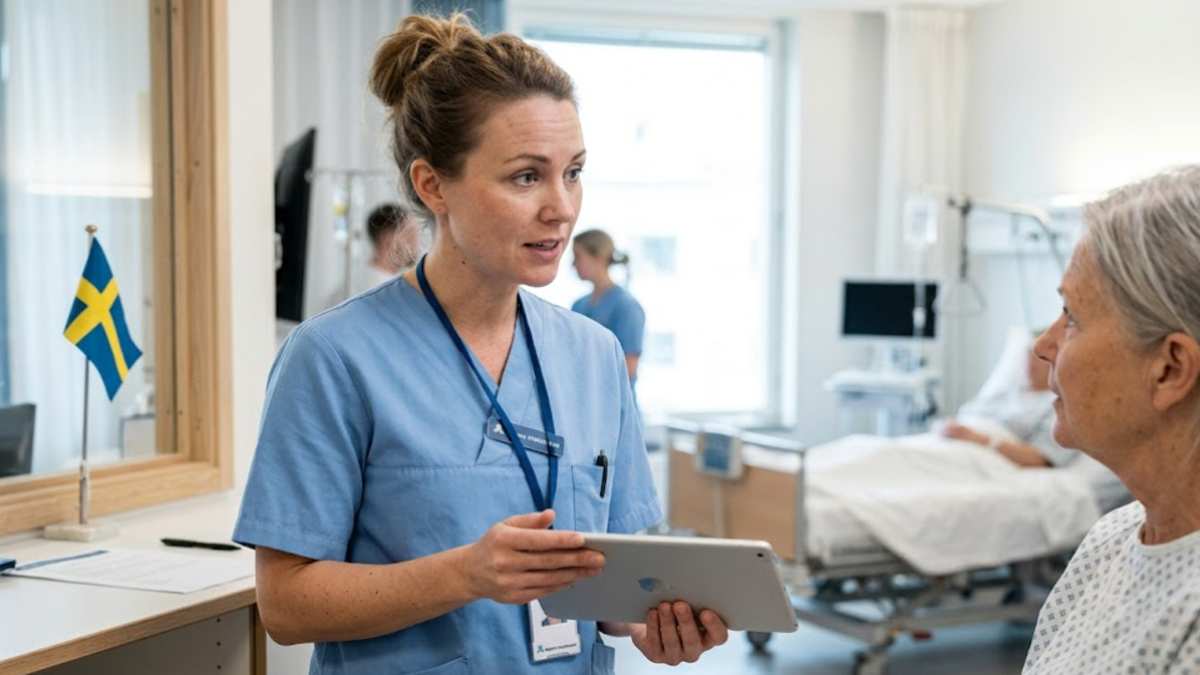
The demand is not limited to one type of healthcare employer. Nurses can work in regional healthcare services, municipal care, private practices, hospitals, healthcare centres and home healthcare. Elderly care and disability services also provide employment opportunities for healthcare professionals.
That range is important for jobseekers because Sweden’s healthcare system is decentralised. Regional authorities have major responsibility for healthcare, while municipalities play an important role in elderly care and other community-based services.
For a qualified nurse, this means the search for work does not necessarily have to focus only on major hospitals in Stockholm, Gothenburg or Malmö. Opportunities can also exist in smaller communities and northern parts of the country, where recruitment challenges can be particularly significant.
However, the existence of vacancies should not be interpreted as an automatic route into employment. Nursing is a regulated profession in Sweden, and professional recognition and language requirements remain central issues for people educated abroad.
International nurses are part of Sweden’s healthcare workforce
Sweden has relied on internationally trained healthcare professionals to strengthen staffing in areas where domestic recruitment has not been sufficient.
Recent reporting on the country’s healthcare workforce said that, over the previous decade, Sweden had relied on almost 4,000 foreign-trained doctors, around 2,000 nurses and approximately 33,000 assistant nurses to help fill important staffing gaps.
The figures underline why international recruitment has become an important part of the Swedish healthcare discussion.
Foreign-born workers are particularly significant in some healthcare occupations. The same reporting noted that immigrants account for a substantial share of healthcare assistants and assistant nurses, while more than one-quarter of doctors are trained abroad.
For nurses from outside Sweden, this creates an interesting but complicated picture. The country needs healthcare workers, yet professional licensing, language skills and immigration rules can determine whether an overseas nurse can actually take up a position.
The Swedish authorities therefore distinguish between labour-market demand and the legal right to practise a regulated profession.
A nursing qualification obtained in another country does not, by itself, allow a person to use the protected professional title of nurse in Sweden.
What foreign nurses need before working in Sweden
The Swedish National Board of Health and Welfare, known as Socialstyrelsen, states that anyone wishing to practise as a nurse in Sweden must have a Swedish licence. The title is protected under Swedish law.
For nurses educated outside the European Union or European Economic Area, the licensing route can involve several stages.
These may include an assessment of the applicant’s education, a proficiency test, a course concerning Swedish laws and regulations, clinical training and the final licence application. Socialstyrelsen says the usual timeframe can vary considerably depending on the individual route and circumstances.
Applicants should therefore prepare for a process that can take considerably longer than simply applying for a vacancy.
The first assessment examines whether the overseas nursing education corresponds sufficiently to Swedish education in terms of level, length and content. The authority asks applicants to provide documentation concerning their education, including relevant certificates and course information.
For nurses outside the EU and EEA, the proficiency test is conducted in Swedish. The test has both theoretical and practical components, with the theoretical part required before the practical section.
This makes language preparation one of the most important parts of the process for international candidates.
Applicants can find the official licensing requirements and application process through Swedish National Board of Health and Welfare – nursing licence information.
Swedish language skills are essential
English may be widely spoken in Swedish society, but that does not remove the language requirement for licensed nursing practice.
Socialstyrelsen says applicants must demonstrate sufficient proficiency in Swedish, Danish or Norwegian. Among the accepted ways of demonstrating language ability is Swedish at C1 level under the Common European Framework of Reference for Languages. Certain Swedish education qualifications can also satisfy the requirement.
For healthcare employers, language is more than an administrative requirement.
Nurses communicate with patients, relatives, doctors, therapists and other healthcare professionals. They must understand medical information, document care and respond accurately to patients in situations where misunderstanding can have serious consequences.
For that reason, learning Swedish should be viewed as part of professional preparation rather than simply an immigration requirement.
Nursing Jobs in Sweden and the challenge of international recruitment
The current debate around nursing employment also reflects a larger question: how should Sweden recruit healthcare professionals while maintaining a stable workforce?
Recent reporting described tensions caused by stricter migration policies affecting foreign healthcare workers. According to that reporting, hundreds of deportation orders had been issued since the previous year, with healthcare workers among those affected. The uncertainty has raised concerns about the impact on foreign professionals already working in Sweden and on future recruitment.
The issue is particularly relevant because international recruitment can help healthcare providers respond to staffing shortages, but recruitment depends on more than the number of available vacancies.
A nurse arriving from another country may need professional recognition, Swedish language training, clinical adaptation and, depending on circumstances, an appropriate work or residence permit.
That means employers and candidates can face a lengthy process before a foreign-trained professional becomes fully integrated into the Swedish healthcare system.
For jobseekers, this is an important distinction. A headline saying that Sweden needs nurses does not necessarily mean that an overseas nurse can immediately obtain a nursing position.
The candidate’s education, experience, language skills, licence status and immigration circumstances all matter.
Where nurses can find opportunities
Nursing employment in Sweden covers a broad range of settings.
Hospitals remain a major employer, with opportunities across medical and surgical departments as well as specialised areas. Healthcare centres provide another route, particularly for nurses interested in primary care.
Municipal healthcare is also important. Nurses may work with elderly patients, people receiving care in their homes or people who require long-term support.
Private healthcare providers can offer additional opportunities, although requirements vary between employers.
The Nordic cooperation information service states that nurses in Sweden can work within regional health authorities, municipalities and private practices. Its examples include hospitals, healthcare centres, home healthcare, elderly care and disability care.
This broad employment structure means that candidates should consider location and healthcare setting when searching for vacancies.
A nurse who focuses exclusively on large-city hospitals may face stronger competition than someone willing to consider municipalities or regions with greater recruitment difficulties.
At the same time, applicants should carefully check whether a vacancy requires a Swedish nursing licence before applying.
Salary should not be the only consideration
Interest in Swedish nursing positions is often connected to salary expectations, working conditions and the country’s reputation for social services.
However, salary figures can vary significantly according to employer, region, professional experience, specialisation, working hours and collective agreements.
For that reason, jobseekers should be cautious about recruitment advertisements that promise a fixed salary without explaining the employment conditions.
The same caution applies to advertisements offering assistance with relocation or immigration.
Candidates should verify who the actual employer is, whether the position is genuine, what professional registration is required and whether any recruitment fees apply.
A legitimate job offer should clearly identify the employer and describe the position, workplace, duties and employment terms.
International applicants should also avoid assuming that an employment contract automatically gives them permission to practise nursing. Professional licensing and immigration status are separate matters.
Migration rules add another layer for overseas applicants
Sweden’s labour migration policy has become an important part of the employment environment for foreign workers.
The Swedish Government has announced changes affecting the wage threshold for labour immigration and has also discussed stricter requirements in areas connected with migration.
For nurses considering relocation, this means that employment conditions and immigration requirements must be checked together.
A candidate may have a nursing qualification and receive interest from an employer but still need to meet the applicable requirements for professional licensing and residence or work permission.
This is why applicants should rely on official Swedish authorities for immigration and professional-registration information rather than recruitment advertisements alone.
The situation can also change. Rules concerning migration, wages and professional recognition may be amended, making it important to verify requirements immediately before submitting an application.
A realistic pathway for international nurses
For an overseas nurse, the Swedish job search is best approached as a sequence rather than as a single application.
The first step is to establish whether the nursing qualification can be assessed for Swedish licensing purposes.
The next stage depends on the applicant’s education and professional background. Nurses educated outside the EU and EEA may have to complete assessment, examination, additional education or clinical training before obtaining a Swedish licence.
Language preparation should begin as early as possible.
Candidates who wait until the end of the licensing process to start learning Swedish may significantly increase the time required to reach professional readiness.
Documentation is another major consideration.
Applicants should keep clear copies of diplomas, transcripts, course descriptions, professional registration documents and other evidence requested by the Swedish authorities. Documents may need to be translated into Swedish or English depending on the application route.
Candidates should also check whether their professional status needs to be confirmed by the relevant authority in the country where they obtained their qualifications.
EU and EEA-trained nurses
Nurses educated within the EU or EEA follow a different recognition route from many applicants educated outside those areas.
Socialstyrelsen explains that professional qualifications are assessed under rules concerning recognition of professional qualifications. Recognition of qualifications is not itself the same as a Swedish licence to practise. Applicants still need to satisfy the applicable licensing and language requirements.
This distinction is important because jobseekers sometimes confuse recognition of their education with permission to work under a protected professional title.
The safest approach is to determine the correct licensing category before accepting a position.
Why demand does not mean an easy job search
Sweden’s nursing shortage creates opportunities, but the market remains professional and competitive.
Employers still need nurses with the right qualifications for specific roles. Hospitals may look for particular clinical experience, while municipal employers may prioritise candidates with backgrounds suited to elderly care, home healthcare or community services.
Language can also affect the number of positions available to an international applicant.
A candidate with strong Swedish skills, recognised qualifications and relevant experience is likely to be in a stronger position than someone who has only an overseas nursing certificate and limited knowledge of Swedish.
There is also an ethical dimension to international recruitment.
European health systems increasingly compete for nurses trained in countries that may themselves have healthcare staffing shortages. Recent academic discussion has highlighted ethical concerns surrounding the growing recruitment of internationally educated nurses from lower- and middle-income countries into Nordic healthcare systems.
That does not eliminate the opportunities for individual nurses, but it demonstrates why recruitment should be transparent and responsible.
What applicants should check before accepting an offer
Anyone considering nursing employment in Sweden should verify several points before making a financial commitment or moving abroad.
First, confirm that the employer is genuine and that the vacancy exists.
Second, determine whether the position requires a Swedish nursing licence and whether the applicant already qualifies to apply.
Third, establish the language level expected by the employer.
Fourth, check the salary, working hours, overtime arrangements, holidays and other employment conditions.
Fifth, verify which party is responsible for recruitment, relocation and immigration costs.
Candidates should also be careful with agencies that demand large payments in exchange for a supposed guaranteed job.
A nursing shortage does not mean every online advertisement is legitimate.
The safest strategy is to cross-check information with Swedish authorities and the employer itself before signing contracts or transferring money.
Nursing Jobs in Sweden offer opportunities, but preparation matters
The latest labour-market reporting presents a clear picture: Sweden continues to experience difficulty recruiting workers in several occupations, with nursing among the professions facing particular staffing challenges.
Healthcare providers also continue to depend on workers who have trained outside Sweden, demonstrating the importance of international professionals to the country’s healthcare system.
For qualified nurses, the opportunity is therefore real, but it comes with conditions.
A foreign nursing qualification does not automatically provide the right to practise. Professional licensing, language proficiency and, where applicable, immigration requirements all need to be addressed.
The strongest candidates will be those who approach the Swedish market with realistic expectations, complete their documentation carefully and invest seriously in Swedish-language skills.
For international nurses, Sweden can offer a route into a developed healthcare system with employment across hospitals, primary care, municipal services and private healthcare. But the journey begins well before the first interview.
Understanding the rules may be just as important as finding the vacancy itself.
Frequently Asked Questions
Can foreign nurses work in Sweden?
Yes. Foreign-trained nurses can work in Sweden after meeting the applicable professional licensing requirements. Nurses must obtain a Swedish licence to use the protected nursing title.
Is Swedish required for nurses?
Yes. Applicants must demonstrate sufficient proficiency in Swedish, Danish or Norwegian. Swedish language ability is an important part of the licensing process.
Where can nurses work in Sweden?
Nurses can work in hospitals, healthcare centres, regional healthcare services, municipalities, home healthcare, elderly care, disability services and private practices.
Is there a shortage of nurses in Sweden?
Recent labour-market reporting identifies nurses among the occupations in which Swedish employers have difficulty finding qualified workers. The country has also relied on internationally trained healthcare professionals to help address staffing needs.
Contact: info@alswedalyom.com