
Sweden’s Weather Warnings Explained: What Yellow, Orange and Red Alerts Mean
Sweden uses a three-level weather warning system to alert the public when dangerous weather could affect daily life, transport, public services and personal safety. Issued by the Swedish Meteorological and Hydrological Institute (SMHI), the warnings are colour-coded yellow, orange and red, with red representing the highest level of danger.

Understanding these alerts is particularly important for people living in Sweden, international residents, tourists and anyone planning to travel around the country. A yellow warning can already indicate potentially serious local problems, while an orange or red alert signals increasingly dangerous conditions that may require people to change their plans or avoid going outside.
Unlike systems that classify weather mainly according to wind speed, rainfall or snowfall measurements, Sweden’s warning system focuses on the consequences that weather conditions could have on society.

Who issues weather warnings in Sweden?
The Swedish Meteorological and Hydrological Institute, known as SMHI (Sveriges meteorologiska och hydrologiska institut), is responsible for monitoring weather conditions and issuing official weather warnings.
Its warnings are designed to help individuals, municipalities, regional authorities, emergency services and businesses prepare for potentially dangerous situations.
Sweden introduced its current impact-based warning system on 26 October 2021, replacing the previous system of Class 1, Class 2 and Class 3 warnings.
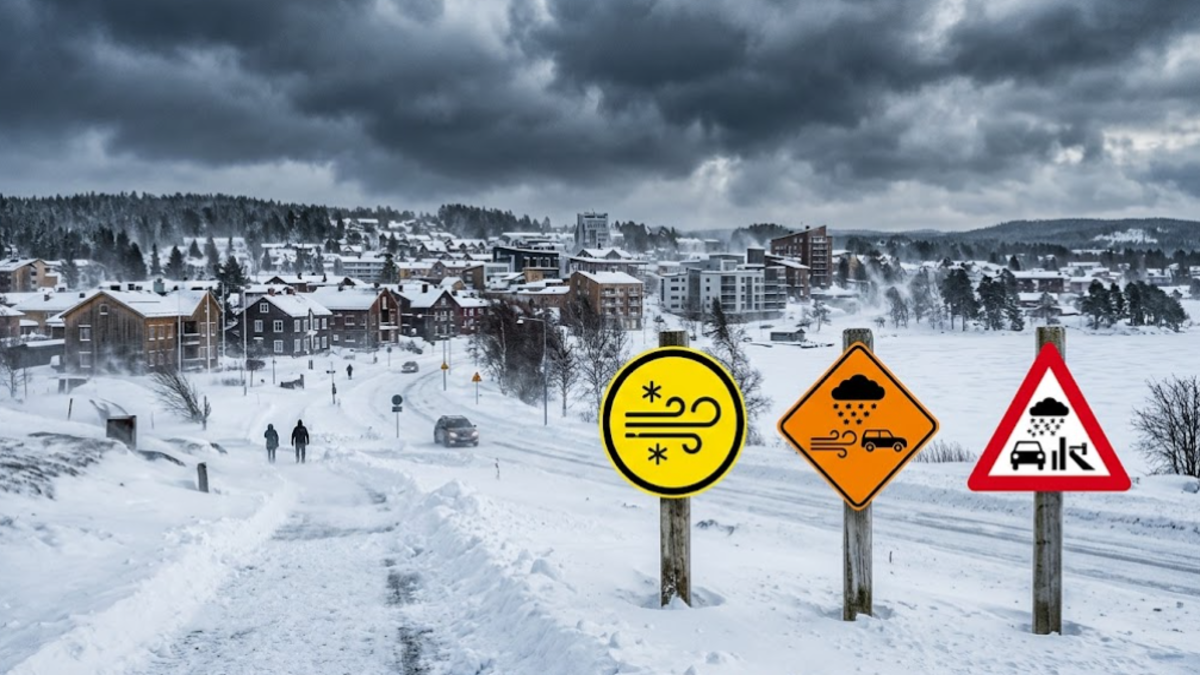
The change was intended to make warnings more relevant to local conditions and easier to understand. The new system uses three colours and corresponding symbols:
Yellow: Circle.
Orange: Diamond.
Red: Triangle.
The different shapes also help people distinguish warning levels when colours are difficult to identify.
The system considers not only the expected weather but also where and when it will occur. For example, heavy snowfall in a large city in southern Sweden could cause significant transport disruption, while similar snowfall in a northern region accustomed to winter conditions may have a different impact.
SMHI therefore assesses the potential consequences rather than relying exclusively on fixed weather measurements.
SMHI+1
What do the three weather warning colours mean?
Yellow warning – Be prepared
Level 1
Weather conditions could cause disruption, damage or risks to the public. People should monitor developments and take precautions, particularly in exposed areas.
Orange warning – Take precautions
Level 2
Weather could pose a danger to the public, cause serious damage and significantly disrupt public services. Avoid unnecessary exposure to the weather.
Red warning – Serious danger
Level 3
Conditions could create major risks to public safety, cause extensive damage and result in widespread disruption. Avoid activities that expose you to the dangerous weather.
These levels represent increasing potential consequences. However, the actual risks depend on the type of weather, the location and the circumstances of the warning.
Krisinformation.se+1
Yellow warning: What should you do?
A yellow warning is the lowest of Sweden’s three official weather warning levels, but it should not be ignored.
It indicates that the expected weather could cause problems for society, including damage to property, environmental effects and disruption to certain public services.
Some locations and groups may face considerably greater risks than others.
Examples of possible consequences include:
Delays or cancellations in public transport.
Roads blocked by fallen branches or trees.
Slippery roads and pavements.
Localised flooding.
Damage to outdoor equipment and property.
What you should do:
Follow SMHI’s latest forecasts and warning updates.
Check road and public transport conditions before travelling.
Secure loose objects outside your home.
Take additional precautions if you live in an area exposed to flooding, strong winds or other weather-related risks.
Pay attention to advice aimed at vulnerable individuals.
A yellow warning means you should be alert and prepared, not necessarily cancel all your activities.
Orange warning: When weather becomes dangerous
An orange warning indicates a more serious situation. The expected weather could create a danger to the public, cause significant damage to buildings and the environment, and disrupt important public services.
People who are particularly vulnerable may face especially serious consequences.
Depending on the type of weather, an orange warning could involve dangerous winds, heavy snowfall, severe rain or hazardous road conditions.
What you should do:
Avoid unnecessary outdoor activities.
Postpone journeys if conditions could make travelling dangerous.
Follow instructions from local authorities and emergency services.
Protect your home and property where possible.
Check whether public transport, roads and other essential services are affected.
An orange warning should be treated as a serious safety alert. Even if the weather appears manageable where you are, conditions may be considerably worse elsewhere within the affected warning area.
Red warning: The highest level of weather danger
A red warning is the most serious alert issued by SMHI.
It indicates that weather conditions could create major dangers for the public, cause very serious damage to property and the environment, and lead to extensive disruption across society.
During a red warning, exposure to the weather can be extremely dangerous.
Potential consequences depend on the event but may include:
Extensive flooding.
Dangerous wind conditions and widespread infrastructure damage.
Severe transport disruption.
Roads becoming impassable.
Major interruptions to public services.
Risks to life and emergency response operations.
What you should do:
Avoid going outside unless absolutely necessary.
Do not undertake activities that expose you to the dangerous conditions.
Avoid unnecessary travel.
Follow official instructions from emergency services and local authorities.
Keep informed about changes to the warning and local safety advice.
A red warning is not simply a stronger version of a yellow alert. It signals a situation in which the potential consequences can be extremely serious.
Krisinformation.se+1
What types of weather can trigger an SMHI warning?
Sweden’s warning system covers several types of weather-related hazards. The warning level depends on the expected consequences of each event.
| Weather event | Possible consequences |
|---|---|
| Strong winds | Fallen trees, damaged buildings and transport disruption |
| Heavy rainfall | Flooding, overflowing drainage systems and road closures |
| Snowfall | Difficult driving conditions, blocked roads and cancelled transport |
| Ice and slippery conditions | Traffic accidents, injuries and disruption to public transport |
| High water levels | Flooding of coastal areas and infrastructure |
| High temperatures | Health risks, particularly for vulnerable people |
| High water flows | Flooding near rivers, lakes and other waterways |
Not every weather event can trigger all three warning levels. The available levels and assessment criteria vary depending on the hazard.
For example, SMHI issues warnings for high temperatures at yellow and orange levels, while warnings for strong winds at sea can reach all three levels.
SMHI+3
Why the same weather can trigger different warning levels in different parts of Sweden
One of the most important features of the Swedish system is its focus on local consequences.
Sweden has substantial geographical and climatic differences. Weather conditions that create major problems in one region may have a much smaller impact elsewhere.
Consider snowfall as an example.
A significant snowfall in a southern Swedish city could disrupt traffic, public transport and everyday activities, particularly if it occurs early in the winter.
In northern Sweden, where winter conditions are more familiar and infrastructure is adapted to snow, the same amount of snowfall may cause fewer problems.
Other factors can also influence the assessment:
Time of year: Weather conditions can have different consequences depending on the season.
Location: Urban areas, coastal communities and rural regions have different vulnerabilities.
Infrastructure: Roads, railways and public services may be more exposed in certain locations.
Population: The number of people affected can influence the potential consequences.
Local conditions: Existing flooding, snow accumulation or damaged infrastructure can increase the risks.
This explains why the colour of a warning should not be interpreted as a simple measurement of how extreme the weather is. It represents the expected impact on people and society in the affected area.
SMHI+1
Where can you check current weather warnings in Sweden?
Residents and visitors should use official sources rather than relying exclusively on social media or general weather applications.
There are several ways to access Swedish weather warnings.
1. SMHI’s official website
The SMHI website is the primary source for official weather warnings and forecasts.
You can search for a specific location, check affected geographical areas and read detailed information about expected weather conditions.
Official website: SMHI – Warnings and Advisories.
2. SMHI weather app
The SMHI weather app provides forecasts and weather warnings. Users can subscribe to notifications and receive alerts when warnings or updates are issued.
This is particularly useful for people who regularly travel between different parts of Sweden.
3. Krisinformation.se
Krisinformation.se is an official Swedish public information service operated by the Swedish Civil Defence and Resilience Agency.
It collects information from Swedish authorities and publishes selected weather warnings, advisories and other important public safety information.
Website: Krisinformation.se – Weather Warnings.
4. Sveriges Radio
Sweden’s public radio service also broadcasts weather information and warnings as part of its weather reports.
Local radio stations can be particularly useful during serious weather events when transport and other public services are affected.
SMHI states that warnings can be published up to three days before the expected weather event. However, forecasts and warnings can change as new information becomes available.
Krisinformation.se+1
What is the difference between a weather warning and a weather advisory?
Not every weather-related notification issued by SMHI is an official yellow, orange or red warning.
SMHI also publishes advisories, which provide information about weather-related risks that may affect particular groups or create indirect hazards.
There are two important situations in which advisories are used:
1. Weather affecting particularly vulnerable groups
For example, high temperatures may create health risks for older people and other vulnerable individuals, even when conditions do not justify a general weather warning.
2. Weather increasing the risk of another dangerous event
Dry weather can increase the risk of grass or forest fires. In these circumstances, SMHI may issue information about fire risk rather than a conventional weather warning.
The distinction matters because an advisory is not equivalent to a yellow warning. Each notification has a different purpose and should be understood according to the information provided by SMHI.
Krisinformation.se+1
Does a yellow weather warning mean you should cancel your plans?
Not necessarily.
A yellow warning means that potentially disruptive weather is expected, but it does not automatically mean that all outdoor activities or journeys must be cancelled.
The appropriate response depends on the type of weather, the affected location and your individual circumstances.
For example, a yellow warning for strong winds may require someone travelling through an exposed rural area to take greater precautions than someone staying indoors in a sheltered urban location.
Similarly, a warning for slippery conditions may have a greater impact on people who need to drive than on those who can work from home.
The most useful approach is to read the detailed warning rather than relying only on its colour.
Check:
The geographical area covered by the warning.
When the warning starts and ends.
The expected weather conditions.
The possible consequences.
SMHI’s recommendations.
Any additional instructions from local authorities or transport operators.
For road travel, SMHI also recommends checking the Swedish Transport Administration’s traffic information map.
Website: Swedish Transport Administration.
SMHI+1
What should residents and tourists do when a weather warning is issued?
Whether you live permanently in Sweden or are visiting for a holiday, knowing how to respond to weather warnings can help prevent unnecessary risks.
Some practical precautions are particularly useful during the Swedish winter, when snow, ice and strong winds can affect travel.
Before travelling:
Check the latest SMHI warning for your destination.
Look at the forecast for the entire journey, not just your starting point.
Check whether trains, buses or flights are affected.
Allow additional time for travel.
Consider postponing non-essential journeys during serious weather events.
At home:
Secure outdoor furniture and other loose objects.
Check that drains and vulnerable areas are not blocked.
Keep essential supplies available.
Charge your mobile phone.
Follow local authority recommendations.
If you are visiting Sweden:
Do not assume that conditions are the same throughout the country.
Check warnings for the specific region you intend to visit.
Pay attention to local travel advice.
Avoid mountain, coastal or other exposed activities when dangerous weather is forecast.
Follow instructions from accommodation providers and local authorities.
The most important principle is to respond to the actual conditions and official recommendations, rather than judging the danger solely by what the weather looks like outside.
Our editorial assessment: Why understanding Sweden’s warning system matters
Sweden’s colour-coded weather warning system provides a practical way to communicate potentially dangerous weather conditions to the public.
Its greatest advantage is that it considers the consequences of weather rather than treating the same meteorological measurements as equally dangerous everywhere.
However, the system is only effective if people understand what the warnings mean and take them seriously.
A yellow warning should not be dismissed simply because it is the lowest level. Certain locations and vulnerable groups can experience serious consequences even during a yellow alert.
For residents, international workers and tourists, our recommendation is straightforward: check SMHI before travelling, read the details behind every warning and follow instructions from the relevant authorities.
Knowing the difference between yellow, orange and red alerts can help people make better decisions and avoid unnecessary exposure to dangerous weather.
Frequently Asked Questions
1. What is the highest weather warning in Sweden?
Red is the highest level in Sweden’s weather warning system. It indicates potentially very dangerous weather that could cause extensive damage, threaten public safety and severely disrupt society.
2. Is a yellow weather warning dangerous in Sweden?
Yes. A yellow warning indicates that weather conditions could cause damage, disruption or risks to the public. Although it is the lowest warning level, certain locations and vulnerable groups may face serious consequences.
3. Who issues weather warnings in Sweden?
The Swedish Meteorological and Hydrological Institute (SMHI) is responsible for monitoring weather conditions and issuing official yellow, orange and red weather warnings.
4. Where can I check weather warnings in Sweden?
You can check official warnings on the SMHI website, through the SMHI weather app and on Krisinformation.se. Sveriges Radio also broadcasts weather warnings as part of its weather reports.
5. What is the difference between orange and red weather warnings?
An orange warning indicates that dangerous weather could seriously affect public safety, property and essential services. A red warning represents a higher level of potential danger, with the possibility of very serious damage and widespread disruption. During a red warning, people should avoid all activities that expose them to the dangerous weather.
Official Sources
1. Swedish Meteorological and Hydrological Institute (SMHI) — Warnings and Advisories
2. Swedish Meteorological and Hydrological Institute (SMHI) — Warnings and Forecasts
3. Swedish Meteorological and Hydrological Institute (SMHI) — SMHI Introduces Impact-Based Weather Warnings in Sweden
SMHI – Introduction of the new warning system
4. Krisinformation.se — Weather Warnings
Krisinformation – Official explanation of weather warnings
5. Swedish Transport Administration (Trafikverket) — Official Website
Contact: info@alswedalyom.com