

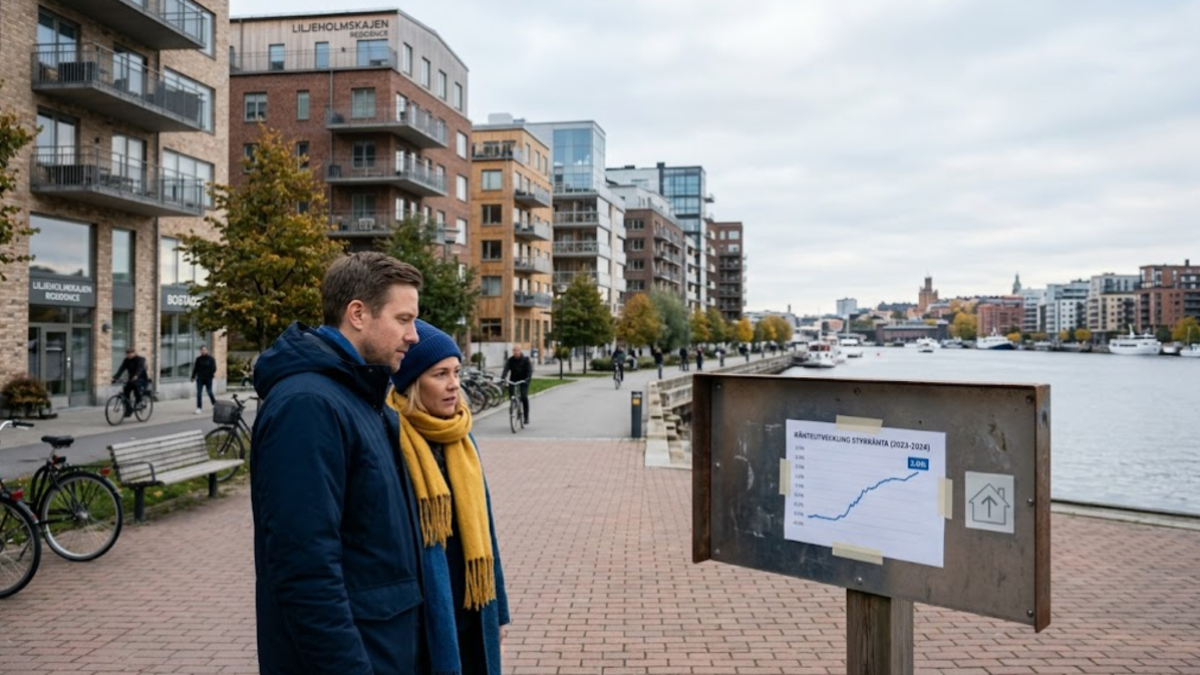
Sweden Raises Interest Rates to 2%: What the November Decision Means for Mortgage Holders
Sweden’s central bank, the Riksbank, has raised its policy rate by 0.25 percentage points to 2%, marking a shift from the previous rate of 1.75%. Announced on 4 November, the decision will take effect on 11 November and could influence mortgage costs, household budgets and borrowing conditions across the country.

For homeowners with variable-rate mortgages, the increase may eventually translate into higher monthly payments, depending on how individual banks adjust their lending rates. Those with fixed-rate mortgages are generally protected from an immediate change until their existing interest-rate agreements expire.
The decision also sends an important signal about the economic outlook: although Sweden’s economy is recovering, the Riksbank is concerned that inflationary pressures could strengthen again, potentially requiring further interest-rate increases.

Why Has the Riksbank Raised the Policy Rate?
The Riksbank’s decision reflects a changing economic picture. Sweden’s economy has begun to recover, but the central bank believes inflation could accelerate again over the coming months.
According to its announcement, three developments played an important role:
Stronger economic activity: Preliminary figures indicate that Swedish GDP increased during the third quarter, while employment also improved.
Higher international costs: Supply disruptions linked to the war in the Middle East have contributed to rising energy prices and increased inflationary pressure.
A weaker Swedish krona: The currency’s depreciation during the year could make imported goods and services more expensive.
The inflation figures help explain the decision. Sweden’s CPIF inflation rate stood at 1.5% in September. However, when the direct effects of temporary fiscal policy measures are excluded, inflation was approximately 3%. An underlying measure that also excludes energy prices stood at 1.6%.
The Riksbank considers that stronger economic activity, international cost pressures and currency movements could push both headline and underlying inflation above its 2% target next year.
The central bank therefore considers a higher policy rate necessary to prevent inflation from becoming too persistent.
What Does the 2% Interest Rate Mean for Swedish Mortgage Holders?
The policy rate is not the same as the interest rate charged by a bank on a mortgage.
It is the Riksbank’s main monetary policy instrument and influences the rates at which commercial banks borrow and deposit money. Changes can subsequently affect mortgage rates, savings accounts and other financial products.
For homeowners, the practical consequences depend largely on the type of mortgage they have.
1. Homeowners with variable-rate mortgages
Borrowers with variable-rate mortgages are likely to be the first group to watch for changes.
In Sweden, what is commonly called a variable mortgage rate is often linked to a three-month interest-rate period. This means the rate is not necessarily adjusted immediately after every Riksbank announcement.
Banks decide their own mortgage rates based on several factors, including their funding costs, market conditions and competition.
If a bank passes on the full 0.25-percentage-point increase to its customers, monthly mortgage costs will rise.
For example, the following table illustrates the potential impact:
| Mortgage balance | Additional monthly cost | Additional annual cost |
|---|---|---|
| SEK 1 million | SEK 208 | SEK 2,500 |
| SEK 2 million | SEK 417 | SEK 5,000 |
| SEK 3 million | SEK 625 | SEK 7,500 |
| SEK 4 million | SEK 833 | SEK 10,000 |
These figures assume the mortgage interest rate increases by the full 0.25 percentage points, with the outstanding loan balance remaining unchanged. They are illustrative calculations, not confirmed increases announced by Swedish banks.
The actual impact will depend on each lender’s decision and the borrower’s mortgage agreement.
2. Homeowners with fixed-rate mortgages
Borrowers who have agreed to a fixed interest rate generally have greater short-term protection against changes in the Riksbank’s policy rate.
Their mortgage rate normally remains unchanged throughout the agreed fixed-rate period.
For example, someone with a two-year fixed mortgage will generally continue paying the agreed interest rate until the contract reaches its renewal date.
However, the situation can change when the fixed period expires. If mortgage rates are higher at that point, refinancing or renewing the agreement could become more expensive.
There is another consideration: fixed mortgage rates can move before an official policy decision because banks and financial markets anticipate future interest-rate developments.
Consequently, homeowners considering a new fixed-rate agreement should compare available offers rather than assume that the latest policy rate automatically determines the best mortgage option.
3. First-time buyers and people planning to move
The increase could also affect people preparing to enter the Swedish housing market.
A higher borrowing cost can reduce the amount a household can comfortably afford to borrow, particularly when banks assess income, existing debts and household expenses.
For prospective buyers, even a relatively small increase can make a difference when calculating monthly housing costs.
However, mortgage affordability is not determined by interest rates alone. Property prices, household income, employment stability, savings and amortisation requirements also matter.
The decision does not automatically mean that property prices will fall. Housing-market developments depend on several factors, including demand, supply and the broader economic outlook.
Swedish Mortgage Market: What the Latest Figures Show
Statistics Sweden (SCB) published its September financial market statistics on 27 October, providing an important picture of mortgage conditions immediately before the Riksbank’s November announcement.
The figures show that floating mortgage rates for new agreements had remained relatively stable, while fixed-rate borrowing had become more expensive.
| Mortgage indicator | September 2026 |
|---|---|
| Average interest rate on new housing loans | 2.83% |
| Average floating mortgage rate on new agreements | 2.72% |
| Average fixed rate, 3 months to 1 year | 3.04% |
| Average fixed rate, 1 to 5 years | 3.39% |
One particularly important finding concerns existing mortgage debt.
According to SCB, Swedish households held approximately SEK 4,366 billion in housing loans in September. Of that amount, around 78% had floating interest rates, equivalent to approximately SEK 3,405 billion.
This means a substantial proportion of Sweden’s mortgage market is potentially exposed to changes in borrowing costs.
However, the statistics describe mortgage agreements and interest rates recorded before the November decision. They should not be interpreted as evidence that banks have already increased their mortgage rates in response to the latest announcement.
The figures also demonstrate why the distinction between the Riksbank’s policy rate and actual mortgage rates matters. In September, the average floating rate on new mortgages was already 2.72%, considerably higher than the previous policy rate of 1.75%.
Could the Riksbank Raise Interest Rates Again?
The November decision may not be the last increase.
In its official announcement, the Riksbank stated that another increase during the coming year is likely if the outlook for inflation and economic activity remains broadly unchanged.
This is particularly relevant for mortgage holders who need to plan their household finances beyond the immediate months.
Nevertheless, the central bank has not guaranteed another increase.
Its assessment depends on future economic developments, including inflation, energy prices, international supply conditions, currency movements and the strength of Sweden’s economic recovery.
The Riksbank also recognises that risks exist on both sides. Inflation could rise more than expected, but weaker international demand or other economic difficulties could also slow the recovery.
The next monetary policy announcement is scheduled for 16 December. The central bank will publish its next Monetary Policy Report, including updated forecasts, on that date.
For homeowners, this will be another important opportunity to assess the likely direction of borrowing costs.
What Should Mortgage Holders Do Now?
Although the rate increase is relatively small, households with significant mortgage debt should use the announcement as an opportunity to review their financial position.
Several practical steps can help.
1. Check your current mortgage interest rate.
Contact your bank or review your online banking account to confirm the rate currently applied to your mortgage and when it can next be adjusted.
2. Compare mortgage offers from different banks.
Do not assume that your existing lender offers the most competitive rate. Compare the average interest rates actually granted to customers, rather than looking exclusively at advertised rates.
The independent Swedish consumer information service Konsumenternas provides a mortgage comparison tool covering different lenders and fixed-rate periods.
3. Calculate how much additional interest you could afford.
Consider what would happen if your mortgage rate increased by another 0.25 or 0.50 percentage points.
This does not mean that further increases are certain. It is simply a way to test whether your household budget could withstand less favourable conditions.
4. Review your fixed-rate options carefully.
Fixing your mortgage can provide greater certainty over monthly payments, but it may also limit flexibility. In certain circumstances, ending a fixed-rate agreement early can result in compensation payable to the bank.
Before making a decision, check the contract conditions and compare the total costs.
5. Avoid making rushed financial decisions.
A single policy announcement is not necessarily a reason to refinance, change banks or fix an entire mortgage. The right approach depends on your financial circumstances, future housing plans and tolerance for interest-rate fluctuations.
Our Assessment: A Warning for Households, Not a Mortgage Crisis
The Riksbank’s decision to raise the policy rate to 2% represents a change in direction for Swedish monetary policy. Although the increase is only 0.25 percentage points, its significance should not be underestimated.
The large proportion of Swedish mortgage debt linked to floating rates means that households remain sensitive to changes in borrowing costs.
In our assessment, the biggest concern is not necessarily the November increase itself, but the possibility of additional increases if inflation remains above expectations.
Households should therefore avoid building their financial plans around the assumption that mortgage rates will soon fall again.
At the same time, there is no reason to interpret this decision as evidence of an impending housing-market crisis. Sweden’s economy is showing signs of improvement, and the Riksbank’s objective is to keep inflation under control while supporting balanced economic development.
For mortgage holders, the most sensible response is to review existing agreements, compare lenders and maintain enough financial flexibility to cope with potentially higher monthly payments.
Frequently Asked Questions
Has Sweden officially raised its interest rate to 2%?
Yes. The Riksbank announced a 0.25-percentage-point increase on 4 November. The new policy rate of 2% takes effect on 11 November.
Will Swedish mortgage payments increase immediately?
Not necessarily. Banks determine their own mortgage rates, and changes are not automatically applied to every mortgage on the day of the Riksbank announcement. Borrowers with three-month variable rates may see adjustments at their next interest-rate review.
Are fixed-rate mortgages affected by the November decision?
Existing fixed-rate mortgages generally remain unchanged until the agreed fixed period expires. However, rates offered for new fixed-rate agreements can change independently of existing contracts.
Could the Riksbank raise interest rates again?
Yes. The Riksbank considers another increase likely during the coming year if its inflation and economic outlook remains unchanged. However, this is an assessment rather than a confirmed future decision.
When is the next Swedish interest-rate announcement?
The next monetary policy announcement is scheduled for 16 December. The Riksbank will also publish an updated Monetary Policy Report.
Official Sources
1. Sveriges Riksbank — Policy rate raised to 2 per cent (4 November 2026)
Official press release2. Sveriges Riksbank — Monetary Policy Decision, November 2026
November monetary policy decision3. Statistics Sweden (SCB) — Financial Market Statistics, September 2026 (27 October 2026)
Official mortgage interest-rate statistics4. Statistics Sweden (SCB) — Financial Market Statistics
Official statistical database and mortgage data5. Konsumenternas — Compare Mortgage Interest Rates
Independent mortgage comparison service6. Sveriges Riksbank — What Is the Policy Rate?
Contact: info@alswedalyom.com